 TESTED 13 Jul
DATABRICKS-CERTIFIED-PROFESSIONAL-DATA-ENGINEER Online Practice Questions and Answers
An upstream source writes Parquet data as hourly batches to directories named with the current date. A nightly batch job runs the following code to ingest all data from the previous day as indicated by the date variable:
Assume that the fields customer_id and order_id serve as a composite key to uniquely identify each order.
If the upstream system is known to occasionally produce duplicate entries for a single order hours apart, which statement is correct?
A. Each write to the orders table will only contain unique records, and only those records without duplicates in the target table will be written.
B. Each write to the orders table will only contain unique records, but newly written records may have duplicates already present in the target table.
C. Each write to the orders table will only contain unique records; if existing records with the same key are present in the target table, these records will be overwritten.
D. Each write to the orders table will only contain unique records; if existing records with the same key are present in the target table, the operation will tail.
E. Each write to the orders table will run deduplication over the union of new and existing records, ensuring no duplicate records are present.
A Delta Lake table in the Lakehouse named customer_parsams is used in churn prediction by the machine learning team. The table contains information about customers derived from a number of upstream sources. Currently, the data engineering team populates this table nightly by overwriting the table with the current valid values derived from upstream data sources.
Immediately after each update succeeds, the data engineer team would like to determine the difference between the new version and the previous of the table.
Given the current implementation, which method can be used?
A. Parse the Delta Lake transaction log to identify all newly written data files.
B. Execute DESCRIBE HISTORY customer_churn_params to obtain the full operation metrics for the update, including a log of all records that have been added or modified.
C. Execute a query to calculate the difference between the new version and the previous version using Delta Lake's built-in versioning and time travel functionality.
D. Parse the Spark event logs to identify those rows that were updated, inserted, or deleted.
Incorporating unit tests into a PySpark application requires upfront attention to the design of your jobs, or a potentially significant refactoring of existing code.
Which statement describes a main benefit that offset this additional effort?
A. Improves the quality of your data
B. Validates a complete use case of your application
C. Troubleshooting is easier since all steps are isolated and tested individually
D. Yields faster deployment and execution times
E. Ensures that all steps interact correctly to achieve the desired end result
In order to prevent accidental commits to production data, a senior data engineer has instituted a policy that all development work will reference clones of Delta Lake tables. After testing both deep and shallow clone, development tables are created using shallow clone.
A few weeks after initial table creation, the cloned versions of several tables implemented as Type 1 Slowly Changing Dimension (SCD) stop working. The transaction logs for the source tables show that vacuum was run the day before.
Why are the cloned tables no longer working?
A. The data files compacted by vacuum are not tracked by the cloned metadata; running refresh on the cloned table will pull in recent changes.
B. Because Type 1 changes overwrite existing records, Delta Lake cannot guarantee data consistency for cloned tables.
C. The metadata created by the clone operation is referencing data files that were purged as invalid by the vacuum command
D. Running vacuum automatically invalidates any shallow clones of a table; deep clone should always be used when a cloned table will be repeatedly queried.
The data engineering team is migrating an enterprise system with thousands of tables and views into the Lakehouse. They plan to implement the target architecture using a series of bronze, silver, and gold tables. Bronze tables will almost exclusively be used by production data engineering workloads, while silver tables will be used to support both data engineering and machine learning workloads. Gold tables will largely serve business intelligence and reporting purposes. While personal identifying information (PII) exists in all tiers of data, pseudonymization and anonymization rules are in place for all data at the silver and gold levels.
The organization is interested in reducing security concerns while maximizing the ability to collaborate across diverse teams.
Which statement exemplifies best practices for implementing this system?
A. Isolating tables in separate databases based on data quality tiers allows for easy permissions management through database ACLs and allows physical separation of default storage locations for managed tables.
B. Because databases on Databricks are merely a logical construct, choices around database organization do not impact security or discoverability in the Lakehouse.
C. Storinq all production tables in a single database provides a unified view of all data assets available throughout the Lakehouse, simplifying discoverability by granting all users view privileges on this database.
D. Working in the default Databricks database provides the greatest security when working with managed tables, as these will be created in the DBFS root.
E. Because all tables must live in the same storage containers used for the database they're created in, organizations should be prepared to create between dozens and thousands of databases depending on their data isolation requirements.
When scheduling Structured Streaming jobs for production, which configuration automatically recovers from query failures and keeps costs low?
A. Cluster: New Job Cluster; Retries: Unlimited; Maximum Concurrent Runs: Unlimited
B. Cluster: New Job Cluster; Retries: None; Maximum Concurrent Runs: 1
C. Cluster: Existing All-Purpose Cluster; Retries: Unlimited; Maximum Concurrent Runs: 1
D. Cluster: Existing All-Purpose Cluster; Retries: Unlimited; Maximum Concurrent Runs: 1
E. Cluster: Existing All-Purpose Cluster; Retries: None; Maximum Concurrent Runs: 1
A Spark job is taking longer than expected. Using the Spark UI, a data engineer notes that the Min, Median, and Max Durations for tasks in a particular stage show the minimum and median time to complete a task as roughly the same, but the max duration for a task to be roughly 100 times as long as the minimum.
Which situation is causing increased duration of the overall job?
A. Task queueing resulting from improper thread pool assignment.
B. Spill resulting from attached volume storage being too small.
C. Network latency due to some cluster nodes being in different regions from the source data
D. Skew caused by more data being assigned to a subset of spark-partitions.
E. Credential validation errors while pulling data from an external system.
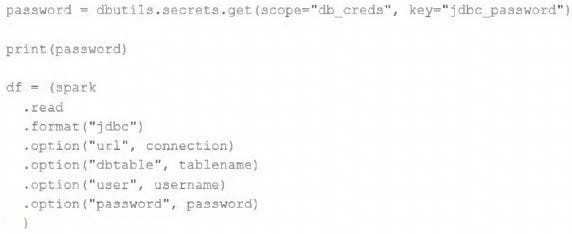
The security team is exploring whether or not the Databricks secrets module can be leveraged for connecting to an external database.
After testing the code with all Python variables being defined with strings, they upload the password to the secrets module and configure the correct permissions for the currently active user. They then modify their code to the following (leaving all other variables unchanged).
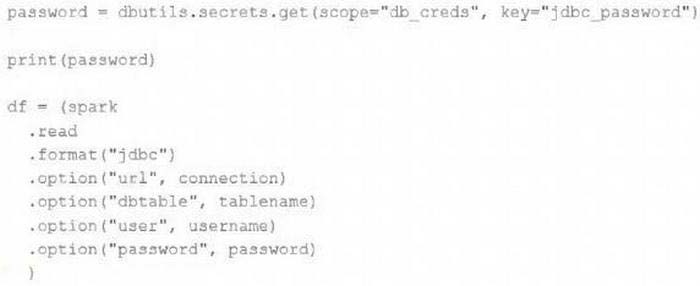
Which statement describes what will happen when the above code is executed?
A. The connection to the external table will fail; the string "redacted" will be printed.
B. An interactive input box will appear in the notebook; if the right password is provided, the connection will succeed and the encoded password will be saved to DBFS.
C. An interactive input box will appear in the notebook; if the right password is provided, the connection will succeed and the password will be printed in plain text.
D. The connection to the external table will succeed; the string value of password will be printed in plain text.
E. The connection to the external table will succeed; the string "redacted" will be printed.
A Delta table of weather records is partitioned by date and has the below schema:
date DATE, device_id INT, temp FLOAT, latitude FLOAT, longitude FLOAT
To find all the records from within the Arctic Circle, you execute a query with the below filter:
latitude > 66.3
Which statement describes how the Delta engine identifies which files to load?
A. All records are cached to an operational database and then the filter is applied
B. The Parquet file footers are scanned for min and max statistics for the latitude column
C. All records are cached to attached storage and then the filter is applied
D. The Delta log is scanned for min and max statistics for the latitude column
E. The Hive metastore is scanned for min and max statistics for the latitude column
An external object storage container has been mounted to the location /mnt/finance_eda_bucket.
The following logic was executed to create a database for the finance team:

After the database was successfully created and permissions configured, a member of the finance team runs the following code:
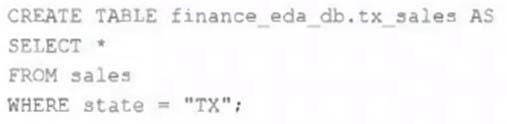
If all users on the finance team are members of the finance group, which statement describes how the tx_sales table will be created?
A. A logical table will persist the query plan to the Hive Metastore in the Databricks control plane.
B. An external table will be created in the storage container mounted to /mnt/finance eda bucket.
C. A logical table will persist the physical plan to the Hive Metastore in the Databricks control plane.
D. An managed table will be created in the storage container mounted to /mnt/finance eda bucket.
E. A managed table will be created in the DBFS root storage container.

Home | Contact Us | About Us | FAQ | Guarantee & Policy | Privacy & Policy | Terms & Conditions | How to buy
Copyright © 2026 pass4itsure.com. All Rights Reserved