 TESTED 13 Jul
VCS-261 Online Practice Questions and Answers
What is the key benefit of file replication?
A. synchronous replication
B. asynchronous replication
C. periodic replication
D. continuous replication
The following command adds two snapshot mirrors to the volume voll on disks mydg10 and mydg11.
# vxsnap –g mydg addmir voll nmirror=2 alloc=mydg10,mydg11
Which plex state indicates the snapshot is fully synchronized?
A. SNAPREADY
B. SNAPTMP
C. SNAPDONE
D. SNAPATT
Which Veritas InfoScale Operations Manager Add-on provides detailed information about the storage enclosures in the data center?
A. the Fabric Insight Add-on
B. the Storage Insight Add-on
C. the Storage Provisioning and Enclosure Migration Add-on
D. the Control Host Add-on
Refer to the exhibit.
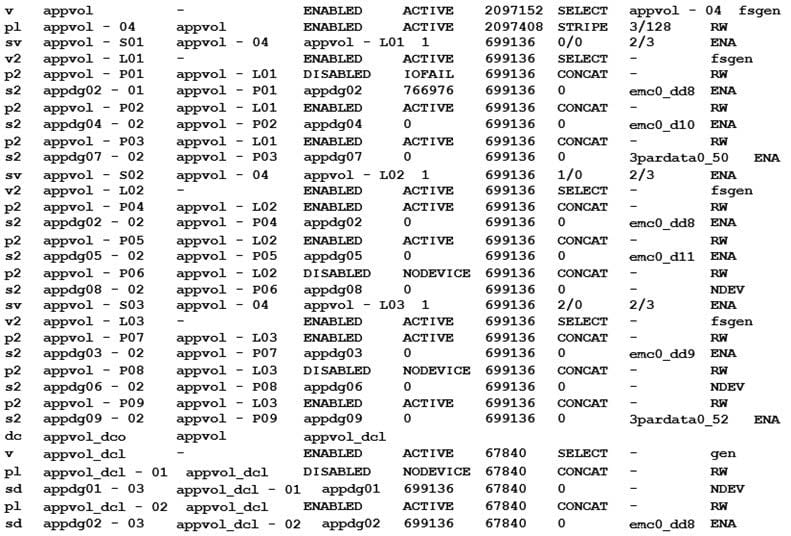
The appvol volume contains a file system and is mounted to /app. The volume has experienced multiple disk failures.
What is the state of the data on the mounted file system?
A. unavailable
B. read-only
C. partially available
D. fully accessible
Which log type can be enabled to track the changed regions of a volume due to I/O writes to a mirrored volume?
A. Data Change Object (DCO)
B. Storage Replicator Log (SRL)
C. Dirty Region Log (DRL)
D. Data Change Map (DCM)
Which command should an administrator use to determine the existing Array Support Libraries (ASL) and supported disk arrays on an existing system?
A. vxinfo
B. vxddladm
C. vxdmpadm
D. vxcheckasl
Dynamic Multi-Pathing for VMware has an operating mode which enables the pooling of locally attached devices such as SSDs at the ESXi host layer.
Which feature should an administrator configure on the ESXi host running Veritas InfoScale?
A. SmartIO
B. SmartDisks
C. SmartPool
D. SmartMove
Which attribute is used to create more than two mirrors of a volume?
A. nmirror
B. ncol
C. mirror
D. snapshot
Which attribute determines the maximum file system size achievable when creating a file system?
A. the intent log size
B. the allocation unit size
C. the block size
D. the inode structure size
What is the purpose of a Data Change Object (DCO)?
A. to manage the FastResync maps for snapshot operations
B. to hold all changed data on a volume that supports instant snapshots
C. to replicate data from one plex to another when taking snapshots
D. to identify the regions in a volume with active writes

Home | Contact Us | About Us | FAQ | Guarantee & Policy | Privacy & Policy | Terms & Conditions | How to buy
Copyright © 2026 pass4itsure.com. All Rights Reserved