 TESTED 13 Jul
TERRAFORM-ASSOCIATE-003 Online Practice Questions and Answers
You ate making changes to existing Terraform code to add some new infrastructure. When is the best time to run terraform validate?
A. After you run terraform apply so you can validate your infrastructure
B. Before you run terraform apply so you can validate your provider credentials
C. Before you run terraform plan so you can validate your code syntax
D. After you run terraform plan so you can validate that your state file is consistent with your infrastructure
Why does this backend configuration not follow best practices?
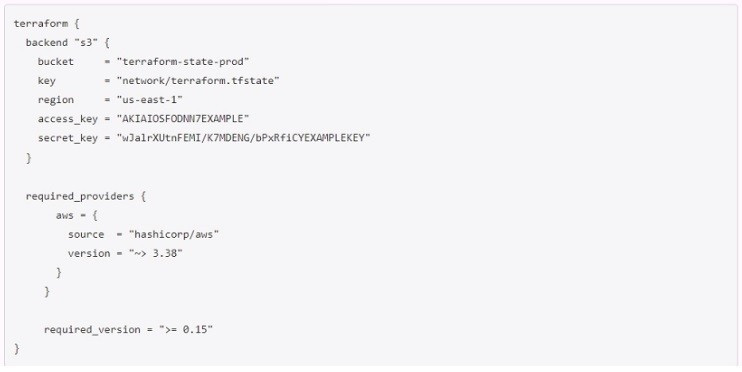
A. An alias meta-argument should be included in backend blocks whenever possible
B. You should use the local enhanced storage backend whenever possible
C. You should not store credentials in Terraform configuration
D. The backend configuration should contain multiple credentials so that more than one user can execute terraform plan and terraform apply
terraform validate confirms that your infrastructure matches the Terraform state file.
A. True
B. False
As a member of an operations team that uses infrastructure as code (lac) practices, you are tasked with making a change to an infrastructure stack running in a public cloud. Which pattern would follow laC best practices for making a change?
A. Make the change via the public cloud API endpoint
B. Clone the repository containing your infrastructure code and then run the code
C. Use the public cloud console to make the change after a database record has been approved
D. Make the change programmatically via the public cloud CLI
E. Submit a pull request and wait for an approved merge of the proposed changes
Variables declared within a module are accessible outside of the module.
A. True
B. False
What is a key benefit of the Terraform state file?
A. A state file can schedule recurring infrastructure tasks
B. A state file is a source of truth for resources provisioned with Terraform
C. A state file is a source of truth for resources provisioned with a public cloud console
D. A state file is the desired state expressed by the Terraform code files
A developer accidentally launched a VM (virtual machine) outside of the Terraform workflow and ended up with two servers with the same name. They don't know which VM Terraform manages but do have a list of all active VM IDs. Which of the following methods could you use to discover which instance Terraform manages?
A. Run terraform state list to find the names of all VMs, then run terraform state show for each of them to find which VM ID Terraform manages
B. Update the code to include outputs for the ID of all VMs, then run terraform plan to view the outputs
C. Run terraform taint/code on all the VMs to recreate them
D. Use terraform refresh/code to find out which IDs are already part of state
How is terraform import run?
A. As a part of terraform init
B. As a part of terraform plan
C. As a part of terraform refresh
D. By an explicit call
E. All of the above
What is the workflow for deploying new infrastructure with Terraform?
A. Write Terraform configuration, run terraform init to initialize the working directory or workspace, and run terraform apply
B. Write Terraform configuration, run terraform show to view proposed changes, and terraform apply to create new infrastructure
C. Write Terraform configuration, run terraform apply to create infrastructure, use terraform validate to confirm Terraform deployed resources correctly
D. Write Terraform configuration, run terraform plan to initialize the working directory or workspace, and terraform apply to create the infrastructure
Running terraform fmt without any flags in a directory with Terraform configuration files check the formatting of those files without changing their contents.
A. True
B. False

Home | Contact Us | About Us | FAQ | Guarantee & Policy | Privacy & Policy | Terms & Conditions | How to buy
Copyright © 2026 pass4itsure.com. All Rights Reserved