 TESTED 13 Jun
SOA-C02 Online Practice Questions and Answers
A SysOps administrator is deploying a test site running on Amazon EC2 instances. The application requires both incoming and outgoing connectivity to the internet. Which combination of steps are required to provide internet connectivity to the EC2 instances? (Choose two.)
A. Add a NAT gateway to a public subnet.
B. Attach a private address to the elastic network interface on the EC2 instance.
C. Attach an Elastic IP address to the internet gateway.
D. Add an entry to the route table for the subnet that points to an internet gateway.
E. Create an internet gateway and attach it to a VPC.
A company needs to create a daily Amazon Machine Image (AMI) of an existing Amazon Linux EC2 instance that hosts the operating system, application, and database on multiple attached Amazon Elastic Block Store (Amazon EBS) volumes. File system integrity must be maintained.
Which solution will meet these requirements?
A. Create an AWS Lambda function to call the CreateImage API operation with the EC2 instance ID and the no-reboot parameter enabled. Create a daily scheduled Amazon EventBridge (Amazon CloudWatch Events) rule that invokes the function.
B. Create an AWS Lambda function to call the CreateImage API operation with the EC2 instance ID and the reboot parameter enabled. Create a daily scheduled Amazon EventBridge (Amazon CloudWatch Events) rule that invokes the function.
C. Use AWS Backup to create a backup plan with a backup rule that runs daily. Assign the resource ID of the EC2 instance with the no-reboot parameter enabled.
D. Use AWS Backup to create a backup plan with a backup rule that runs daily. Assign the resource ID of the EC2 instance with the reboot parameter enabled.
A Sysops administrator creates an Amazon Elastic Kubernetes Service (Amazon EKS) cluster that uses AWS Fargate. The cluster is deployed successfully. The Sysops administrator needs to manage the cluster by using the kubect1 command line tool.
Which of the following must be configured on the Sysops administrator's machine so that kubect1 can communicate with the cluster API server?
A. The kubeconfig file
B. The kube-proxy Amazon EKS add-on
C. The Fargate profile
D. The eks-connector.yaml file
A company has an application that customers use to search for records on a website. The application's data is stored in an Amazon Aurora DB cluster. The application's usage varies by season and by day of the week.
The website's popularity is increasing, and the website is experiencing slower performance because of increased load on the DB cluster during periods of peak activity. The application logs show that the performance issues occur when users
are searching for information. The same search is rarely performed multiple times.
A SysOps administrator must improve the performance of the platform by using a solution that maximizes resource efficiency.
Which solution will meet these requirements?
A. Deploy an Amazon ElastiCache for Redis cluster in front of the DB cluster. Modify the application to check the cache before the application issues new queries to the database. Add the results of any queries to the cache.
B. Deploy an Aurora Replica for the DB cluster. Modify the application to use the reader endpoint for search operations. Use Aurora Auto Scaling to scale the number of replicas based on load. Most Voted
C. Use Provisioned IOPS on the storage volumes that support the DB cluster to improve performance sufficiently to support the peak load on the application.
D. Increase the instance size in the DB cluster to a size that is sufficient to support the peak load on the application. Use Aurora Auto Scaling to scale the instance size based on load.
A SysOps administrator is responsible for managing a company's cloud infrastructure with AWS CloudFormation. The SysOps administrator needs to create a single resource that consists of multiple AWS services. The resource must support
creation and deletion through the CloudFormation console.
Which CloudFormation resource type should the SysOps administrator create to meet these requirements?
A. AWS::EC2::Instance with a cfn-init helper script
B. AWS::OpsWorks::Instance
C. AWS::SSM::Document
D. Custom::MyCustomType
A company hosts a static website on Amazon S3. An Amazon CloudFront distribution presents this site to global users. The company uses the Managed-CachingDisabled CloudFront cache policy. The company's developers confirm that they
frequently update a file in Amazon S3 with new information.
Users report that the website presents correct information when the website first loads the file. However, the users' browsers do not retrieve the updated file after a refresh.
What should a SysOps administrator recommend to fix this issue?
A. Add a Cache-Control header field with max-age=0 to the S3 object.
B. Change the CloudFront cache policy to Managed-CachingOptimized.
C. Disable bucket versioning in the S3 bucket configuration.
D. Enable content compression in the CloudFront configuration.
A SysOps administrator creates a new VPC that includes a public subnet and a private subnet. The SysOps administrator successfully launches 11 Amazon EC2 instances in the private subnet. The SysOps administrator attempts to launch one more EC2 instance in the same subnet. However, the SysOps administrator receives an error message that states that not enough free IP addresses are available.
What must the SysOps administrator do to deploy more EC2 instances?
A. Edit the private subnet to change the CIDR block to /27.
B. Edit the private subnet to extend across a second Availability Zone.
C. Assign additional Elastic IP addresses to the private subnet.
D. Create a new private subnet to hold the required EC2 instances.
A SysOps administrator is examining the following AWS CloudFormation template:
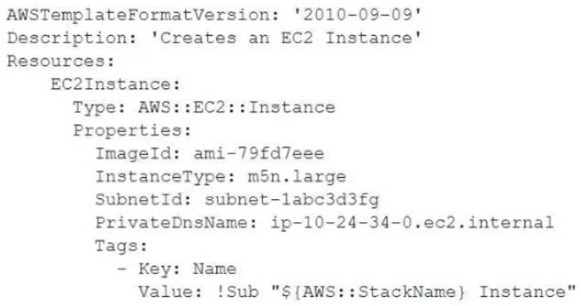
Why will the stack creation fail?
A. The Outputs section of the CloudFormation template was omitted.
B. The Parameters section of the CloudFormation template was omitted.
C. The PrivateDnsName cannot be set from a CloudFormation template.
D. The VPC was not specified in the CloudFormation template.
A company has deployed an application on AWS. The application runs on a fleet of Linux Amazon EC2 instances that are in an Auto Scaling group. The Auto Scaling group is configured to use launch templates. The launch templates launch
Amazon Elastic Block Store (Amazon EBS) backed EC2 instances that use General Purpose SSD (gp3) EBS volumes for primary storage.
A SysOps administrator needs to implement a solution to ensure that all the EC2 instances can share the same underlying files. The solution also must ensure that the data is consistent.
Which solution will meet these requirements?
A. Create an Amazon Elastic File System (Amazon EFS) file system. Create a new launch template version that includes user data that mounts the EFS file system. Update the Auto Scaling group to use the new launch template version to cycle in newer EC2 instances and to terminate the older EC2 instances.
B. Enable Multi-Attach on the EBS volumes. Create a new launch template version that includes user data that mounts the EBS volume. Update the Auto Scaling group to use the new template version to cycle in newer EC2 instances and to terminate the older EC2 instances.
C. Create a cron job that synchronizes the data between the EBS volumes for all the EC2 instances in the Auto Scaling group. Create a lifecycle hook during instance launch to configure the cron job on all the EC2 instances. Rotate out the older EC2 instances.
D. Create a new launch template version that creates an Amazon Elastic File System (Amazon EFS) file system. Update the Auto Scaling group to use the new template version to cycle in newer EC2 instances and to terminate the older EC2 instances.
A company stores data in Amazon S3 buckets that are provisioned in three separate AWS Regions. The data is copied from the S3 buckets to the data center over the public internet using a VPN. The SysOps administrator notices that, occasionally, the transfers take longer than usual, and determines the issue is congestion within the company's ISP network.
What is the MOST cost-effective approach the administrator can take to ensure consistent transfer times from S3 to the data center?
A. Establish an AWS Direct Connect link to each Region. Create a private virtual interface over each link.
B. Establish an AWS Direct Connect link to each Region. Create a public virtual interface over each link.
C. Establish an AWS Direct Connect link to one of the Regions. Create a private virtual interface over that link.
D. Establish an AWS Direct Connect link to one of the Regions. Create a public virtual interface over that link.

Home | Contact Us | About Us | FAQ | Guarantee & Policy | Privacy & Policy | Terms & Conditions | How to buy
Copyright © 2026 pass4itsure.com. All Rights Reserved