 TESTED 13 Jul
QSDA2022 Online Practice Questions and Answers
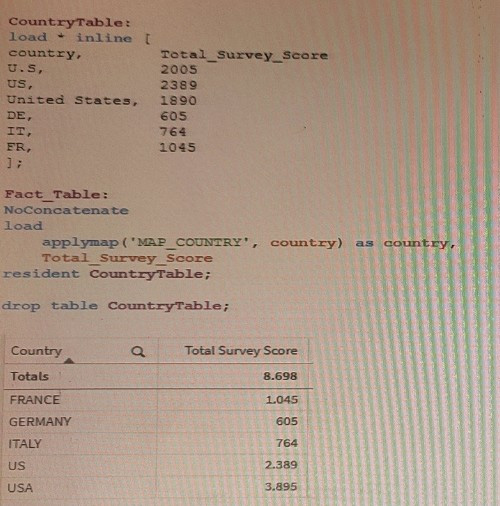
On executing a load script of an app, the country field needs to be normalized. The developer uses a mapping table to address the issue. What should the data architect do?
A. Use a LEFT JOIN instead of the APPLYMAP
B. Use LOAD DISTINCT on the mapping table
C. Create two different mapping tables
D. Review the values of the source mapping table
A data architect is using an Include statement to load the collection of variables from a TextFiles folder connection into an app. The data architect needs to load the data and generate an error if it fails. Which statement should the data architect use?
A. $ B. $(Must_Include=lib://TextFiles/Variables.txt); C. (Must_Include=lib://TextFiies/Variables.txt); D. (Includs=lib://TextFiles/Variables.txt);
Refer to the exhibit.
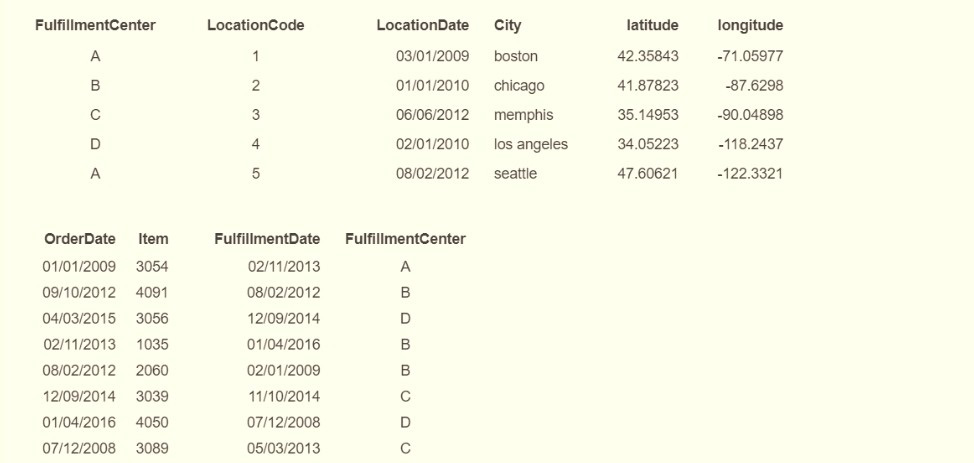
A data architect has a data model that includes historical order fulfillment centers. The order fulfillment centers occasionally changed location. The history of order fulfillment must be tracked on a per center, per location basis. Which scripting function should the data architect use to meet this data modeling requirement?
A. IntervalMatch
B. Peek
C. ApplyMap
D. Inner Join
A global retailer has a large database in which millions of sales transactions are added per hour.
Each regional sales manager should only see details for customers in their region. After filtering based on criteria such as region, gender, and income level, sales managers should be able to see the most current detailed transactions.
What should a data architect do to meet these requirements?
A. Create an app for each sales manager with Qlik GeoAnalytics
B. Use section access and include a service account in the table
C. Use On-Demand App Generation (ODAG) and section access
D. Use section access to restrict sales manager access by region
The Marketing department is using some similar KPIs in different apps that need to be modified frequently according to the business needs. The KPIs are created using master items with the same expression.
Which method should the data architect use to manage the modifications in all apps?
A. Create a variable repository and load them using INCLUDE statements in the apps where needed
B. Create a selection app with all the master items and use an on-demand app generation method.
C. Create a core app with all the master items needed and use a BINARY load in the other apps.
D. Create only a single app with all the master items needed and protect it with SECTION ACCESS.
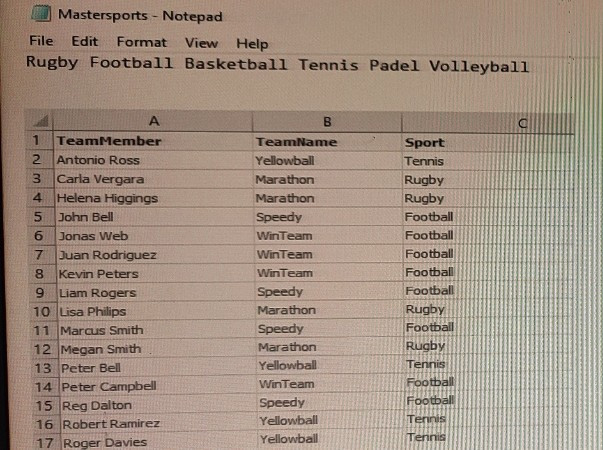
Refer to the exhibits.
The first table, Mastersports, contains the master list of all sport names that need to be loaded into the app. The second table, TeamMembers, contains the teams and team members registered for specific sports.
In a Qlik Sense app, a data architect is loading the two tables that need to be linked together based on the Sport field. The table format cannot be changed in the source.
What should the data architect do in the data load editor?
A. Apply a preceding LOAD from the TeamMembers table with the SUBFIELD function and rename the field to Sport
B. Apply a preceding LOAD to the MasterSports table with the SUBFIELD function to create the Sport field
C. Apply a FOR loop to load to the MasterSports table creating the values for the Sport field
A data architect needs to develop multiple apps for various departments. More departments are requesting apps over time The company uses specific requirements for the number interpretation variables (e.g., ThousandSep, DecimalSep) found at the beginning of a LOAD script.
The data architect wants to reduce duplicate scripts but does not want to copy and paste the number interpretation variables each time new app is created. The data architect prefers to use the least amount of script in Qlik Sense.
How should the data architect meet these requirements?
A. Save the script for the number interpretation variables in a text file and use the CALL function to insert the variables.
B. Create an Excel file with the number interpretation variables and use a FOR Next loop to load the variables into Qlik Sense
C. Save the script for the number interpretation variables in a text file and INLUDE function to insert the variables
D. Create an Excel file with the number interpretation variables and apply the variables to the app using a mapping table
A data architect wants to combine data on present and historic sales performance. The historic data is stored in a de-normalized archive, and the present data is maintained in a database. The output must be contained in a single table. Which script should the data architect use?
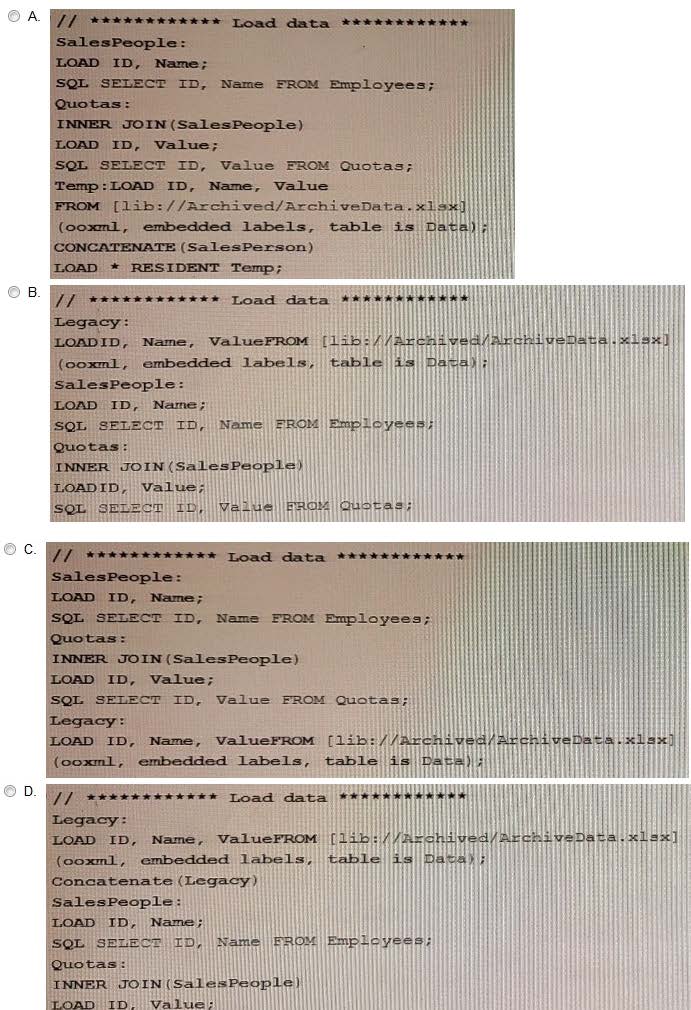
A. Option A
B. Option B
C. Option C
D. Option D
A company needs to analyze sales data based on the exchange rate of the different countries every day About 30 reports must be produced with an average of 20r000 rows each. This process is estimated to take about three hours. Reports will be in Excel and distributed to business users according to defined security rules
Which two products should the data architect use to build this solution? (Select two.)
A. OQIikGeoAnalytics
B. ODAG
C. QIikDataMarket
D. Qlik Storytelling
E. QIik NPrinting
A customer has a dataset that contains latitude and longitude data for service points around the country. The data is retrieved using the following statement:

It must be clear to the end user that this is geographic data. Drag and drop, map-based visualization of this data is required. Which two steps should the data architect take to support this data? (Select two.)
A. Define Location as a master item, and set the tag to Sgeodata
B. Add GeoProject{' Point' , LatandLong) AS Point to the preceding load
C. Add GeoKakePoint (Lat, Long} as Point to Location's preceding load
D. Add the following to the end of the script: TAG FIELD LocationName With 'Sgeodata1, 'Srelated'; TAG FIELD Point With 'Sgeodata', 'Srelated1;
E. Add the following to the end of the script: TAG FIELD LocationName With 'Sgeoname', @relates_Pt'; TAG FIELD Point With 'Sgeopoint*f 'Srelates Location', '$hidden';

Home | Contact Us | About Us | FAQ | Guarantee & Policy | Privacy & Policy | Terms & Conditions | How to buy
Copyright © 2026 pass4itsure.com. All Rights Reserved