 TESTED 13 Jul
PW0-250 Online Practice Questions and Answers
To achieve a 450 Mbps MCS, what 802.11n features (from the numbered list below) are required?
1.
Frame aggregation
2.
Short GI
3.
40 MHz channels
4.
2 spatial streams
5.
3 spatial streams
6.
Transmit beamforming (TxBF)
A. 1, 2, 3, 4
B. 1, 2, 3, 5
C. 1, 2, 3, 4, 6
D. 1, 2, 3, 5, 6
E. 2, 3, 4
F. 2, 3, 5
What is the DSCP Per Hop Behavior equivalent classification of the 802.11e AC_VO priority level?
A. AF31
B. CS3
C. VO
D. EF
E. AF12
An associated STA detects a new BSS with the same SSID as the STA's current BSS. The new BSS uses a different IP subnet than the current BSS. If the STA is configured to use 802.1X/EAP preauthentication, what is likely to occur?
A. The STA will not attempt to preauthenticate because the new BSS uses a different IP subnet.
B. The STA will attempt to preauthenticate, but fail because the new BSS uses a different data-link broadcast domain.
C. The STA will attempt to preauthenticate and succeed if DHCP is supported on the new subnet.
D. The STA will attempt to preauthenticate and succeed if IP Mobility is enabled on the AP or WLAN controller.
E. The STA will attempt to preauthenticate and succeed if the current AP has shared its cached PMK.
What RF math formula should be used to convert an RF value in units of dBm into a value of mW?
*NotE. "dBm" in the formulas represents the known dBm value
A. mW 10(dBm/10)
B. mW
C. mW
D. mW
E. mW
F. mW =
You told your customer that multipath fading may be mitigated simply by moving one or both of the receiver's antennas a little bit, usually by one to four wavelengths away from its original position. Your customer is prepared to make the change, but does not know the wavelength for 802.11a.
What is the approximate wavelength of an 802.11a radio wave?
A. 5.5 cm (2.16 inches)
B. 12 cm (4.72 inches)
C. 15.24 cm (6 inches)
D. 45 cm (17.71 inches)
E. 58 cm (22.83 inches)
When performing an indoor predictive site survey to make the WLAN planning and design cycle more efficient, what is a best practice for configuration of the simulated APs in the predictive modeling software?
A. All simulated APs should be set to 20 MHz channels only.
B. Always use the default 2.2 dBi omnidirectional antenna patterns for simulated APs.
C. If dynamic RRM will be used, AP transmit power should be set to an estimated average level of the expected client devices, such as 25 mW.
D. Defining custom AP and antenna patterns will yield more accurate prediction data than the pre- configured vendor AP/antenna combinations.
A wireless engineer from your company performed a site survey in an office building where a wireless network extension was needed. He reports that while performing a Layer 1 sweep near a meeting room full of people, he detected the RF environment displayed in the exhibit. He is unsure how to interpret what he recorded to determine its impact on a future Wi-Fi network.
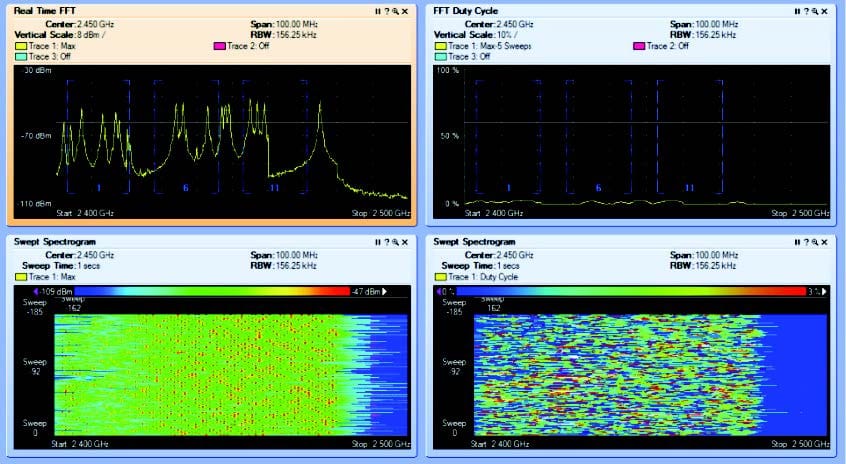
A. The signal affects the entire spectrum and will render the wireless network unusable. It must be located and removed.
B. The signal has a low duty cycle and should not be of major impact on the wireless network.
C. The signal is alternating between peaks (high interference level) and valleys (low interference level). The network channel design must be built to avoid the affected peak frequencies.
D. The signal is typical of a high radio card background noise. It shows that the card used for the Layer 1 sweep should be replaced and the Layer 1 sweep re-done.
E. The Real Time FFT shows a high amplitude, narrowband jammer pulsing across the entire 2.4 GHz band. This will cause significant, intermittent interference to the WLAN.
ABC Manufacturing has a heavily-used dual-band (2.4 / 5 GHz) WLAN, but sporadic RF interference across the 2.4 GHz band is causing dropped VoWiFi calls and leading to data connectivity and throughput problems.

What steps should ABC Manufacturing take to most effectively remedy this problem?
A. Solution 1
B. Solution 2
C. Solution 3
D. Solution 4
In a centralized WLAN architecture, what new problem may arise when you change the data forwarding model from centralized to distributed? (Choose 2)
A. APs that were designed for a centralized forwarding model may not support all features in distributed forwarding mode.
B. Centralized control functions, such as key management and distribution, RRM, and load balancing will no longer be supported.
C. All RRM controls will also need to be distributed to a master AP that acts as a channel and transmit power arbiter for other APs in the ESS.
D. The Ethernet switch ports to which APs are connected may need to be reconfigured to support VLAN tagging and QoS at the network edge.
E. APs will not have the processing capabilities to support AES-CCMP, so TKIP will be the recommended encryption method.
Multicast video applications typically require special treatment on the Wi-Fi network due to the nature of multicast traffic. Many vendors implement proprietary multicast-to-unicast conversion for this reason.
Which of the following is NOT a valid reason for special unicast conversion of downlink multicast traffic?
A. Multicast traffic must always be transmitted via omnidirectional antennas.
B. Group addressed downlink frames are not acknowledged on the wireless medium.
C. In QoS WLANs, multicast traffic is always assigned to the best effort (AC_BE) transmit queue.
D. Frames with a group receiver address must always be sent at a rate in the Basic Rate Set.

Home | Contact Us | About Us | FAQ | Guarantee & Policy | Privacy & Policy | Terms & Conditions | How to buy
Copyright © 2026 pass4itsure.com. All Rights Reserved