 TESTED 13 Jul
PW0-105 Online Practice Questions and Answers
What statement best describes the manual RF site survey report?
A. It is a series of notes taken during the interview with the network manager and given to the site survey project manager.
B. It is a one-page network inspection summary used to create a certificate of network compliance.
C. It contains the results from the RF coverage, capacity, and interference analysis.
D. It is an internal document used by the site surveying firm for network deployment, and is not usually shown to the client.
E. It states the customer requirements, business justification, and a detailed budget for the WLAN.
Given:
ABC Company performs top-secret government contract work and has recently purchased an 802.11
Wireless Intrusion Prevention System (WIPS) to enforce their "NO WIRELESS" network security policy.
What attack type cannot be recognized by the WIPS?
A. Deauthentication
B. MAC Spoofing
C. Protocol Jamming
D. Eavesdropping
E. RF Jamming
Which unit of measurement is a relative unit that is used to quantify power level changes?
A. dBm
B. dBW
C. dB
D. mW
E. VSWR
What factor is NOT taken into account when calculating the Link Budget of a point-to-point outdoor WLAN bridge link?
A. Operating frequency
B. Transmit antenna gain
C. Transmit power
D. Antenna height
E. Receive sensitivity
F. Distance
Given: As defined in the 802.11 specification, legacy Power Save requires an inefficient back-and-forth frame exchange process. Due to this inefficiency, many WLAN device implementations use a variation of
802.11 Power Save to accomplish the same function.
What non-standard power save behavior is used by most Wi-Fi devices in actual implementations?
A. Client devices ignore the TIM field and automatically send PS-Poll frames after every beacon.
B. After each beacon, the AP attempts to empty its frame buffer by sending Wake-on-WLAN frames to wake each dozing client.
C. Request-to-Send and Clear-to-Send frame exchanges are used to trigger the delivery of buffered data.
D. The Beacon interval is changed from the default 100 time units to 10 or less time units.
E. Clients send null data frames to the AP and switch the power management bit from 1 to 0 to receive queued data.
F. Stations send a CTS-to-self frame to the AP with a very long duration period so they can receive all of their buffered data at once.
What statements accurately describe the RF cables and connectors that are used in an 802.11 WLAN system? (Choose three)
A. RF cables have upper and lower frequency range specifications.
B. 75 and 125 ohms are the typical impedances of 802.11 WLAN connectors.
C. Two RF connectors of the same type (e.g. SMA), manufactured by different companies, may vary in specifications.
D. Every RF connector causes insertion loss.
E. Large diameter RF cables cause greater loss than small diameter cables.
F. Coaxial RF cables can be used to carry Power-over-Ethernet (PoE) to an outdoor bridge mounted on a mast.
Given: You are on-site to perform a post-deployment site survey. When verifying a multiple channel VoWiFi deployment using a VoWiFi handset, which aspect is most important?
A. Performing protocol analysis with a single wireless adapter that is scanning all channels in use
B. Testing a constant conversation or handset tone while roaming from area to area, or performing an active survey
C. Configuring DSCP-to-802.11e QoS maps on the handset for each access category.
D. Verifying the orientation/polarity of all omni-directional antennas in use by the VoWiFi clients.
When a client moves to a new BSS within an ESS, what steps are part of the 802.11 reassociation process? (Choose two)
A. The client station transmits a Reassociation Request frame to its current access point.
B. The current access point informs the IP gateway of the reassociation.
C. The current access point triggers the client's reassociation service.
D. The new access point transmits a Reassociation Response to the client station with a status value.
E. The client and new access point create unicast encryption keys.
F. The client station transmits a deauthentication frame to the current access point.
Given the Wi-Fi certification shown in the exhibit, what statement is FALSE about this device?
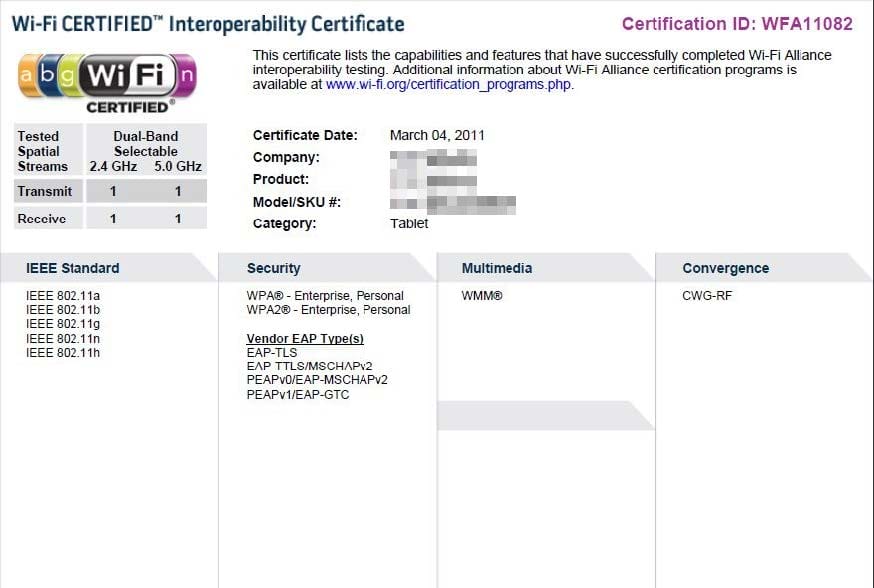
A. This client device supports protection mechanisms such as RTS/CTS and/or CTS-to-Self.
B. This client device supports both TKIP and CCMP cipher suites.
C. 300 Mbps is the maximum supported data rate for this device.
D. This client device supports the ERP, OFDM, and HT physical layer specifications.
E. This client device supports X.509 certificates for EAP authentication.
In WLAN security, which authentication methods always create Layer 2 dynamic encryption keys? (Choose two)
A. HTTPS Captive Portal
B. WEP
C. WPA2-PSK
D. EAP-TLS
E. Shared Key
F. TKIP

Home | Contact Us | About Us | FAQ | Guarantee & Policy | Privacy & Policy | Terms & Conditions | How to buy
Copyright © 2026 pass4itsure.com. All Rights Reserved