 TESTED 13 Jul
PMI-PBA Online Practice Questions and Answers
The business analyst is conducting a feasibility study to understand how well a potential solution fits into the organization. What kind of feasibility assessment is the business analyst undertaking?
A. Operational
B. Time
C. Technical
D. Cost-effectiveness
The business analyst wishes to clarify the project's key business drivers and ensure that requirements can be prioritized to provide maximum business value. Which question should the business analyst ask of stakeholders to help obtain this clarification?
A. How is the organizational chart structured?
B. What is the business need?
C. Which functional areas are impacted?
D. Which stakeholders have the most influence?
A business analyst anticipates receiving requirements changes. What should the business analyst do to avoid scope creep?
A. Meet with the stakeholder and discuss timeline impact.
B. Define a requirements baseline and implement a change control process.
C. Implement only the original requirements.
D. Refer changes to the project manager.
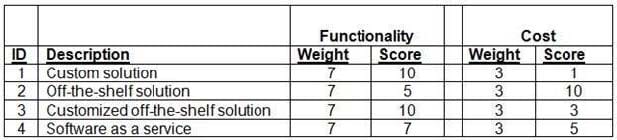
A company uses a prioritization range of 110, in which 10 represents the highest or best. According to the information from the table, which option should the business analyst recommend?
A. 3
B. 4
C. 2
D. 1
What is a standardized, effective, and efficient way to manage changes to project documentation?
A. A change control board
B. A requirements traceability matrix
C. A configuration management system
D. A configuration verification and audit system
Company A has been awarded a contract to finalize the development of a product that Company B was not able to finish. The business analyst is given a copy of the documentation left by Company B.
To which of the following documents should the business analyst pay the most attention to ensure the project succeeds this time?
A. Application design documentation
B. Business use cases
C. Test case documentation
D. Clauses in the contract
A company is developing a new risk management system. The company expects the system to evolve in the near future due to changing government regulations.
Which approach will better cope with the requirements' volatility?
A. Multivoting
B. Phased baselining
C. Comparative analysis
D. Storyboarding
One of the main purposes for creating a requirements traceability matrix is to:
A. track how requirements can be connected to the solution.
B. provide test cases to validate solution deliverables.
C. document stakeholder approval of project requirements.
D. track the project solution scope.
The business analyst has been assigned to a project which delivers functionality for a much larger solution. The project has many requirements but has not received adequate funding. In addition, the stakeholders' views conflict.
Which tools and techniques should the business analyst use to maximize business value while establishing the requirements baseline?
A. Decision trees, weighted matrix, and context diagrams.
B. Traceability matrix, context diagrams, and scope document.
C. Weighted matrix, process flow, and organizational chart
D. Stakeholder register, decision tree, and capability matrix
After reviewing a business case, project goals, and objectives, a business analyst determines that the organization prefers taking an exploratory approach to finding the solution that best meets the business need. Which approach best aligns with the business need for this organization?
A. Change-driven approach
B. Analytical approach
C. Waterfall approach
D. Plan-driven approach

Home | Contact Us | About Us | FAQ | Guarantee & Policy | Privacy & Policy | Terms & Conditions | How to buy
Copyright © 2026 pass4itsure.com. All Rights Reserved