 TESTED 13 Jul
PFMP Online Practice Questions and Answers
A key role for portfolio management is to balance the use of resources following the need against the existing skill-set. One of the component managers told you that an important SME on his program is traveling and there is no replacement for her. This will cause a major delay in the program. What is your first step as a portfolio manager?
A. Do interdependency management and see the impact
B. Send a broadcast report to all components informing them of the issue
C. Ask him to do a quick recruitment and hire someone to solve the issues
D. Tell him that he needs to find out a solution and that you will be ready for any assistance needed
You are managing a complex portfolio with high risk levels due to emerging technological breakthroughs and a short benefit window to market your product. You know that managing risk is key to success and you are coaching your team on the same. You started with developing the plan that will be used as guideline for the component plans to manage risks at their level. What are the outputs of this plan?
A. Portfolio Management Plan updates, Portfolio updates, Portfolio Reports, Enterprise Environmental Factors updates
B. Portfolio Management Plan updates, Organizational Process Assets updates, Portfolio Process Assets updates
C. Portfolio Management Plan updates, Organizational Process Assets updates, Portfolio Reports, Enterprise Environmental Factors updates
D. Portfolio Management Plan updates, Organizational Process Assets updates, Portfolio Process Assets updates, Portfolio updates
Based on the following table, assume you have been asked to perform a prioritization analysis based on these data. You realize risk is a major concern to the company, but you have some data available about potential benefits. These data show A and D have the greatest benefits. A and D are followed in terms of benefits by C, then B, then F, and finally Assume three of the programs and projects can be added to the portfolio when the Board meets. Your recommendation is to select:
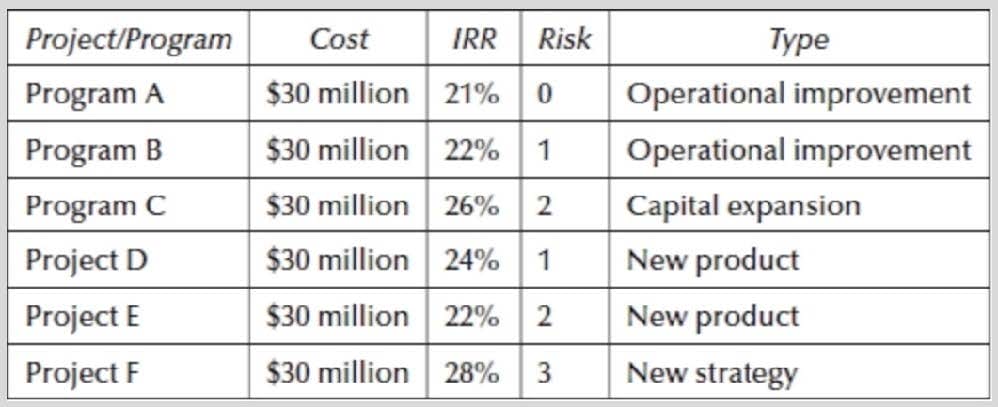
A. A, B, and C
B. A, D, and C
C. A, F, and C
D. D, B, and C
Ideally, the organization practices a policy of open communications on risks and encourages people to point any out at all levels, even if the risk does not affect one's own work and especially if it affects the portfolio. Different people, though, have different perspectives of the various portfolio risks based on their position in the organization. Assume a risk has been identified concerning the organization's operating model. This risk was identified by:
A. A functional manager
B. A PMO Director
C. An executive
D. The portfolio manager
When we talk about portfolios, programs and projects, it is inevitable to mention the business value which is the sum of tangible and intangible assets of an organization, also known as the net quantifiable benefit.
When it comes to business value, at which level of the organization is the pursuit of Business Value optimized?
A. Program
B. Portfolio
C. Operational
D. Project
Processes in the portfolio management layer interact with each others. For example, Manage Portfolio Information interacts with Provide Portfolio Oversight in order to store decisions made during the portfolio review meetings. Where are these decisions stored?
A. Portfolio Management Plan
B. Portfolio
C. Portfolio Reports
D. Portfolio Process Assets
As vision is the desired end state, it requires specific strategies to attain it. These strategies are best achieved by establishing:
A. Outcomes
B. Key performance indicators
C. Critical success factors
D. Goals
Each time a strategic change occurs, it requires a number of updates, and it includes the need to update the portfolio process assets including:
A. Timelines
B. Prioritization model
C. Lessons learned
D. Communication requirements
Assume it was your suggestion to the executive team as the newly appointed Chief Financial Officer for your organization to implement portfolio management. While someone has been identified to be the portfolio manager, you are developing the charter and the structure. In doing so, guidance is provided by the:
A. Portfolio strategic plan
B. Organization's strategic plan
C. Portfolio roadmap
D. Plans, policies, and documentation of stakeholder expectations
Your organization, given the economic downturn in your country, decided to reduce its staff by 90% and outsource all operational activities including those of program and project managers and their teams. It has, however, retained the portfolio manager, and it has a Portfolio Review Board comprised of senior executives that meets monthly. Since outsourcing is the norm and not the exception, the manager of Procurement and Contracting is a major stakeholder. Her areas of interest are:
A. Benefits and outcomes toward strategic goals
B. Overall portfolio performance
C. Financial standing
D. Change decisions

Home | Contact Us | About Us | FAQ | Guarantee & Policy | Privacy & Policy | Terms & Conditions | How to buy
Copyright © 2026 pass4itsure.com. All Rights Reserved