 TESTED 13 Jul
OMG-OCUP2-INT200 Online Practice Questions and Answers
What is NOT a purpose of a port owned by a classifier?
A. server as an end point for connectors
B. hides the internals of that classifier from other classifiers
C. provides a distinct point of interaction between the classifier and its environment
D. specifies an association to the classifier
What does it mean when message m is ignored in a combined fragment?
A. Nothing happens within the fragment until m appears.
B. Message m appears only in illegal traces of the fragment.
C. If m happens, the system should abort.
D. One or more m messages may appear at any point within the fragment.
Refer to the exhibit. How many interfaces does the TradeBroker component make visible to its clients?
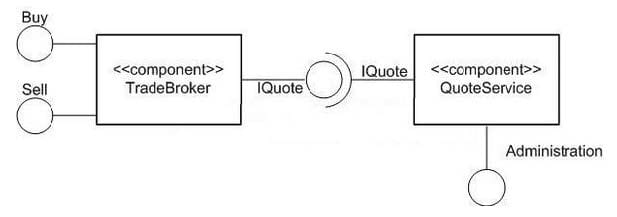
A. 0
B. 1
C. 2
D. 4
E. 3
What is a Connection Point Reference used to declare?
A. a pointer to a connection point
B. a submachine state
C. an entry or exit point of a submachine state
D. an entry or exit point of a state
E. a pseudostate
What does a conditional node consist of?
A. clauses
B. guards
C. parameters
D. body Part nodes
E. behaviors
F. partitions
What value should insertAt be set to when adding a new value to the end of a 5-element ordered structural feature using an AddStructuralFeatureValueAction?
A. any integer greater than 5
B. -1
C. infinity
D. 0
What situation results from performing a Create Object Action on an abstract class?
A. undefined behavior
B. arbitrary object of one of its subclasses being created
C. exception being raised
D. error log entry created
E. object of the specified class being created
What is NOT true about a roles and role bindings?
A. A role binding is an association.
B. A role binding maps a connectable element to a role in a collaboration occurrence.
C. The same object may play roles in multiple collaborations.
D. A role types by an interface specifies a set of features required by a participant in a collaboration.
E. The same connectable element may be bound to multiple roles in a single collaboration occurrence.
A component may legally participate in which relationship(s)?
A. associations and generalizations
B. dependencies, associations, and generalizations
C. dependencies and generalizations
D. dependencies
To what does an internal structure of a class refer?
A. the decomposition of that class in terms of interconnected parts
B. the set of structural features of that class
C. the inheritance structure of that class
D. the set of nested classifiers of that class
E. class and associations owned by that class

Home | Contact Us | About Us | FAQ | Guarantee & Policy | Privacy & Policy | Terms & Conditions | How to buy
Copyright © 2026 pass4itsure.com. All Rights Reserved