 TESTED 24 Jul
OMG-OCUP-100 Online Practice Questions and Answers
What does amond shape (as depicted in the exhibit) represent in UML 2.0 activity rams? (Choose two)

A. joins
B. forks
C. merges
D. decisions
E. initial nodes
F. flow final nodes
G. activity final nodes
In a sequence diagram, what does a stop symbol express?
A. The interaction is no longer valid.
B. A message is stopped short of its reception.
C. The object represented by a lifeline terminates.
D. The behavior of a lifeline halts within this diagram.
What is the difference between the <
A. <
B. <
C. <
D. <
What is an element in UML 2.0?
A. member of a set
B. instance of a class
C. constituent of a model
D. abstract metaclass with only one superclass
E. substance not separable by ordinary chemical means
What does multiplicity in UML 2.0 signify?
A. interval of integers
B. range of allowable cardinalities
C. sequence and uniqueness of association
D. ability to multiply two or more numbers
E. upper bound for the number of allowable instances
Let us denote sending of p as !p and receiving p as ?p. Which trace defines the interaction N2 in the exhibit?
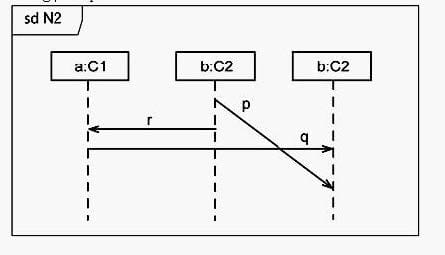
A.
B.
C.
D.
E.
What would NOT make a good subject for use cases? (Choose two)
A. actor
B. class
C. system
D. model
E. subsystem
F. component
In the exhibit, which use cases must be available to meet the goals of Actor X when it initiates Use Case A? ose 2)
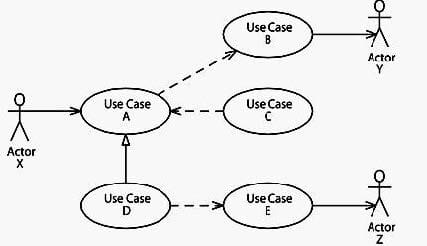
A. Use Case A
B. Use Case B
C. Use Case C
D. Use Case D
E. Use Case E
What does an activity contain? (Choose two)
A. edges
B. nodes
C. states
D. classes
E. lifelines
F. messages
What are the possible relationships among use cases in UML 2.0? (Choose two)
A. <
B. <
C. <
D. <
E. <
F. <

Home | Contact Us | About Us | FAQ | Guarantee & Policy | Privacy & Policy | Terms & Conditions | How to buy
Copyright © 2026 pass4itsure.com. All Rights Reserved