 TESTED 13 Jul
NSE5_FMG-5.4 Online Practice Questions and Answers
View the following exhibit:
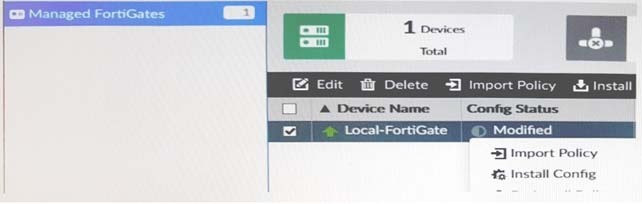
When using Install Config option to install configuration changes to managed FortiGate, which of the following statements are true? (Choose two.)
A. Will not create new revision in the revision history.
B. Provides the option to preview configuration changes prior to installing them.
C. Installs device-level changes to FortiGate without launching the Install Wizard.
D. Once installed, the install process cannot be canceled and changes will be installed on the managed device.
View the following exhibit:
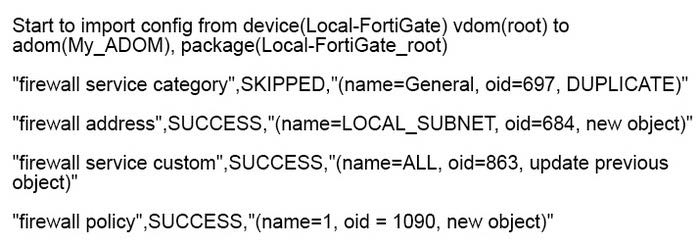
Which one of the following statements is true regarding the object named ALL?
A. FortiManager updated the object ALL using FortiManager's value in its database.
B. FortiManager updated the object ALL using FortiGate's value in its database.
C. FortiManager created the object ALL as a unique entity in its database, which can be only used by this managed FortiGate.
D. FortiManager installed the object ALL with the updated value.
An administrator has configured the following command on FortiManager:
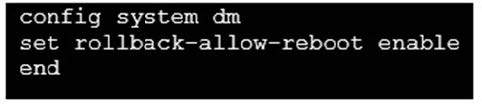
A configuration change has been installed from FortiManager to the managed FortiGate that causes the FGFM tunnel to go down for more than 15 minutes. What is the purpose of this command?
A. It allows FortiGate to reboot and recover the previous configuration from its configuration file.
B. It allows FortiGate to unset central management settings.
C. It allows the FortiManager to revert and install a previous configuration revision on the managed FortiGate.
D. It allows FortiGate to reboot and restore a previously working firmware image.
How are the points calculated when using FortiMeter to deploy FortiOS-VM? (Choose two.)
A. Based on the number of sessions on the mgmt interface of FortiOS-VM.
B. Based on the FortiGuard service option enabled for FortiOS-VM.
C. Based on the traffic usage on port1 and port2 on FortiOS-VM.
D. Based on the amount of traffic (per GB) passing through the FortiOS-VM.
Which of the following statements are true regarding ADOM revisions? (Choose two.)
A. ADOM revisions can save the current state of all policy packages and objects for an ADOM.
B. ADOM revisions can significantly increase the size of the configuration backups.
C. ADOM revisions can create System Checkpoints for the FortiManager configuration.
D. ADOM revisions can save the current state of the whole ADOM.
What does the diagnose cdb check policy-assignment command do?
A. Fixes incorrect ADOM-level object references based on the firewall policies.
B. Internally upgrades existing ADOMs to the same ADOM version in order to clean up and correct the ADOM syntax.
C. Verifies and checks dynamic mappings, and removes invalid dynamic mappings.
D. Verifies and corrects global ADOM policy package assignments that have been disassociated from an ADOM.
An administrator's PC crashed before the administrator could submit a workflow session for approval. After the PC restarted, the administrator noticed that the ADOM was locked from the session before the crash. How can the administrator unlock the ADOM?
A. The administrator must log in as Super_User in order to unlock the ADOM.
B. The administrator must restore the configuration from a previous backup.
C. Delete the previous admin session manually through the FortiManager's GUI or CLI.
D. The administrator must log in using the same administrator account to unlock the ADOM
An administrator removed one of the secondary devices from the FortiManager HA cluster. What change will be pushed by the primary FortiManager device?
A. FortiManager will remove the secondary device's IP address and serial number immediately from the central management configuration of managed devices.
B. FortiManager will remove the secondary device's serial number immediately from the central management configuration of managed devices.
C. FortiManager will remove the secondary device's IP address immediately from the central management configuration of managed devices.
D. FortiManager will remove the secondary device's IP address from the server-list configuration central management configuration of managed devices.
An administrator has assigned a global policy package to custom ADOM1. Then the administrator created a new policy package, Fortinet, in the custom ADOM1. Which one of the following statements is true regarding global policy package assignment to the newly-created policy package Fortinet?
A. When a new policy package is created, you need to reapply the global policy package to the ADOM.
B. When a new policy package is created, it automatically assigns the global policies to the new package.
C. When a new policy package is created, you need to assign the global policy package from the global ADOM.
D. When a new policy package is created, you can select the option to assign the global policies to the new package.
Which of the following statements are true regarding device management on FortiManager? (Choose two.)
A. FortiGate in transparent mode configurations are not counted toward the device count on FortiManager.
B. The maximum number of managed devices for each ADOM is 500.
C. FortiGate devices in HA cluster devices are counted as a single device.
D. FortiGate devices in an HA cluster that has five VDOMs are counted as five separate devices.

Home | Contact Us | About Us | FAQ | Guarantee & Policy | Privacy & Policy | Terms & Conditions | How to buy
Copyright © 2026 pass4itsure.com. All Rights Reserved