 TESTED 13 Jul
NS0-509 Online Practice Questions and Answers
An enterprise customer has both a NetApp FAS8200 4-node cluster and a third-party storage array in a shared SAN environment. The host servers connect to both storage vendors' arrays in the fabric. Regarding (he hosts in this scenario, what are- two NetApp best practices when performing this task? (Choose two.)
A. Set the default timeout values and storage parameters for the host system.
B. Provide isolation between storage systems using NetApp's multitenancy feature.
C. Always use the same adapter for heterogeneous storage systems.
D. Use separate adapters to connect to each vendors' storage system.
You have a 4-node cluster with a FAS8200 HA pair and an AFF A300 HA pair. You need to migrate a LUN from a FAS8200 node to an AFF A300 node for faster performance. Which method will non-disruptively migrate the LUN to the AFF A300 while retaining snapshots of the LUN on the FAS8200?
A. You move the LUN.
B. You relocate the aggregate.
C. You move the volume.
D. You copy the LUN.
You want to access and mount a Linux L.UN using only iSCSl. In the past, the LUN ha;; been accessed using FC. What must you do to accomplish this task?
A. Change the LUN protocol type to (SCSI.
B. Create a new iSCSI igroup. and change the LUN mapping from the original to the new igroup.
C. Create a new iSCSI Igroup and map the LUN to both the new and existing FC igroup.
D. Add an iSCSI protocol type to the existing igroup so that the LUN can be accessed by both FC and iSCSI hosts.
Click the Exhibit button.
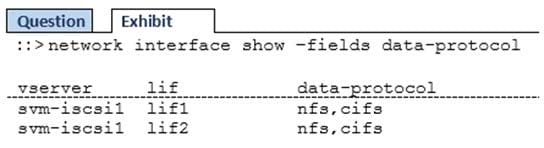
You are asked to serve iSCSI LUNs in an existing SVM on your AFF A220 using ONTAP 9.5. You verified that the iSCSI license is configured on your cluster and that the iSCSI protocol is enabled.
Referring to the exhibit, what is needed to allow hosts to log into the iSCSI target?
A. Create new LIFs with the iSCSI data protocol.
B. Create new igroups with the host IQNs.
C. Add iSCSI to the data protocol of the existing LIFs.
D. Map LUNs to the igroups.
Click the Exhibit button.
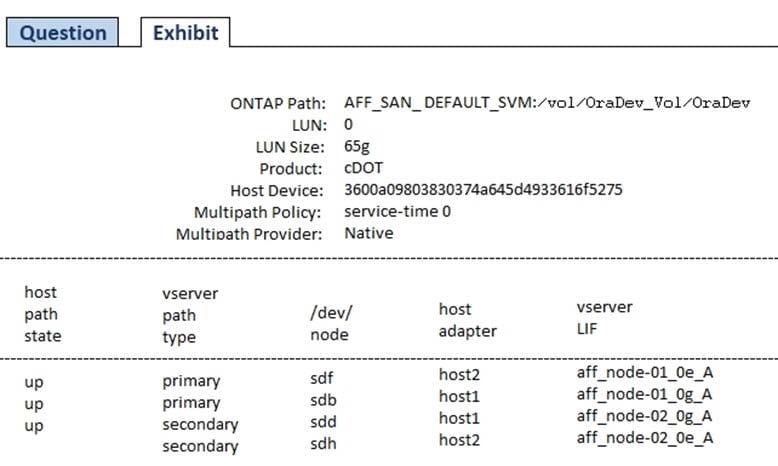
Referring to the exhibit, which two LIFs would be optimized paths to LUN /vol/OraDev_Vol/OraDev? (Choose two.)
A. aff_node-01_0g_A
B. aff_node-02_0e_A
C. aff_node-02_0g_A
D. aff_node-01_0e_A
While expanding a 200 GB LUN in an ONTAP 9.4 system, the following error is observed:

What is the cause of this error?
A. The volume auto-grow is disabled.
B. The LUN reached maximum capacity.
C. The LUN can be expanded up to 10 times its original size.
D. Space reservation is enabled.
Click the Exhibit button.
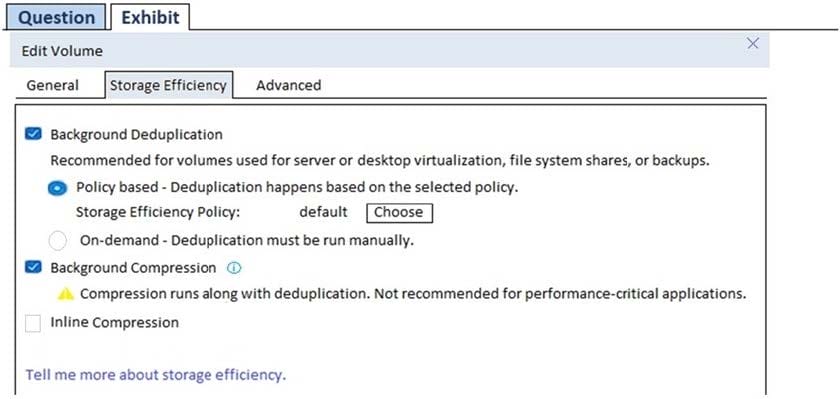
You have a performance critical database application that is running on a FAS9000 controller that uses FC. As shown in the exhibit, volume efficiency is enabled.
If you follow the performance recommendation, what are two results to the data in the volume? (Choose two.)
A. The new written data is compressed.
B. The new written data is uncompressed.
C. The existing data is uncompressed.
D. The existing data is compressed.
Click the Exhibit button.
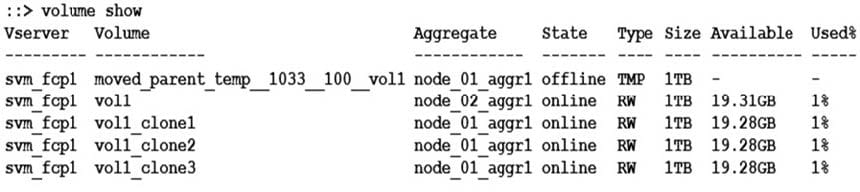
You notice that your volume named vol1 has a temporary volume that is doubling the space that is used by the volume.
In this scenario, which operation caused the volume to take up twice the space?
A. FlexClone
B. SnapRestore
C. FlexGroup
D. SnapMirror
You create a new iSCSI SVM and secure iSCSI sessions by using both Challenge-Handshake Authentication Protocol (CHAP) and iSCSI Access Control Lists (ACL).
In this scenario, in which two ways are you securing your iSCSI implementation? (Choose two.)
A. CHAP creates a hash value for the username and shared secret.
B. iSCSI ACLs are applied to the initiator configuration to provide an IP address of the targets.
C. CHAP encrypts all iSCSI session I/O.
D. iSCSI ACLs are applied to the target configuration to provide an IP address of the initiators.
How do you configure the iSCSI-SendTargets datastore when the datastore is provisioned from NetApp storage?
A. You must configure jumbo frames when SendTargets-based iSCSI is used.
B. Use static discovery to add the target IQN.
C. Use dynamic discovery to add the target IQN.
D. You must configure a single protocol on the SVM when SendTargets-based iSCSI is used.

Home | Contact Us | About Us | FAQ | Guarantee & Policy | Privacy & Policy | Terms & Conditions | How to buy
Copyright © 2026 pass4itsure.com. All Rights Reserved