 TESTED 13 Jul
NS0-192 Online Practice Questions and Answers
You are adding an additional node to a single-node cluster.
Which of the actions should be performed after this upgrade? (Choose two.)
A. Verify that HA is enabled.
B. Verify that epsilon is not assigned.
C. Verify that epsilon is assigned.
D. Verify that HA is disabled.
A manager wants a volume to have a guaranteed 300 MB/s of read performance. You explain that you cannot do this on FAS storage running ONTAP 9.3 backed by 10,000 RPM disks.
What is the reason for this response?
A. Throughput floors apply to only iSCSI access.
B. Throughput floors can only guarantee up to 125 MB/s.
C. Throughput floors require a license.
D. Throughput floors require AFF.
Click the Exhibit button.

A backup administrator notices throughput problems during backup jobs. While the job is running, you review the QoS output for the target volume.
Referring to the exhibit, which statement is correct?
A. The volume is encountering the QoS limit.
B. The network is slow.
C. The data layer of the controller is slow.
D. The traffic is going over an indirect path in the cluster.
Which two statements are true about epsilon in a 4-node cluster? (Choose two.)
A. Epsilon is used as a tie-breaker for determining a quorum.
B. Epsilon is automatically assigned to the first node when a cluster is created.
C. Epsilon is used for determining the up node in failover.
D. Epsilon is automatically assigned to the last node added to a cluster.
When you expand an aggregate, the spare partitions can be added as only a new RAID group, even though the current RAID group size is large enough for the current and new partitions.
In this scenario, which statement is correct?
A. The partitions to be added share disks with the partitions in the existing RAID group.
B. RAID group size is used only when dealing with non-partitioned disks.
C. Only nonpartitioned disks can be added to a RAID group with existing partitions.
D. The aggregate must be converted to RAID-TEC to expand RAID groups using partitions.
An administrator added a spare disk to the data aggregate in an ONTAP system. The administrator immediately noticed messages about the disk being partitioned.
Why did this event occur?
A. Disks on the same disk shelf were shared by both nodes.
B. The RAID group to which the disk was added contained root partitions.
C. The RAID was full and another RAID group was needed.
D. The disk was larger than the other disks in the aggregate and needed to be right-sized.
After replacing a failed disk, the disk does not appear as a spare on any node in the cluster.
What should be done to correct this problem?
A. Physically remove the disk and re-seat it firmly in the storage bay.
B. Physically remove and re-seat each IOM in the shelf, one at a time.
C. Assign ownership of the replaced disk to a node.
D. Add the disk into an aggregate on either node.
An upgrade to ONTAP 8.3 and later fails because the cluster contains 32-bit data.
In this scenario, which statement is correct?
A. Ignore the warning, and use the -force parameter to complete the upgrade.
B. ONTAP 8.3 and later supports 32-bit data format.
C. Identify and move the volume with 32-bit data to another node of the cluster.
D. Identify the 32-bit data and either convert, remove or move out of the cluster.
Click the Exhibit Button.
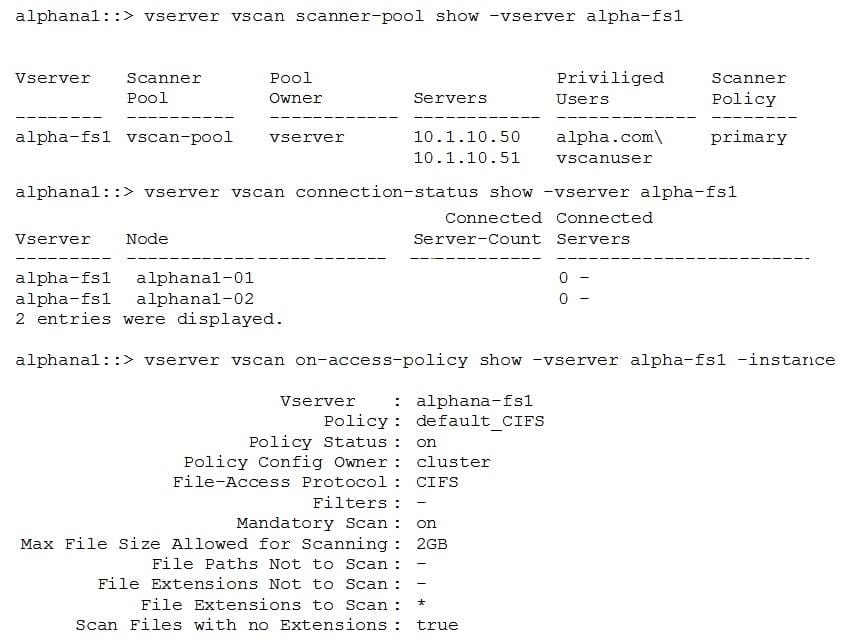
All CIFS users are unable to access file shares on the SVM alpha-fs1.
Referring to the exhibit, users are unable to access shares because of which two reasons? (Choose two.)
A. The Policy Config Owner should be vserver.
B. The scan-mandatory parameter is on.
C. No Vscan servers have been added to the scanner pool.
D. No Vscan servers are connected.
Which two conditions would prevent a normal giveback operation? (Choose two.)
A. the presence of failed disks
B. active SnapMirror transfers
C. connected NFSv3 sessions
D. the presence of a failed IOM module

Home | Contact Us | About Us | FAQ | Guarantee & Policy | Privacy & Policy | Terms & Conditions | How to buy
Copyright © 2026 pass4itsure.com. All Rights Reserved