 TESTED 13 Jul
JN0-682 Online Practice Questions and Answers
You are an architect for an enterprise organization that currently operates three data centers with plans to expand to five data centers in the next year. You already notice large amounts of BUM flooding and must control this issue before implementing the next two data centers.
Which feature would address this issue?
A. type-5 routes
B. type-6 routes
C. mesh groups
D. VXLAN BUM traffic filter
You have deployed a multitenant EVPN-VXLAN fabric. You must have the routes in the BLUE VRF show up in the RED VRF. In this scenario, how would you achieve this goal?
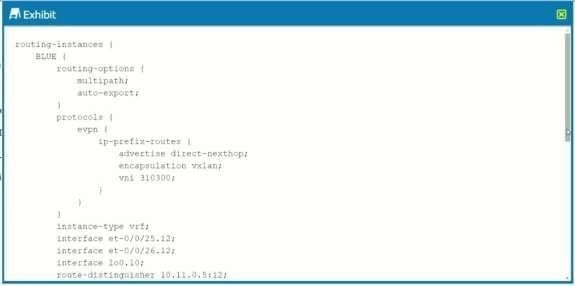
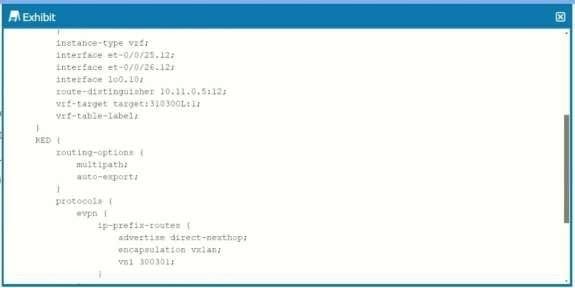
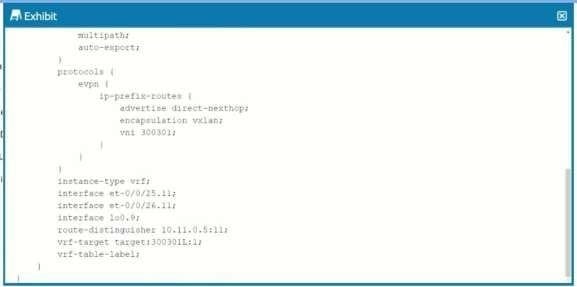
A. Configure a VRF export policy on the BLUE VRF that matches the RED VRF route target.
B. Configure the RED route target in the BLUE VRF.
C. Configure the BLUE route target in the RED VRF.
D. Configure a VRF import policy on the RED VRF that matches the BLUE VRF route target.
You are configuring an EVPN overlay network. You want to ensure that leaf devices can respond to ARP requests from locally connected hosts, when the leaf device knows the MAC of the intended destination. In this scenario, what should you configure on the leaf devices to accomplish this task?
A. Proxy ARP
B. Static ARP entries
C. Persistent MAC learning
D. IGMP snooping
You want to configure redundant Layer 3 gateways.
In this scenario, which two juniper best practices would accomplish this task? (Choose two.)
A. Allowing Junos to dynamically create the virtual MAC address of the IRB interface
B. Configuring both IRB interfaces manually with the same IP address
C. Configuring both IRB interfaces manually with the same address
D. Allowing Junos to dynamically create the virtual IP address of the IRB interface
The MC-LAG group shown in the exhibit is providing high availability services for the directly connected servers. The backup liveness detection is applied to the ICL-PL link, however, when one of the members rebooted, there was traffic loss for a few seconds.
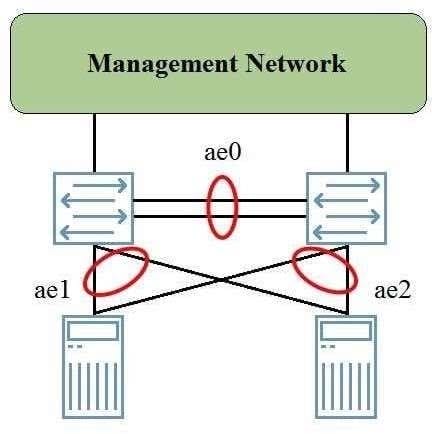
In this scenario, where should you apply the backup liveness detection?
A. On the management interfaces
B. On the ae2 interface
C. On the ae1 interface
D. On the ae0 interface
Which statement is true about the route shown in the exhibit?
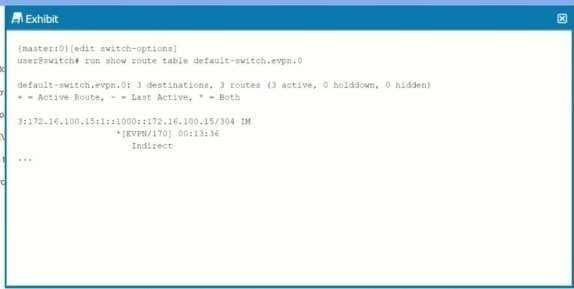
A. The route target on this route is 1000
B. The route is an EVPN type-1 route.
C. The route uses a type-1 route distinguisher.
D. The VNI for this route is 304.
Host1 and host2 are connected to an EVPN signaled VXLAN overlay, and must have Layer 3 connectivity. The VNI and VLAN assignments are shown in the exhibit.
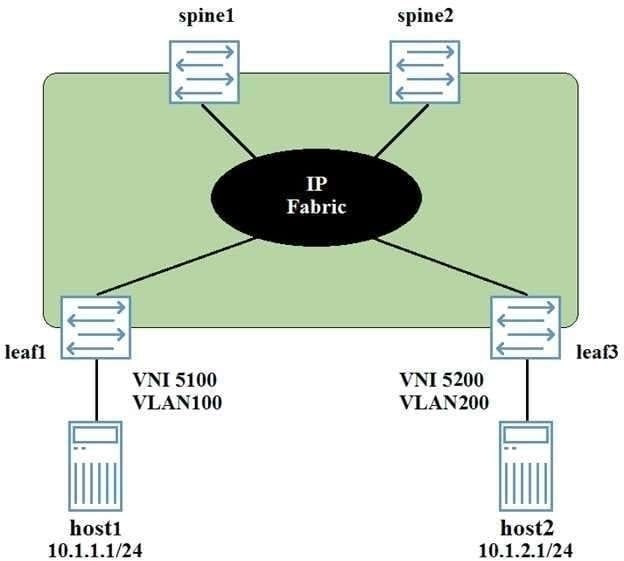
In this scenario, which two statements are true? (Choose two.)
A. A Layer 3 gateway can be configured on the leaf devices.
B. The VNI assigned to the host1 link must be same as the VNI assigned to the host2 link.
C. The ESI assigned to the host1 link will be different from the ESI assigned to the host link.
D. A layer 3 gateway can be configured on the spine devices.
After configuring an IP fabric using EBGP as you protocol, you notice that not all of the routers are showing up in the routing tables. You have verified that all adjacencies have formed, and place and configured properly. In this scenario, which statement is true?
A. The routers have not been configured with the multipath multiple-as parameter.
B. The routers have not been configured using the bfd-1 Liveness-detection parameter.
C. The routers have not been configured using the multihop parameter.
D. The routers have not been configured using the add-path parameter
You are building a new IP fabric data center underlay network and want to ensure predicted load- balancing behavior for traffic, traversing the fabric. What are two approaches you should take to satisfy the requirement in this scenario? (Choose two.)
A. Ensure that all spine devices are the same switched mode.
B. Ensure that all uplinks are 40GbE.
C. Ensure that every leaf node has an uplink spine node
D. Ensure that every node has a link to every other leaf node
Referring to the exhibit, you have a data center with two PODs. Seamless EVPN-VXLAN stitching is used to facilitate communication between the PODs.
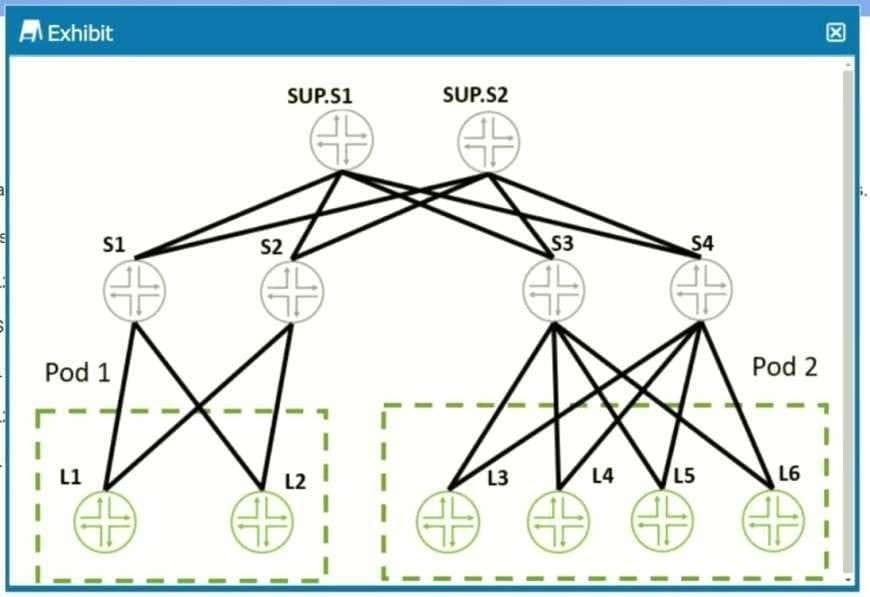
Which three statements are true in this scenario? (Choose three.)
A. AVXLAN tunnel can form between L2 and S1.
B. A VXLAN tunnel can form between S1 and S2.
C. AVXLAN tunnel can form between L1 and L2.
D. AVXLAN tunnel can form between L2 and S3.
E. AVXLAN tunnel can form between L1 and L4.

Home | Contact Us | About Us | FAQ | Guarantee & Policy | Privacy & Policy | Terms & Conditions | How to buy
Copyright © 2026 pass4itsure.com. All Rights Reserved