 TESTED 08 Jul
JN0-662 Online Practice Questions and Answers
Click the Exhibit button.
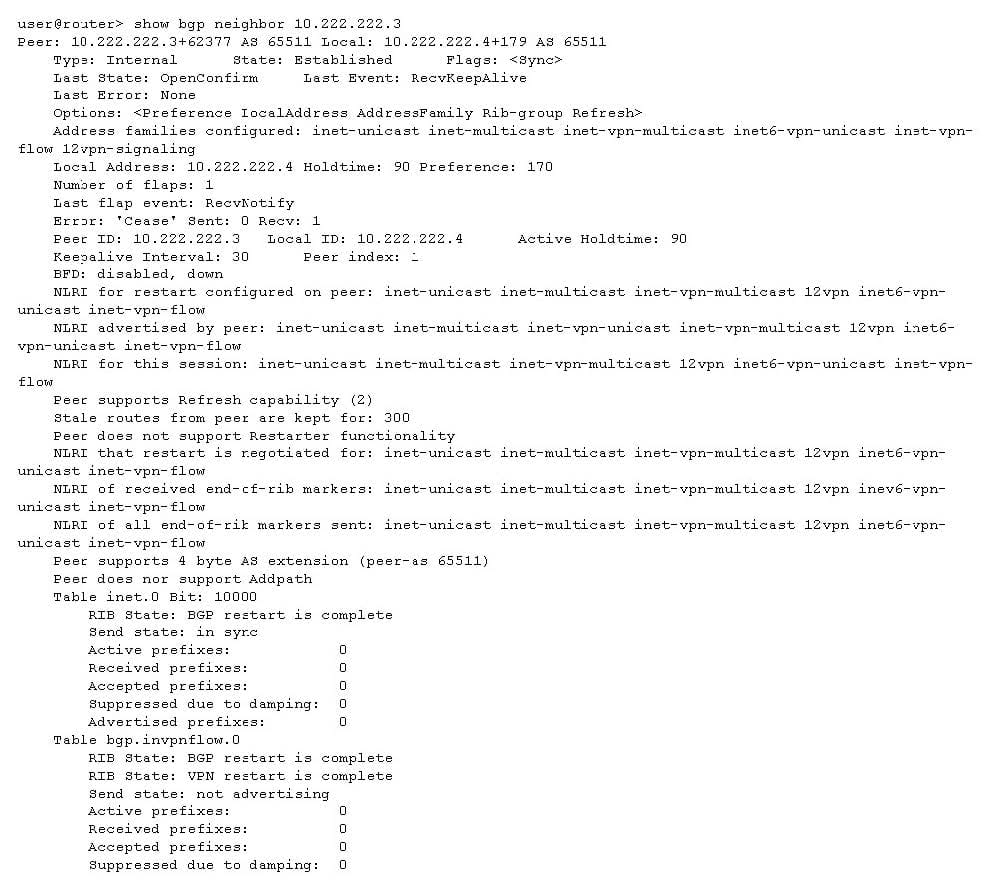
The exhibit shows a BGP peering session for two PE routers. The BGP session is up, but IPv4 hosts in the Layer 3 VPN that use the BGP session are unable to communicate.
What is the problem?
A. The BGP peer does not support the add-path feature.
B. The BGP peer does not support the restarter functionality.
C. The local BGP router does not support Layer 2 VPN and Layer 3 VPN NLRI address families at the same time.
D. There is a mismatch in the supported NLRI address families between the BGP peers.
Click the Exhibit button.
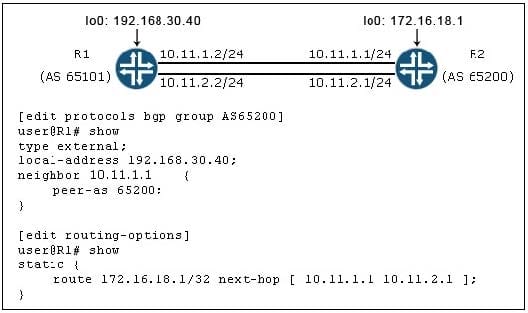
Referring to the exhibit, what must be added to the existing configuration to ensure that per-prefix load balancing occurs?
A. multihop
B. keep all
C. multipath
D. family inet unicast
Click the Exhibit button.
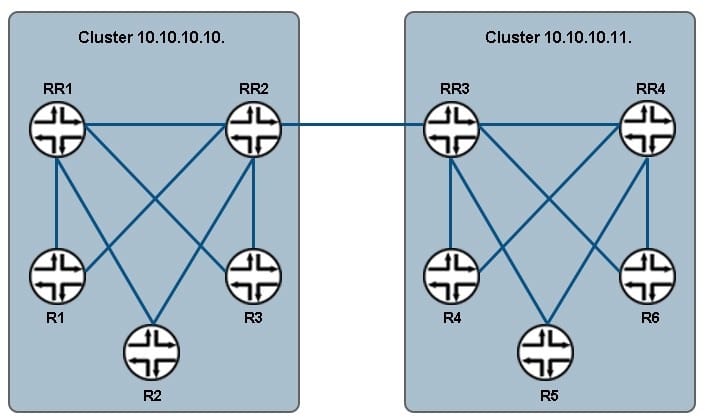
Referring to the exhibit, RR1-RR4 are route reflectors.
Which three routers would RR1 need to peer with if the no-client-reflect parameter has been configured? (Choose three.)
A. R2
B. R5
C. RR4
D. R6
E. R1
Which two routes use a proper route distinguisher? (Choose two.)
A. 192.168.0.1:12:10.1.0.0/16
B. 12345:12:10.1.0.0/16
C. 192.168.0.1:10.1.0.0:12/16
D. 12345:10.1.0.0:12/16
According to Juniper Networks, what are three methods of scaling Layer 2 VPNs? (Choose three.)
A. inbound route filters
B. route reflection
C. outbound route filters
D. filter-based forwarding
E. BGP route refresh
Click the Exhibit button.
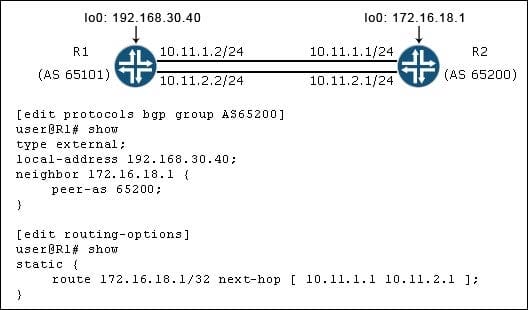
Referring to the exhibit, what must be added to the existing configuration to ensure that per-prefix load balancing occurs?
A. multihop
B. keep all
C. multipath
D. family inet unicast
Click the Exhibit button.
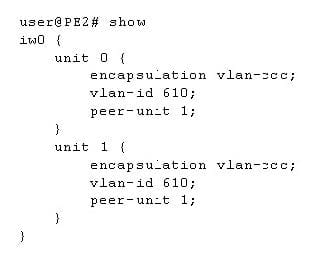
You have configured Layer 2 VPN stitching between two Layer 2 circuits on PE2, but traffic is not passing through the VPN.
Referring to the exhibit, what is the problem?
A. The unit 1 peer unit must be set to 0.
B. The VLAN IDs must be lower than 512.
C. The VLAN IDs must be different on each unit.
D. The peer units must reference the VLAN IDs.
To reduce the size of OSPF Area 100, you configure the area with the no-summaries parameter. After committing this configuration change, you notice that an OSPF router in a remote area is no longer receiving Type 5 LSAs from an ASBR in Area 100.
Which statement is true in this scenario?
A. The ASBR in Area 100 generates Type 5 LSAs, and places them in its own database.
B. The ASBR in Area 100 generates Type 5 LSAs, and they are translated to Type 7 LSAs.
C. The ASBR in Area 100 generates Type 5 LSAs, and they are blocked by the ABR.
D. The ASBR in Area 100 generates Type 5 LSAs, and a virtual link is required for transport to other areas.
Click the Exhibit button.
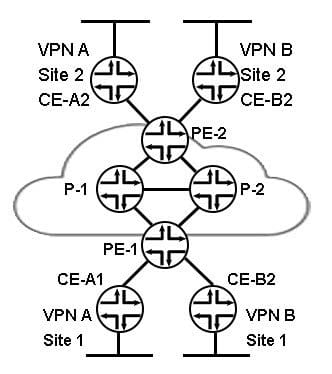
Referring to the exhibit, which two statements are true? (Choose two.)
A. A BGP full mesh is only required between PE-1 and PE-2.
B. A BGP full mesh is required between P1, P2, PE-1, and PE-2.
C. MPLS must only be enabled on PE-1 and PE-2.
D. MPLS must be enabled on P1, P2, PE-1, and PE-2.
Click the Exhibit button.
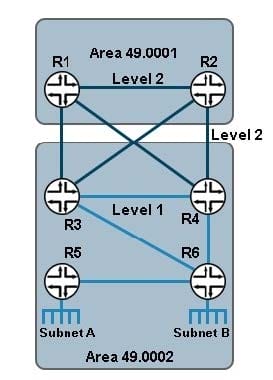
R5 must advertise Subnet A into IS-IS so that Subnet A and Subnet B can communicate. Subnet B must be able to forward traffic to Subnet A and towards Area 49.0001. However, R5 should not be able to route traffic from Subnet A to Area 49.0001.
Referring to the exhibit, how would you solve this problem?
A. Configure Level 2 on all links in Area 49.0002.
B. Configure the set protocols isis ignore-attached-bit parameter on R5.
C. Configure the set protocols isis overload parameter on R6.
D. Configure an export policy on R6 to reject all routes except Subnet B towards R5.

Home | Contact Us | About Us | FAQ | Guarantee & Policy | Privacy & Policy | Terms & Conditions | How to buy
Copyright © 2026 pass4itsure.com. All Rights Reserved