 TESTED 13 Jul
JN0-649 Online Practice Questions and Answers
Which two multicast listenerregistration protocols are supported in the Junos operating system? (Choose two.)
A. MLD
B. DVMRP
C. IGMP
D. PIM
Referring to the exhibit, how will router E quickly learn that the remote MAC addresses are no longer reachable through the router attached to the failed link?
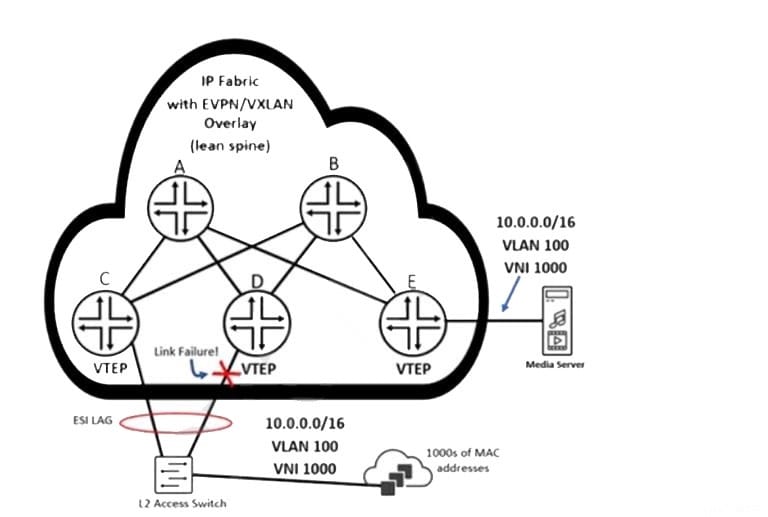
A. Router E receives Type 2 withdrawal messages from router D.
B. Router E receives Type 1 withdrawal messages from router D.
C. Router E receives Type 1 withdrawal messages from router C.
D. Router E receives Type 2 withdrawal messages from router C.
In OSPF, how does a router ensure that LSAs advertised to a neighboring router are received?
A. LSA flooding guarantees that all routers will receive them successfully.
B. LSAs are sent over a TCP connection.
C. LSAs are acknowledged by the neighboring router.
D. LSAs are advertised with an acknowledgement bit.
You are implementing the route summarization feature of OSPF. Which two results do you achieve in this scenario? (Choose two.)
A. It helps in migrating to future multi-area OSPF network designs.
B. It reduced the routing table size, enabling devices to store and process lessinformation.
C. It reduces the impact of topology changes on a device.
D. It provides optimal routing in the network.
You have scheduled maintenance operationsfor one of the devices in your OSPF network. Referring to the exhibit, which three statements are correct? (Choose three.)
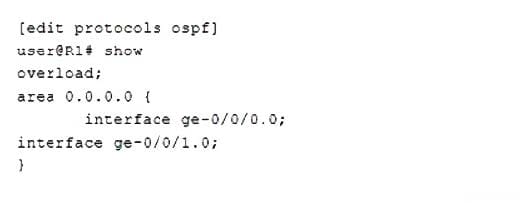
A. R1 does not participate in OSPF routing.
B. Any traffic destined for networks that terminate on R1 will still beforwarded to R1.
C. The metrics for all transit interfaces on R1 is set to the maximum value of 65,535.
D. R1 participates in OSPF routing but does not send or receive transit traffic.
E. R1 does not send or receive transit traffic during the maintenance window even if no alternative paths exist to the given destination.
You are deploying new Juniper EX Series switches in a network that currently is usingCisco's Per-VLAN spanning tree plus (PVST+) and you must provide compatibility with this environment. Which spanning tree protocol do you deploy in this scenario?
A. STP
B. MSTP
C. VSTP
D. RSTP
Your organization has recently acquired another company. You must carry all of the company's existing VLANsacross the corporate backbone to the existing branch locations without changing addressing and with minimal configuration. Which technology will accomplish this task?
A. Q-in-Q all-in-one bundling
B. PVLAN isolated VLAN
C. MVRP registration normal
D. EVPN-VXLAN anycast gateway
You want to create an OSPF area that only contains intra-area route information in the form of Type 1 and Type 2 LSAs.
In this scenario, which area is needed to accomplish this task?
A. totally non-to-stubby area
B. totally stubby area
C. stub area
D. non-to-stubby area
You are troubleshooting an EVPN-VXLAN IP fabric and observe the loop shown in the exhibit. Which two steps would you take to further troubleshoot this problem? (Choose two.)
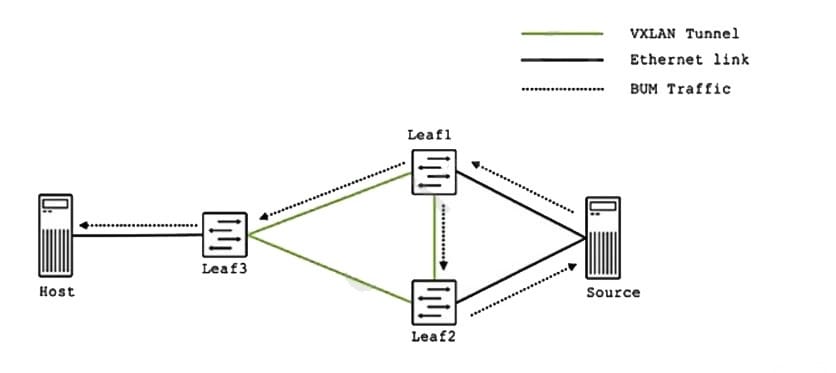
A. Verify that the same ESI is configured on the link from thehost and that it matches the source.
B. Issue the show route table bgp.evpn.0 command on Leaf2 and verify that Type 4 routes are present.
C. Issue the show route table bgp.evpn.0 command on Leaf2 and verify that Type 3 routes are present.
D. Verify thatthe same ESI is configured on the two links from the source.
Your network has an unmanaged switch between the hosts and your EX Series switch. After the traffic enters theEX Series switch, each host must be on a separate VLAN.
How would you accomplish this task?
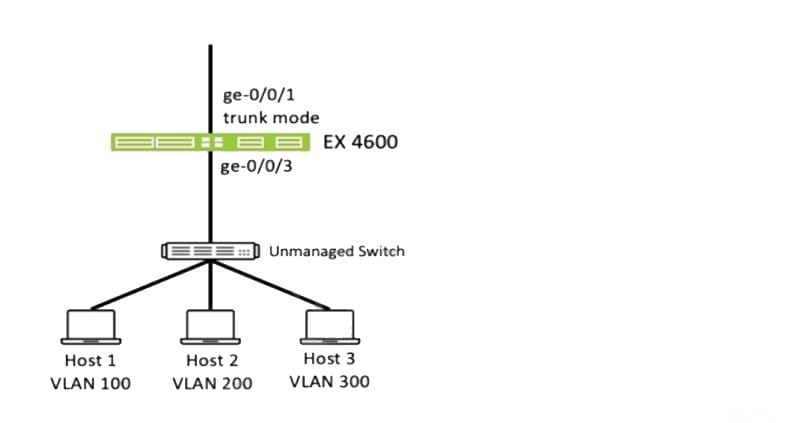
A. Configure an input firewall filter on interface ge-0/0/3 to match the source MAC or IP address of the hosts to assign the VLANs.
B. Configure an output firewall filter on interface ge-0/0/1 to match the destination MAC or IP address of the hosts to assign the VLANs.
C. Configure interface ge-0/0/3 to a mode trunk to assign the VLANs.
D. Configure VSTP on interface ge-0/0/1 to assign the VLANs.

Home | Contact Us | About Us | FAQ | Guarantee & Policy | Privacy & Policy | Terms & Conditions | How to buy
Copyright © 2026 pass4itsure.com. All Rights Reserved