 TESTED 19 Jul
JAVASCRIPT-DEVELOPER-I Online Practice Questions and Answers
developer has a web server running with Node.js. The command to start the web server is node server,js. The web server started having latency issues. Instead of a one second turn around for web requests, the developer now sees a five second turnaround
Which command can the web developer run to see what the module is doing during the latency period?
A. DEBUG = http, https node server.js
B. NODE_DEBUG =http, https node server.js
C. DEBUG =true node server.js
D. NODE_DEBUG =true node server.js
Given the following code: Let x =(`15' + 10)*2;
What is the value of a?
A. 3020
B. 1520
C. 50
D. 35
Given the following code:
document.body.addEventListener(` click ', (event) => {
if (/* CODE REPLACEMENT HERE */) {
console.log(`button clicked!');
)
});
Which replacement for the conditional statement on line 02 allows a developer to
correctlydetermine that a button on page is clicked?
A. Event.clicked
B. e.nodeTarget ==this
C. event.target.nodeName == `BUTTON'
D. button.addEventListener(`click')
A developer wrote the following code:
01 let X = object.value; 03 try { 04 handleObjectValue(X); 05 } catch (error) { 06 handleError(error); 07 }
The developer has agetNextValue function to execute after handleObjectValue(), but does not want to execute getNextValue() if an error occurs.
How can the developer change the code to ensure this behavior?
A. 03 try{ 04 handleObjectValue(x); 05 } catch(error){ 06handleError(error); 07 } then { 08 getNextValue(); 09 }
B. 03 try{ 04 handleObjectValue(x); 05 } catch(error){ 06 handleError(error); 07 } finally { 08 getNextValue(); 10 }
C. 03 try{ 04 handleObjectValue(x); 05 } catch(error){ 06 handleError(error); 07 } 08 getNextValue();
D. 03 try { 04 handleObjectValue(x) 05 ........................
A developer wants to create an object from a function in the browser using the code below:
Function Monster() { this.name = `hello' };
Const z = Monster();
What happens due tolack of the new keyword on line 02?
A. The z variable is assigned the correct object.
B. The z variable is assigned the correct object but this.name remains undefined.
C. Window.name is assigned to `hello' and the variable z remains undefined.
D. Window.mis assigned the correct object.
Refer to the following code:
Let obj ={
Foo: 1,
Bar: 2
}
Let output=[],
for(let something in obj{
output.push(something);
}
console.log(output);
What is the output line 11?
A. [1,2]
B. ["bar","foo"]
C. ["foo","bar"]
D. ["foo:1","bar:2"]
A developer wants to leverage a module to print a price in pretty format, and has imported a method as shown below:
Import printPrice from `/path/PricePrettyPrint.js';
Based on the code, what mustbe true about the printPrice function of the PricePrettyPrint module for this import to work ?
A. printPrice must be be a named export
B. printPrice must be an all export
C. printPrice must be the default export
D. printPrice must be a multi exportc
Refer to the HTML below:
- Leo
- Tony
- Tiger
Which JavaScript statement results in changing " Tony" to "Mr. T."?
A. document.querySelectorAll(`$main $TONY').innerHTML = ' Mr. T. ';
B. document.querySelector(`$main li:second-child').innerHTML = ' Mr. T. ';
C. document.querySelector(`$main li.Tony').innerHTML = ' Mr. T. ';
D. document.querySelector(`$main li:nth-child(2)'),innerHTML = ' Mr. T. ';
Which code change should be done for the console to log the following when 'Click me!' is clicked'
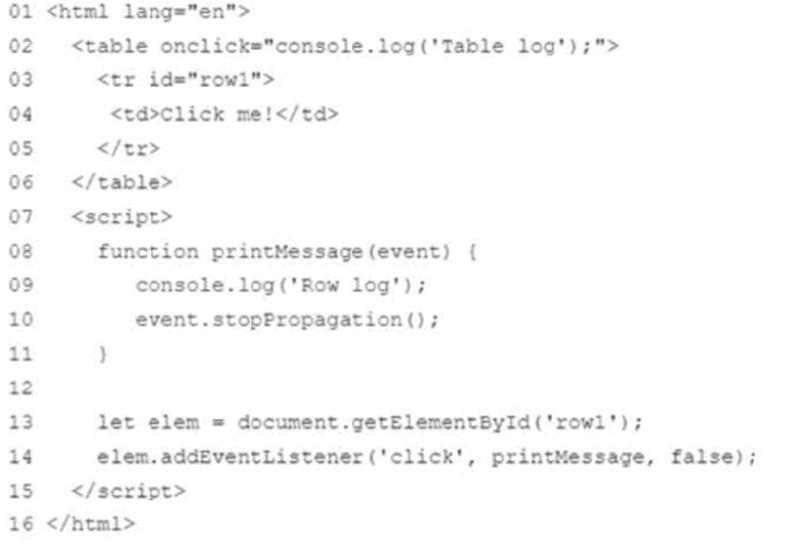
> Row log > Table log
A. Remove lines 13and 14
B. Change line 10 to event.stopPropagation (false) ;
C. Change line 14 to elem.addEventListener ('click', printMessage, true);
D. Remove line 10
Which three options show valid methods for creating a fat arrow function? Choose 3 answers
A. x => ( console.log(` executed ') ; )
B. [ ] => ( console.log(` executed ') ;)
C. ( ) => ( console.log(` executed ') ;)
D. X,y,z => ( console.log(` executed ') ;)
E. (x,y,z) => ( console.log(` executed ') ;)

Home | Contact Us | About Us | FAQ | Guarantee & Policy | Privacy & Policy | Terms & Conditions | How to buy
Copyright © 2026 pass4itsure.com. All Rights Reserved