 TESTED 13 Jul
HPE6-A84 Online Practice Questions and Answers
You are reviewing an endpoint entry in ClearPass Policy Manager (CPPM) Endpoints Repository.
What is a good sign that someone has been trying to gain unauthorized access to the network?
A. The entry shows multiple DHCP options under the fingerprints.
B. The entry shows an Unknown status.
C. The entry shows a profile conflict of having a new profile of Computer for a profiled Printer.
D. The entry lacks a hostname or includes a hostname with long seemingly random characters.
Refer to the scenario.
A customer requires these rights for clients in the "medical-mobile" AOS firewall role on Aruba Mobility Controllers (MCs):
1.
Permitted to receive IP addresses with DHCP
2.
Permitted access to DNS services from 10.8.9.7 and no other server
3.
Permitted access to all subnets in the 10.1.0.0/16 range except denied access to 10.1.12.0/22
4.
Denied access to other 10.0.0.0/8 subnets
5.
Permitted access to the Internet
6.
Denied access to the WLAN for a period of time if they send any SSH traffic
7.
Denied access to the WLAN for a period of time if they send any Telnet traffic
8.
Denied access to all high-risk websites
External devices should not be permitted to initiate sessions with "medical-mobile" clients, only send return traffic.
The exhibits below show the configuration for the role.
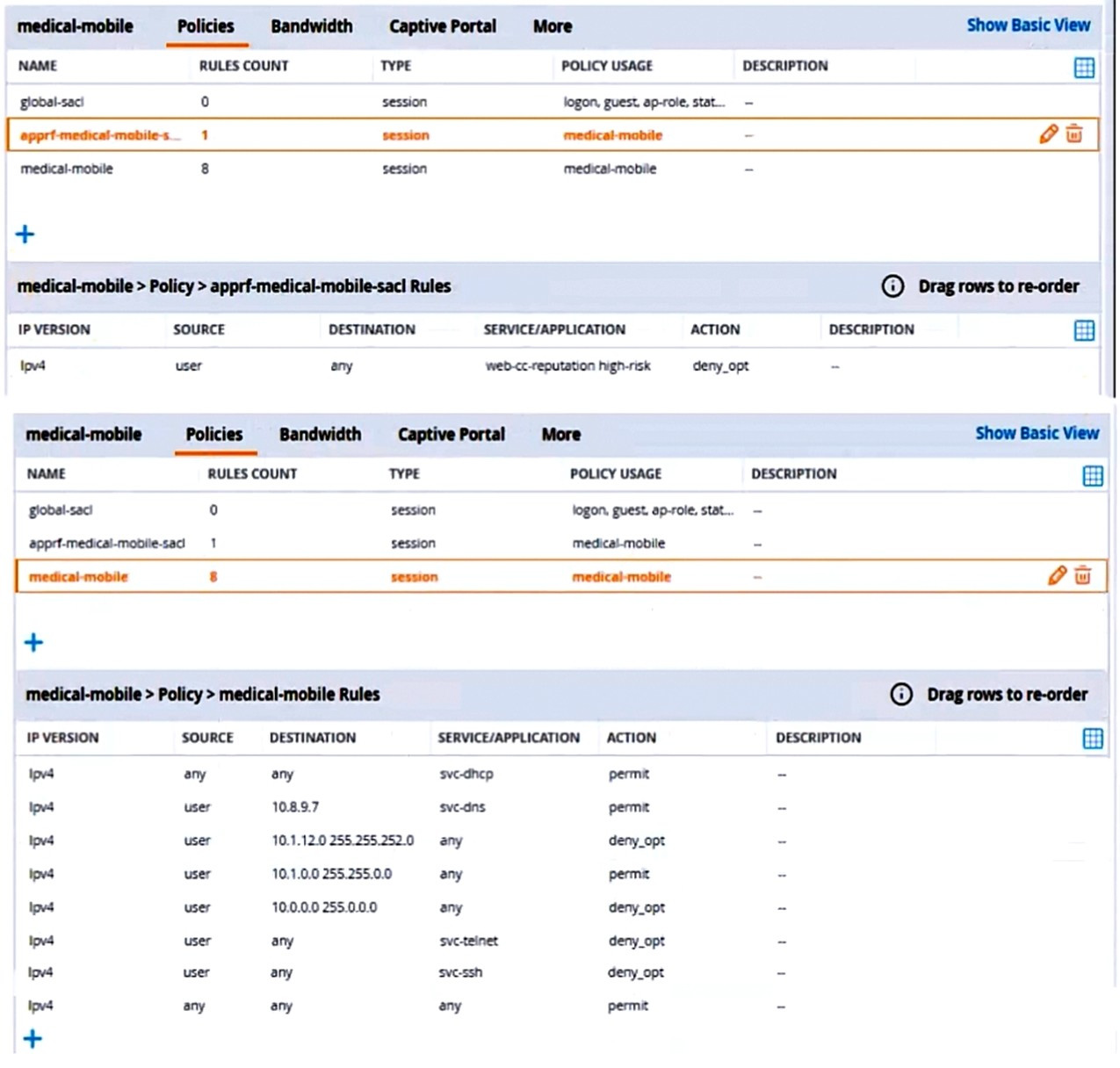
There are multiple issues with this configuration. What is one change you must make to meet the scenario requirements? (In the options, rules in a policy are referenced from top to bottom. For example, "medical-mobile" rule 1 is "ipv4 any any svc-dhcp permit," and rule 8 is "ipv4 any any any permit".)
A. In the "medical-mobile" policy, move rules 2 and 3 between rules 7 and 8.
B. In the "medical-mobile" policy, change the subnet mask in rule 3 to 255.255.248.0.
C. Move the rule in the "apprf-medical-mobile-sacl" policy between rules 7 and 8 in the "medical-mobile" policy.
D. In the "medical-mobile" policy, change the source in rule 8 to "user."
Refer to the scenario.
A customer has an Aruba ClearPass cluster. The customer has AOS-CX switches that implement 802.1X authentication to ClearPass Policy Manager (CPPM).
Switches are using local port-access policies.
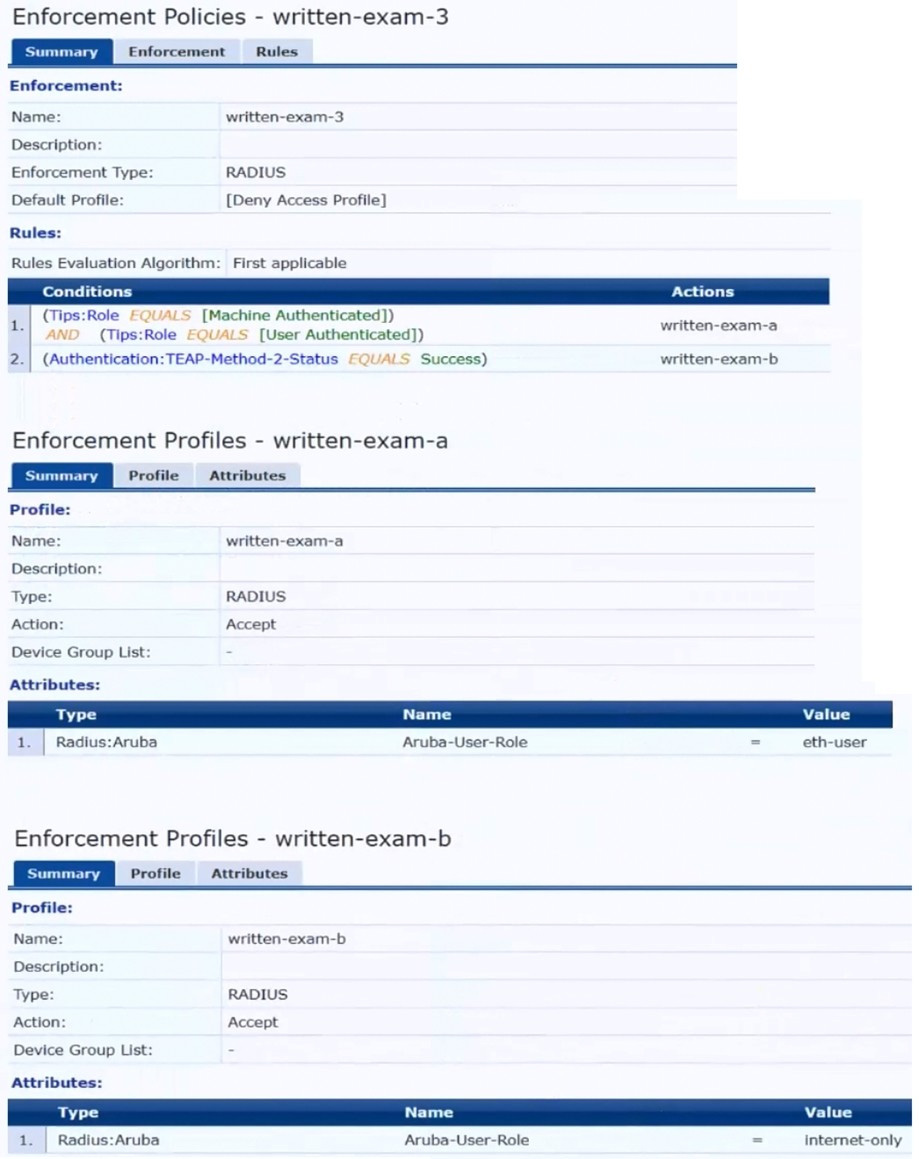
The customer wants to start tunneling wired clients that pass user authentication only to an Aruba gateway cluster. The gateway cluster should assign these clients to the "eth- internet" role. The gateway should also handle assigning clients
to their VLAN, which is VLAN 20.
The plan for the enforcement policy and profiles is shown below:
The gateway cluster has two gateways with these IP addresses:
Gateway 1
1.
VLAN 4085 (system IP) = 10.20.4.21
2.
VLAN 20 (users) = 10.20.20.1
3.
VLAN 4094 (WAN) = 198.51.100.14
Gateway 2
1.
VLAN 4085 (system IP) = 10.20.4.22
2.
VLAN 20 (users) = 10.20.20.2
3.
VLAN 4094 (WAN) = 198.51.100.12
VRRP on VLAN 20 = 10.20.20.254
The customer requires high availability for the tunnels between the switches and the gateway cluster. If one gateway falls, the other gateway should take over its tunnels. Also, the switch should be able to discover the gateway cluster regardless of whether one of the gateways is in the cluster.
Assume that you are using the "myzone" name for the UBT zone.
Which is a valid minimal configuration for the AOS-CX port-access roles?
A. port-access role eth-internet gateway-zone zone myzone gateway-role eth-user
B. port-access role internet-only gateway-zone zone myzone gateway-role eth-internet
C. port-access role eth-internet gateway-zone zone myzone gateway-role eth-internet vlan access 20
D. port-access role internet-only gateway-zone zone myzone gateway-role eth-internet vlan access 20
What is a common characteristic of a beacon between a compromised device and a command and control server?
A. Use of IPv6 addressing instead of IPv4 addressing
B. Lack of encryption
C. Use of less common protocols such as SNAP
D. Periodic transmission of small, identically sized packets
Refer to the exhibit.
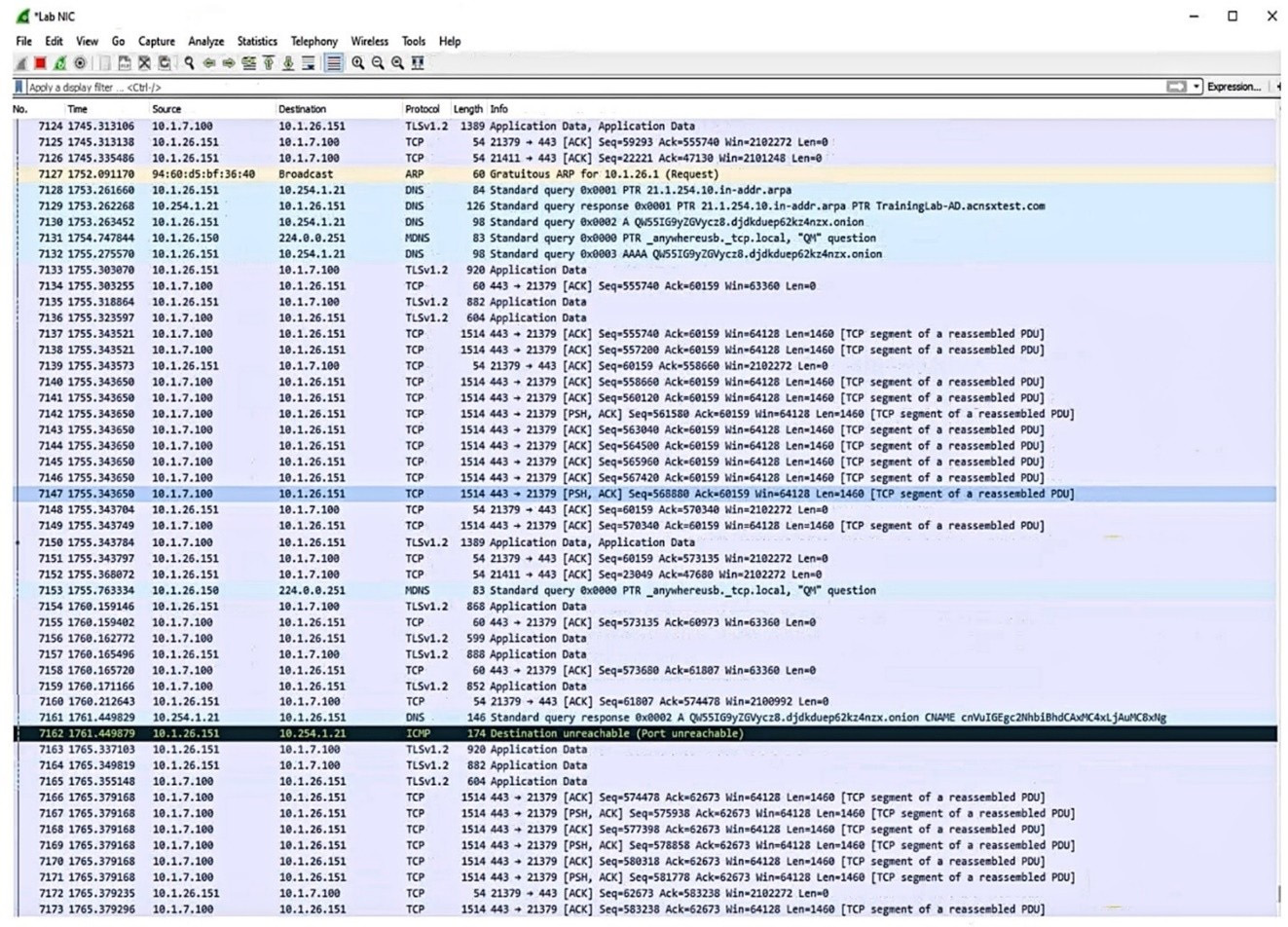
Which security issue is possibly indicated by this traffic capture?
A. An attempt at a DoS attack by a device acting as an unauthorized DNS server
B. A port scan being run on the 10.1.7.0/24 subnet
C. A command and control channel established with DNS tunneling
D. An ARP poisoning or man-in-the-middle attempt by the device at 94:60:d5:bf:36:40
You are configuring gateway IDS/IPS settings in Aruba Central.
For which reason would you set the Fail Strategy to Bypass?
A. To permit traffic if the IPS engine falls to inspect It
B. To enable the gateway to honor the allowlist settings configured in IDS/IPS policies
C. To tell gateways to stop enforcing IDS/IPS policies if they lose connectivity to the Internet
D. To avoid wasting IPS engine resources on filtering traffic for unauthenticated clients
Refer to the scenario.
# Introduction to the customer
You are helping a company add Aruba ClearPass to their network, which uses Aruba network infrastructure devices.
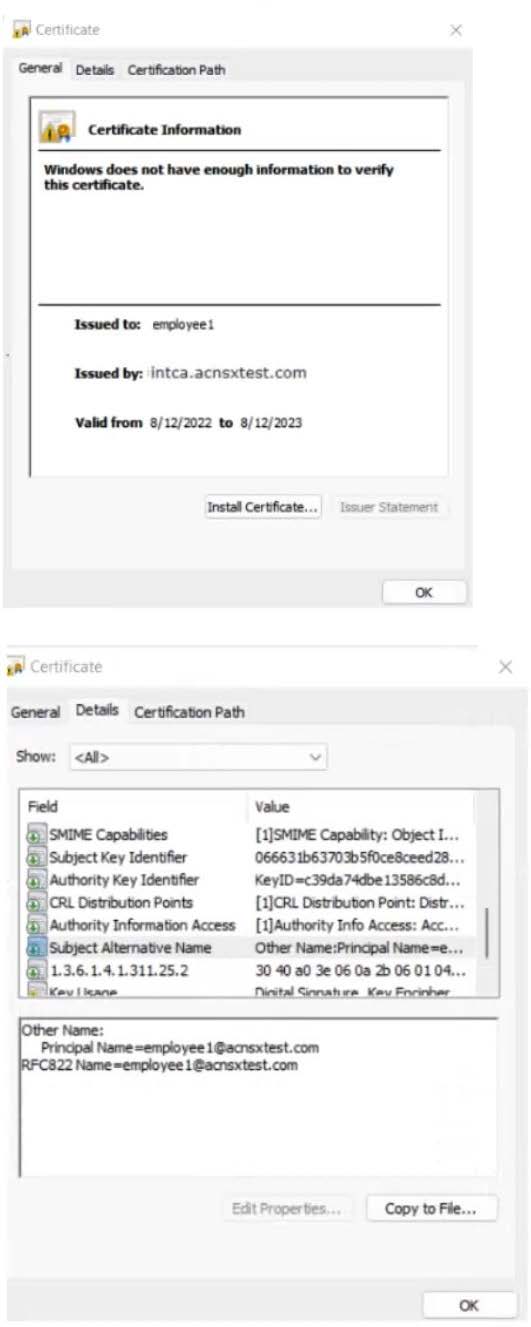
The company currently has a Windows domain and Windows CA. The Window CA issues certificates to domain computers, domain users, and servers such as domain controllers. An example of a certificate issued by the Windows CA is
shown here.
The company is in the process of adding Microsoft Endpoint Manager (Intune) to manage its mobile clients. The customer is maintaining the on-prem AD for now and uses Azure AD Connect to sync with Azure AD.
# Requirements for issuing certificates to mobile clients
The company wants to use ClearPass Onboard to deploy certificates automatically to mobile clients enrolled in Intune. During this process, Onboard should communicate with Azure AD to validate the clients. High availability should also be
provided for this scenario; in other words, clients should be able to get certificates from Subscriber 2 if Subscriber 1 is down.
The Intune admins intend to create certificate profiles that include a UPN SAN with the UPN of the user who enrolled the device.
# Requirements for authenticating clients
The customer requires all types of clients to connect and authenticate on the same corporate SSID.
The company wants CPPM to use these authentication methods:
1.
EAP-TLS to authenticate users on mobile clients registered in Intune
2.
TEAR, with EAP-TLS as the inner method to authenticate Windows domain computers and the users on them To succeed, EAP-TLS (standalone or as a TEAP method) clients must meet these requirements:
1.
Their certificate is valid and is not revoked, as validated by OCSP
2.
The client's username matches an account in AD # Requirements for assigning clients to roles After authentication, the customer wants the CPPM to assign clients to ClearPass roles based on the following rules:
1.
Clients with certificates issued by Onboard are assigned the "mobile-onboarded" role
2.
Clients that have passed TEAP Method 1 are assigned the "domain-computer" role
3.
Clients in the AD group "Medical" are assigned the "medical-staff" role
4.
Clients in the AD group "Reception" are assigned to the "reception-staff" role The customer requires CPPM to assign authenticated clients to AOS firewall roles as follows:
1.
Assign medical staff on mobile-onboarded clients to the "medical-mobile" firewall role
2.
Assign other mobile-onboarded clients to the "mobile-other" firewall role
3.
Assign medical staff on domain computers to the "medical-domain" firewall role
4.
All reception staff on domain computers to the "reception-domain" firewall role
5.
All domain computers with no valid user logged in to the "computer-only" firewall role
6.
Deny other clients access # Other requirements Communications between ClearPass servers and on-prem AD domain controllers must be encrypted. # Network topology For the network infrastructure, this customer has Aruba APs and Aruba gateways, which are managed by Central. APs use tunneled WLANs, which tunnel traffic to the gateway cluster. The customer also has AOS-CX switches that are not
managed by Central at this point.
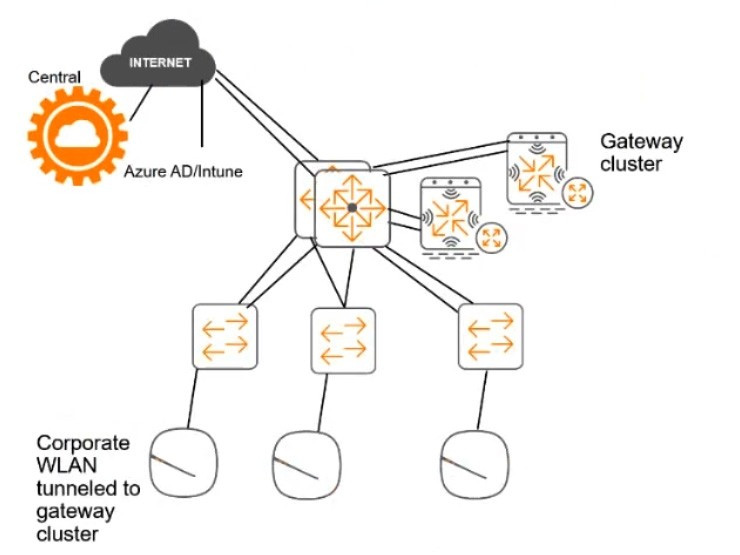
# ClearPass cluster IP addressing and hostnames
A customer's ClearPass cluster has these IP addresses:
1.
Publisher = 10.47.47.5
2.
Subscriber 1 = 10.47.47.6
3.
Subscriber 2 = 10.47.47.7
4.
Virtual IP with Subscriber 1 and Subscriber 2 = 10.47.47.8
The customer's DNS server has these entries
1.
cp.acnsxtest.com = 10.47.47.5
2.
cps1.acnsxtest.com = 10.47.47.6
3.
cps2.acnsxtest.com = 10.47.47.7
4.
radius.acnsxtest.com = 10.47.47.8
5.
onboard.acnsxtest.com = 10.47.47.8
On CPPM, you are creating the authentication method shown in the exhibit below:
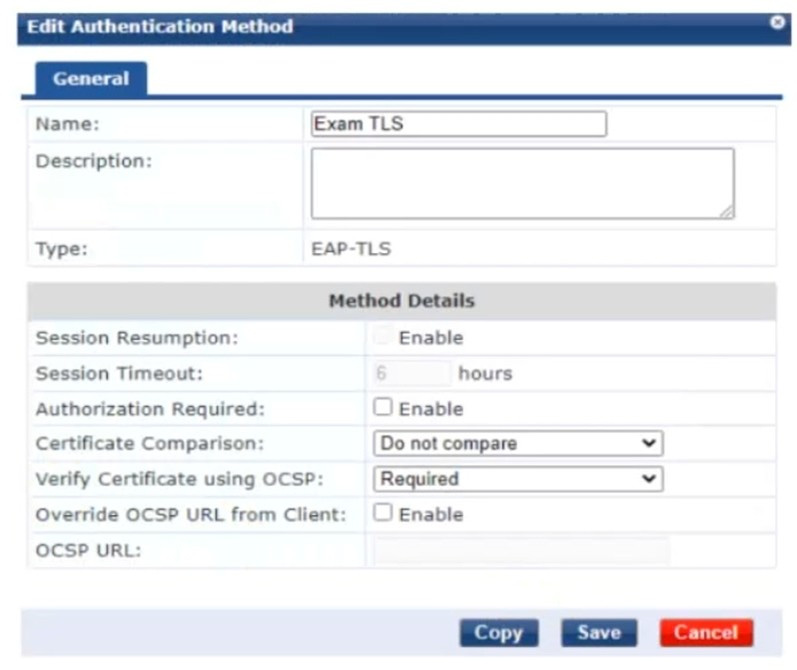
You will use the method for standalone EAP-TLS and for inner methods in TEAP. What should you do?
A. Configure OCSP override and set the OCSP URL to localhost/onboard/mdps ocspphp/2
B. Enable certificate comparison.
C. Enable authorization.
D. Configure OCSP override and leave the OCSP URL blank.
Refer to the scenario.
A customer has an AOS10 architecture that is managed by Aruba Central. Aruba infrastructure devices authenticate clients to an Aruba ClearPass cluster.
In Aruba Central, you are examining network traffic flows on a wireless IoT device that is categorized as "Raspberry Pi" clients. You see SSH traffic. You then check several more wireless IoT clients and see that they are sending SSH also.
You want a relatively easy way to communicate the information that an IoT client has used SSH to Aruba CPPM.
What is one prerequisite?
A. Enable event processing on subscribers in the ClearPass cluster.
B. In CPPM's CA trust list, add the Aruba Infrastructure usage to the DigiCert certificate.
C. Obtain a data collector token from Central's platform integration settings.
D. Create an API application and token within the REST API settings.
A customer has an AOS 10-based mobility solution, which authenticates clients to Aruba ClearPass Policy Manager (CPPM). The customer has some wireless devices that support WPA2 in personal mode only.
How can you meet these devices' needs but improve security?
A. Use MPSK on the WLAN to which the devices connect.
B. Configure WIDS policies that apply extra monitoring to these particular devices.
C. Connect these devices to the same WLAN to which 802.1X-capable clients connect, using MAC-Auth fallback.
D. Enable dynamic authorization (RFC 3576) in the AAA profile for the devices.
Refer to the scenario.
A customer has an Aruba ClearPass cluster. The customer has AOS-CX switches that implement 802.1X authentication to ClearPass Policy Manager (CPPM).
Switches are using local port-access policies.
The customer wants to start tunneling wired clients that pass user authentication only to an Aruba gateway cluster. The gateway cluster should assign these clients to the "eth- internet" role. The gateway should also handle assigning clients to their VLAN, which is VLAN 20.
The plan for the enforcement policy and profiles is shown below: The gateway cluster has two gateways with these IP addresses:
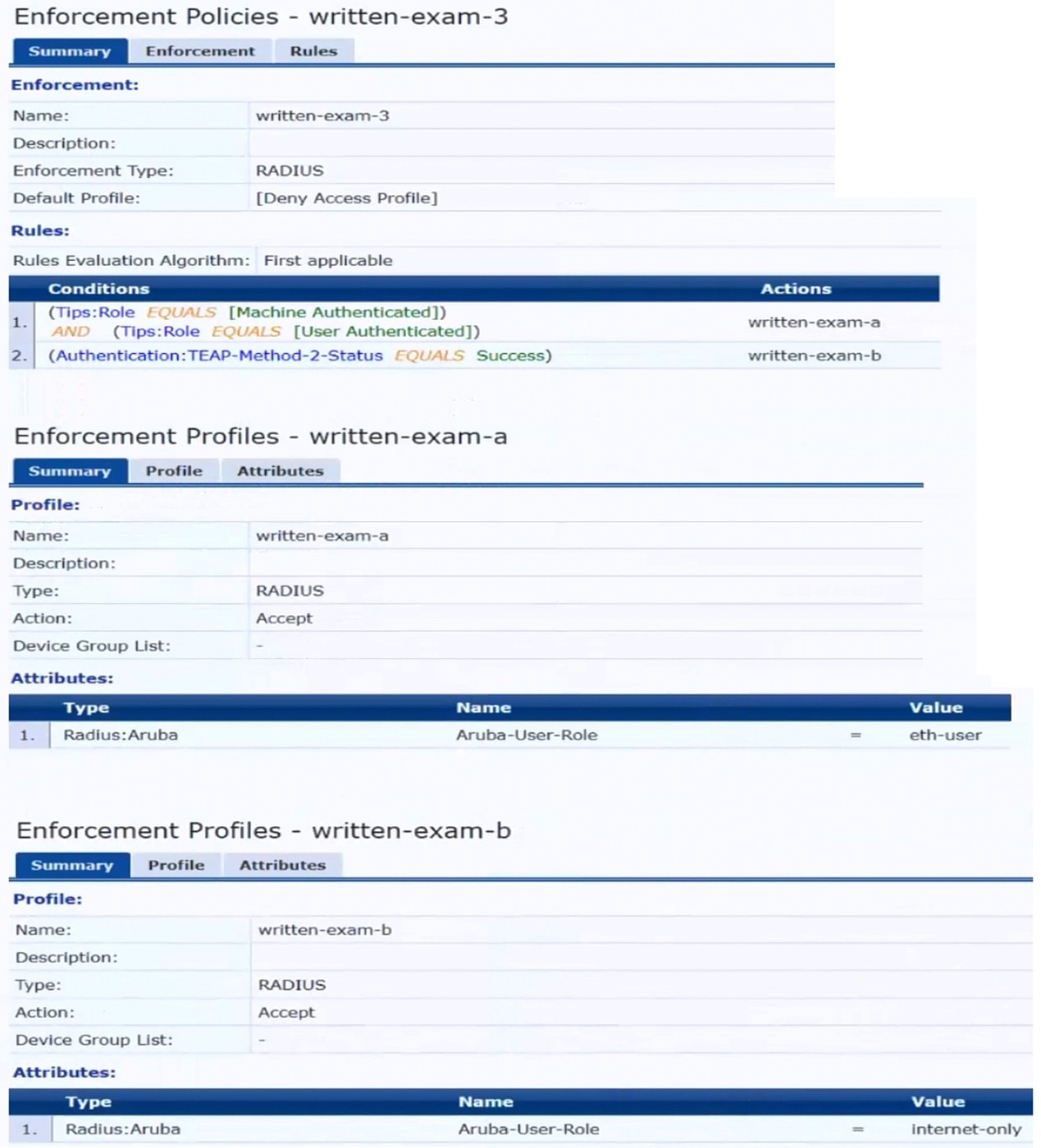
Gateway 1
1.
VLAN 4085 (system IP) = 10.20.4.21
2.
VLAN 20 (users) = 10.20.20.1
3.
VLAN 4094 (WAN) = 198.51.100.14
Gateway 2
1.
VLAN 4085 (system IP) = 10.20.4.22
2.
VLAN 20 (users) = 10.20.20.2
3.
VLAN 4094 (WAN) = 198.51.100.12
VRRP on VLAN 20 = 10.20.20.254
The customer requires high availability for the tunnels between the switches and the gateway cluster. If one gateway falls, the other gateway should take over its tunnels. Also, the switch should be able to discover the gateway cluster regardless of whether one of the gateways is in the cluster.
You are setting up the UBT zone on an AOS-CX switch.
Which IP addresses should you define in the zone?
A. Primary controller = 10.20.4.21; backup controller = 10.20.4.22
B. [Primary controller = 198.51.100.14; backup controller = 10.20.4.21
C. Primary controller = 10 20 4 21: backup controller not defined
D. Primary controller = 10.20.20.254; backup controller, not defined

Home | Contact Us | About Us | FAQ | Guarantee & Policy | Privacy & Policy | Terms & Conditions | How to buy
Copyright © 2026 pass4itsure.com. All Rights Reserved