 TESTED 20 Jul
HPE6-A67 Online Practice Questions and Answers
How can Enforcement Policy rules be evaluated? (Choose two.)
A. It is checked top down, as configured in the rules tab.
B. All rules are checked, and all matches are used.
C. If no rules match, the request is rejected.
D. It is checked bottom up, as configured in the rules tab.
E. All rules are checked, and the best match is used.
What is the primary use of the ClearPass Onboard Application?
A. Connect company-issued devices.
B. Configure network profiles for BYOD Devices.
C. Enforce endpoint device profiling.
D. Provide for system validation of client posture.
ClearPass Onboard can be configured for which three types of security? (Choose three.)
A. SSL-VPN
B. EAP-RADIUS
C. EAP-TLS
D. EAP-PEAP
E. Personal PSK
A guest user connects to an Open Guest SSID on a wireless network and is redirected to a web login page
on ClearPass.
How is the authentication performed?
A. The controller will capture the credentials as they are passed to ClearPass by the Web Login page.
B. ClearPass instructs the wireless controller to fetch the credentials from the Web Login Page.
C. The User submits the credentials, and ClearPass instructs the browser to post the credentials to the wireless controller.
D. When the user submits the credentials, ClearPass will capture the credentials and post them to the wireless controller.
Refer to the exhibit.
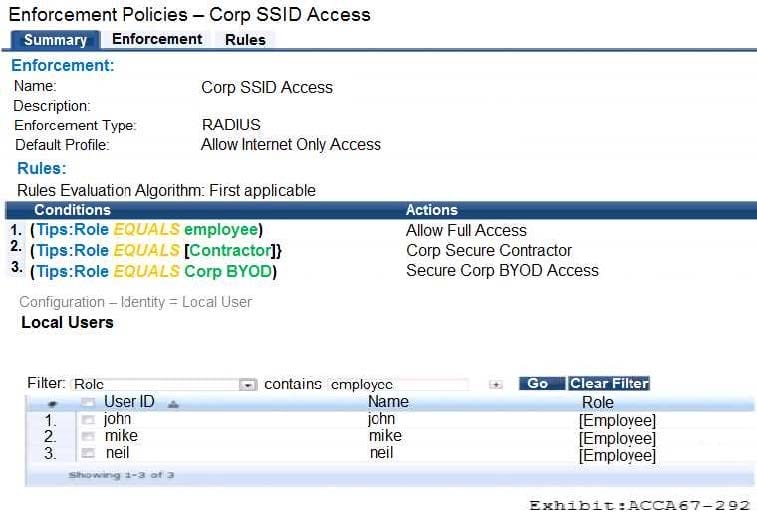
What will be the enforcement for the user "neil"?
A. Allow Internet Only Access
B. Allow Full Access
C. Corp Secure Contractor
D. Secure Corp BYOD Access
A ClearPass deployment needs to be designed to determine whether a user authenticating is an HR department employee in the Active Directory Server and whether the user's device is healthy. Which policy service components will the network administrator need to use?
A. Posture, Authentication and Authorization
B. Posture and Firewall Roles
C. Posture and Onboard
D. Authentication andAuthorization
E. Posture, Authentication and Onboarding
What is Radius CoA used for?
A. to validate a host MAC against a white and a black list
B. to force the client to re-authenticate upon roaming to a new controller
C. to authenticate users or devices before granting them access to a network
D. to transmit messages to the NAD/NAS to modify a user's session status
E. to apply firewall policies based on authentication credentials
Based on the self-registration customization, what is the expected outcome?
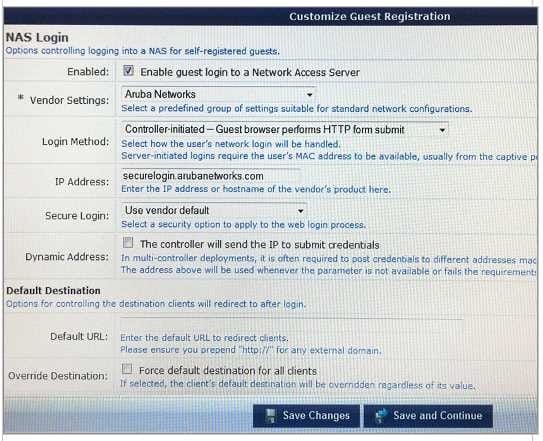
A. When the user connects to an ArubaNAD device, the user will be redirected to this self- registration page.
B. When the user completes the self-registration form, a NAS login request will be sent from the client to ClearPass alternate domain at securelogin.arubanetworks.com.
C. When the userbrowses to securelogin.arubanetworks.com, the user will be redirected to the self-registration page.
D. User credentials will be sent to the NAD device when the user clicks the login button on the self-registration receipt page.
E. When the user clicks the register button on the self-registration page, user credentials will be sent to the NAD.
A customer wants to use the OS information of devices in the Enforcement policy. Which source should be added as an authorization source?
A. OnGuard Repository
B. Guest User Repository
C. Local User Repository
D. Endpoints Repository
E. Active Directory
Which ClearPass feature is used for endpoint compliance and client health status?
A. Posture
B. Onboard
C. Profiling
D. Captive Portal
E. RADIUS COA

Home | Contact Us | About Us | FAQ | Guarantee & Policy | Privacy & Policy | Terms & Conditions | How to buy
Copyright © 2026 pass4itsure.com. All Rights Reserved