 TESTED 25 Jul
DP-203 Online Practice Questions and Answers
HOTSPOT
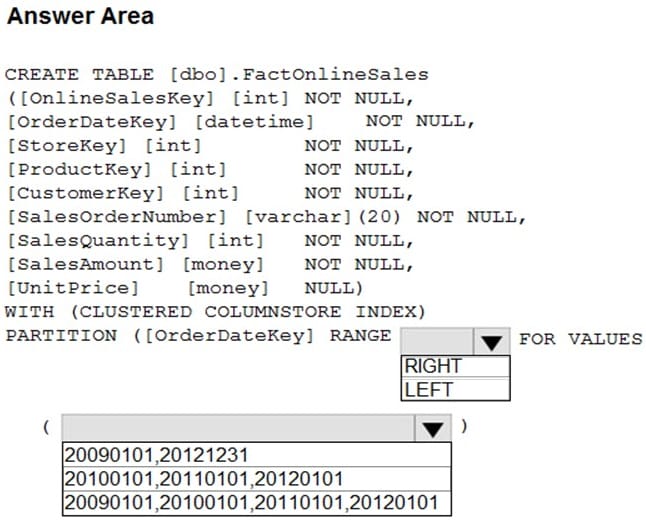
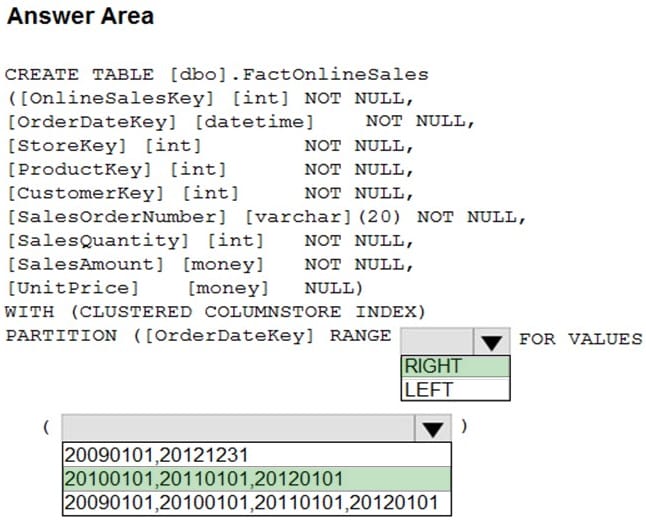
You have an enterprise data warehouse in Azure Synapse Analytics that contains a table named FactOnlineSales. The table contains data from the start of 2009 to the end of 2012.
You need to improve the performance of queries against FactOnlineSales by using table partitions. The solution must meet the following requirements:
1.
Create four partitions based on the order date.
2.
Ensure that each partition contains all the orders places during a given calendar year.
How should you complete the T-SQL command? To answer, select the appropriate options in the answer area.
NOTE: Each correct selection is worth one point.
Hot Area:
HOTSPOT
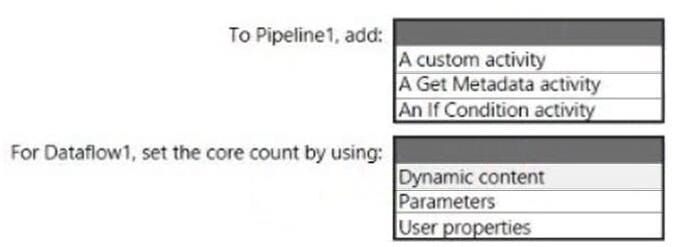
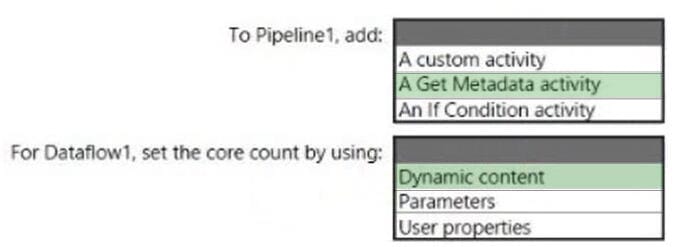
You have an Azure Synapse Analytics pipeline named Pipeline1 that contains a data flow activity named Dataflow1.
Pipeline1 retrieves files from an Azure Data Lake Storage Gen 2 account named storage1.
Dataflow1 uses the AutoResolveIntegrationRuntime integration runtime configured with a core count of 128. You need to optimize the number of cores used by Dataflow1 to accommodate the size of the files in storage1. What should you configure? To answer, select the appropriate options in the answer area.
Hot Area:
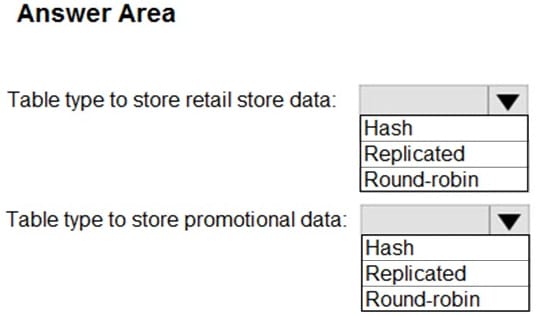
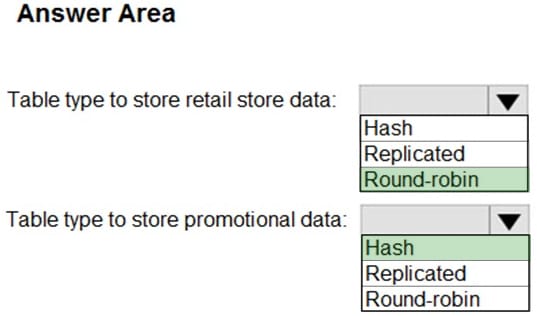
HOTSPOT
You need to design an analytical storage solution for the transactional data. The solution must meet the sales transaction dataset requirements.
What should you include in the solution? To answer, select the appropriate options in the answer area.
NOTE: Each correct selection is worth one point.
Hot Area:
You plan to create an Azure Databricks workspace that has a tiered structure. The workspace will contain the following three workloads:
1.
A workload for data engineers who will use Python and SQL.
2.
A workload for jobs that will run notebooks that use Python, Scala, and SOL.
3.
A workload that data scientists will use to perform ad hoc analysis in Scala and R.
The enterprise architecture team at your company identifies the following standards for Databricks environments:
1.
The data engineers must share a cluster.
2.
The job cluster will be managed by using a request process whereby data scientists and data engineers provide packaged notebooks for deployment to the cluster.
3.
All the data scientists must be assigned their own cluster that terminates automatically after 120 minutes of inactivity. Currently, there are three data scientists.
You need to create the Databricks clusters for the workloads.
Solution: You create a Standard cluster for each data scientist, a High Concurrency cluster for the data engineers, and a High Concurrency cluster for the jobs.
Does this meet the goal?
A. Yes
B. No
You are designing an Azure Databricks interactive cluster. The cluster will be used infrequently and will be configured for auto-termination. You need to use that the cluster configuration is retained indefinitely after the cluster is terminated. The solution must minimize costs. What should you do?
A. Pin the cluster.
B. Create an Azure runbook that starts the cluster every 90 days.
C. Terminate the cluster manually when processing completes.
D. Clone the cluster after it is terminated.
After you answer a question in this section, you will NOT be able to return to it. As a result, these questions will not appear in the review screen.
You are designing an Azure Stream Analytics solution that will analyze Twitter data.
You need to count the tweets in each 10-second window. The solution must ensure that each tweet is counted only once.
Solution: You use a hopping window that uses a hop size of 10 seconds and a window size of 10 seconds.
Does this meet the goal?
A. Yes
B. No
You have an enterprise data warehouse in Azure Synapse Analytics named DW1 on a server named Server1. You need to verify whether the size of the transaction log file for each distribution of DW1 is smaller than 160 GB. What should you do?
A. On the master database, execute a query against the sys.dm_pdw_nodes_os_performance_counters dynamic management view.
B. From Azure Monitor in the Azure portal, execute a query against the logs of DW1.
C. On DW1, execute a query against the sys.database_files dynamic management view.
D. Execute a query against the logs of DW1 by using the Get-AzOperationalInsightSearchResult PowerShell cmdlet.
You are designing a financial transactions table in an Azure Synapse Analytics dedicated SQL pool. The table will have a clustered columnstore index and will include the following columns:
1.
TransactionType: 40 million rows per transaction type
2.
CustomerSegment: 4 million per customer segment
3.
TransactionMonth: 65 million rows per month
4.
AccountType: 500 million per account type
You have the following query requirements:
1.
Analysts will most commonly analyze transactions for a given month.
2.
Transactions analysis will typically summarize transactions by transaction type, customer segment, and/or account type
You need to recommend a partition strategy for the table to minimize query times.
On which column should you recommend partitioning the table?
A. CustomerSegment
B. AccountType
C. TransactionType
D. TransactionMonth
After you answer a question in this section, you will NOT be able to return to it. As a result, these questions will not appear in the review screen.
You have an Azure Data Lake Storage account that contains a staging zone.
You need to design a daily process to ingest incremental data from the staging zone, transform the data by executing an R script, and then insert the transformed data into a data warehouse in Azure Synapse Analytics.
Solution: You use an Azure Data Factory schedule trigger to execute a pipeline that copies the data to a staging table in the data warehouse, and then uses a stored procedure to execute the R script.
Does this meet the goal?
A. Yes
B. No
You have an Azure Synapse Analytics dedicated SQL pool named Pool1. Pool1 contains a fact table named Table1.
You need to identify the extent of the data skew in Table1.
What should you do in Synapse Studio?
A. Connect to the built-in pool and query sys.dm_pdw_nodes_db_partition_stats.
B. Connect to Pool1 and run DBCC PDW_SHOWSPACEUSED.
C. Connect to Pool1 and query sys.dm_pdw_node_status.
D. Connect to the built-in pool and query sys.dm_pdw_sys_info.

Home | Contact Us | About Us | FAQ | Guarantee & Policy | Privacy & Policy | Terms & Conditions | How to buy
Copyright © 2026 pass4itsure.com. All Rights Reserved