 TESTED 22 Jul
DOP-C02 Online Practice Questions and Answers
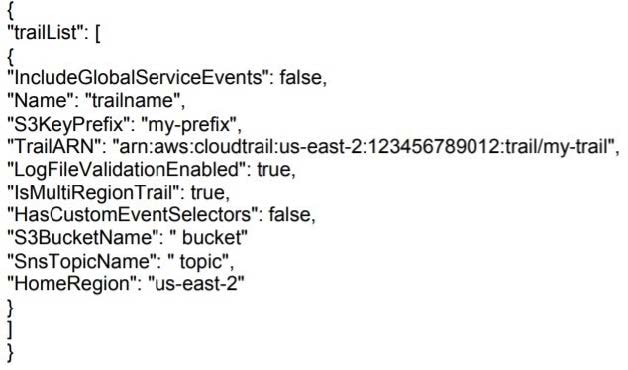
Using the AWS CLI, which command retrieves CloudTrail trail settings, including the status of the trail itself?
A. aws cloudtrail return-trails
B. aws cloudtrail validate-settings
C. aws cloudtrail get-settings
D. aws cloudtrail describe-trails
A DevOps engineer at a company is supporting an AWS environment in which all users use AWS IAM Identity Center (AWS Single Sign-On). The company wants to immediately disable credentials of any new IAM user and wants the security team to receive a notification.
Which combination of steps should the DevOps engineer take to meet these requirements? (Choose three.)
A. Create an Amazon EventBridge rule that reacts to an IAM CreateUser API call in AWS CloudTrail.
B. Create an Amazon EventBridge rule that reacts to an IAM GetLoginProfile API call in AWS CloudTrail.
C. Create an AWS Lambda function that is a target of the EventBridge rule. Configure the Lambda function to disable any access keys and delete the login profiles that are associated with the IAM user.
D. Create an AWS Lambda function that is a target of the EventBridge rule. Configure the Lambda function to delete the login profiles that are associated with the IAM user.
E. Create an Amazon Simple Notification Service (Amazon SNS) topic that is a target of the EventBridge rule. Subscribe the security team's group email address to the topic.
F. Create an Amazon Simple Queue Service (Amazon SQS) queue that is a target of the Lambda function. Subscribe the security team's group email address to the queue
An ecommerce company is receiving reports that its order history page is experiencing delays in reflecting the processing status of orders. The order processing system consists of an AWS Lambda function that uses reserved concurrency. The Lambda function processes order messages from an Amazon Simple Queue Service (Amazon SQS) queue and inserts processed orders into an Amazon DynamoDB table. The DynamoDB table has auto scaling enabled for read and write capacity.
Which actions should a DevOps engineer take to resolve this delay? (Choose two.)
A. Check the ApproximateAgeOfOldestMessage metric for the SQS queue. Increase the Lambda function concurrency limit.
B. Check the ApproximateAgeOfOldestMessage metnc for the SQS queue Configure a redrive policy on the SQS queue.
C. Check the NumberOfMessagesSent metric for the SQS queue. Increase the SQS queue visibility timeout.
D. Check the WriteThrottleEvents metric for the DynamoDB table. Increase the maximum write capacity units (WCUs) for the table's scaling policy.
E. Check the Throttles metric for the Lambda function. Increase the Lambda function timeout.
A company has a data ingestion application that runs across multiple AWS accounts. The accounts are in an organization in AWS Organizations. The company needs to monitor the application and consolidate access to the application. Currently the company is running the application on Amazon EC2 instances from several Auto Scaling groups. The EC2 instances have no access to the internet because the data is sensitive Engineers have deployed the necessary VPC endpoints. The EC2 instances run a custom AMI that is built specifically tor the application.
To maintain and troubleshoot the application, system administrators need the ability to log in to the EC2 instances. This access must be automated and controlled centrally. The company's security team must receive a notification whenever the instances are accessed.
Which solution will meet these requirements?
A. Create an Amazon EventBridge rule to send notifications to the security team whenever a user logs in to an EC2 instance Use EC2 Instance Connect to log in to the instances. Deploy Auto Scaling groups by using AWS Cloud Formation Use the cfn-init helper script to deploy appropriate VPC routes for external access Rebuild the custom AMI so that the custom AMI includes AWS Systems Manager Agent.
B. Deploy a NAT gateway and a bastion host that has internet access Create a security group that allows incoming traffic on all the EC2 instances from the bastion host Install AWS Systems Manager Agent on all the EC2 instances Use Auto Scaling group lifecycle hooks for monitoring and auditing access Use Systems Manager Session Manager to log in to the instances Send logs to a log group m Amazon CloudWatch Logs. Export data to Amazon S3 for auditing Send notifications to the security team by using S3 event notifications.
C. Use EC2 Image Builder to rebuild the custom AMI Include the most recent version of AWS Systems Manager Agent in the Image Configure the Auto Scaling group to attach the AmazonSSMManagedinstanceCore role to all the EC2 instances Use Systems Manager Session Manager to log in to the instances Enable logging of session details to Amazon S3 Create an S3 event notification for new file uploads to send a message to the security team through an Amazon Simple Notification Service (Amazon SNS) topic.
D. Use AWS Systems Manager Automation to build Systems Manager Agent into the custom AMI Configure AWS Configure to attach an SCP to the root organization account to allow the EC2 instances to connect to Systems Manager Use Systems Manager Session Manager to log in to the instances Enable logging of session details to Amazon S3 Create an S3 event notification for new file uploads to send a message to the security team through an Amazon Simple Notification Service (Amazon SNS) topic.
A company has multiple member accounts that are part of an organization in AWS Organizations. The security team needs to review every Amazon EC2 security group and their inbound and outbound rules. The security team wants to programmatically retrieve this information from the member accounts using an AWS Lambda function in the management account of the organization.
Which combination of access changes will meet these requirements? (Choose three.)
A. Create a trust relationship that allows users in the member accounts to assume the management account IAM role.
B. Create a trust relationship that allows users in the management account to assume the IAM roles of the member accounts.
C. Create an IAM role in each member account that has access to the AmazonEC2ReadOnlyAccess managed policy.
D. Create an I AM role in each member account to allow the sts:AssumeRole action against the management account IAM role's ARN.
E. Create an I AM role in the management account that allows the sts:AssumeRole action against the member account IAM role's ARN.
F. Create an IAM role in the management account that has access to the AmazonEC2ReadOnlyAccess managed policy.
A company needs a strategy for failover and disaster recovery of its data and application. The application uses a MySQL database and Amazon EC2 instances. The company requires a maximum RPO of 2 hours and a maximum RTO of 10 minutes for its data and application at all times.
Which combination of deployment strategies will meet these requirements? (Select TWO.)
A. Create an Amazon Aurora Single-AZ cluster in multiple AWS Regions as the data store. Use Aurora's automatic recovery capabilities in the event of a disaster.
B. Create an Amazon Aurora global database in two AWS Regions as the data store. In the event of a failure, promote the secondary Region to the primary for the application. Update the application to use the Aurora cluster endpoint in the secondary Region.
C. Create an Amazon Aurora cluster in multiple AWS Regions as the data store. Use a Network Load Balancer to balance the database traffic in different Regions.
D. Set up the application in two AWS Regions. Use Amazon Route 53 failover routing that points to Application Load Balancers in both Regions. Use health checks and Auto Scaling groups in each Region.
E. Set up the application in two AWS Regions. Configure AWS Global Accelerator to point to Application Load Balancers (ALBs) in both Regions. Add both ALBs to a single endpoint group. Use health checks and Auto Scaling groups in each Region.
A large enterprise is deploying a web application on AWS. The application runs on Amazon EC2 instances behind an Application Load Balancer. The instances run in an Auto Scaling group across multiple Availability Zones. The application stores data in an Amazon RDS for Oracle DB instance and Amazon DynamoDB. There are separate environments tor development testing and production.
What is the MOST secure and flexible way to obtain password credentials during deployment?
A. Retrieve an access key from an AWS Systems Manager securestring parameter to access AWS services. Retrieve the database credentials from a Systems Manager SecureString parameter.
B. Launch the EC2 instances with an EC2 1AM role to access AWS services Retrieve the database credentials from AWS Secrets Manager.
C. Retrieve an access key from an AWS Systems Manager plaintext parameter to access AWS services. Retrieve the database credentials from a Systems Manager SecureString parameter.
D. Launch the EC2 instances with an EC2 1AM role to access AWS services Store the database passwords in an encrypted config file with the application artifacts.
A company is testing a web application that runs on Amazon EC2 instances behind an Application Load Balancer. The instances run in an Auto Scaling group across multiple Availability Zones. The company uses a blue green deployment process with immutable instances when deploying new software.
During testing users are being automatically logged out of the application at random times. Testers also report that when a new version of the application is deployed all users are logged out. The development team needs a solution to ensure users remain logged m across scaling events and application deployments.
What is the MOST operationally efficient way to ensure users remain logged in?
A. Enable smart sessions on the load balancer and modify the application to check tor an existing session.
B. Enable session sharing on the toad balancer and modify the application to read from the session store.
C. Store user session information in an Amazon S3 bucket and modify the application to read session information from the bucket.
D. Modify the application to store user session information in an Amazon ElastiCache cluster.
A DevOps team uses AWS CodePipeline, AWS CodeBuild, and AWS CodeDeploy to deploy an application. The application is a REST API that uses AWS Lambda functions and Amazon API Gateway Recent deployments have introduced errors that have affected many customers.
The DevOps team needs a solution that reverts to the most recent stable version of the application when an error is detected. The solution must affect the fewest customers possible.
Which solution Will meet these requirements With the MOST operational efficiency?
A. Set the deployment configuration in CodeDepIoy to LambdaAlIAtOnce Configure automatic rollbacks on the deployment group Create an Amazon CloudWatch alarm that detects HTTP Bad Gateway errors on API Gateway Configure the deployment group to roll back when the number of alarms meets the alarm threshold
B. Set the deployment configuration in CodeDeploy to LambdaCanary10Percent10Minutes. Configure automatic rollbacks on the deployment group Create an Amazon CloudWatch alarm that detects HTTP Bad Gateway errors on API Gateway Configure the deployment group to roll back when the number of alarms meets the alarm threshold
C. Set the deployment configuration in CodeDeploy to LambdaAllAtOnce Configure manual rollbacks on the deployment group. Create an Amazon Simple Notification Service (Amazon SNS) topc to send notifications every time a deployrnent fads. Configure the SNS topc to Invoke a new Lambda function that stops the current deployment and starts the most recent successful deployment
D. Set the deployment configuration in CodeDeploy to LambdaCanaryIOPercentIOMinutes Configure manual rollbacks on the deployment group Create a metric filter on an Amazon CloudWatch log group for API Gateway to monitor HTTP Bad Gateway errors. Configure the metric filter to Invoke a new Lambda function that stops the current eployment and starts the most recent successful deployment
A company has a mission-critical application on AWS that uses automatic scaling. The company wants the deployment lifecycle to meet the following parameters:
1.
The application must be deployed one instance at a time to ensure the remaining fleet continues to serve traffic.
2.
The application is CPU intensive and must be closely monitored.
3.
The deployment must automatically roll back if the CPU utilization of the deployment instance exceeds 85%.
Which solution will meet these requirements?
A. Use AWS CloudFormation to create an AWS Step Functions state machine and Auto Scaling lifecycle hooks to move to one instance at a time into a wait state. Use AWS Systems Manager automation to deploy the update to each instance and move it back into the Auto Scaling group using the heartbeat timeout.
B. Use AWS CodeDeploy with Amazon EC2 Auto Scaling Configure an alarm tied to the CPU utilization metric. Use the CodeDeployDefault OneAtAtime configuration as a deployment strategy. Configure automatic rollbacks within the deployment group to roll back the deployment if the alarm thresholds are breached.
C. Use AWS Elastic Beanstalk for load balancing and AWS Auto Scaling. Configure an alarm tied to the CPU utilization metric. Configure rolling deployments with a fixed batch size of one instance. Enable enhanced health to monitor the status of the deployment and roll back based on the alarm previously created.
D. Use AWS Systems Manager to perform a blue/green deployment with Amazon EC2 Auto Scaling. Configure an alarm tied to the CPU utilization metric. Deploy updates one at a time. Configure automatic rollbacks within the Auto Scaling group to roll back the deployment if the alarm thresholds are breached.

Home | Contact Us | About Us | FAQ | Guarantee & Policy | Privacy & Policy | Terms & Conditions | How to buy
Copyright © 2026 pass4itsure.com. All Rights Reserved