 TESTED 15 Jul
CAS-005 Online Practice Questions and Answers
SIMULATION
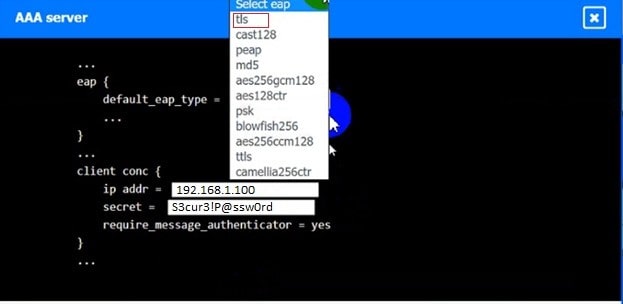
An IPSec solution is being deployed. The configuration files for both the VPN concentrator and the AAA server are shown in the diagram.
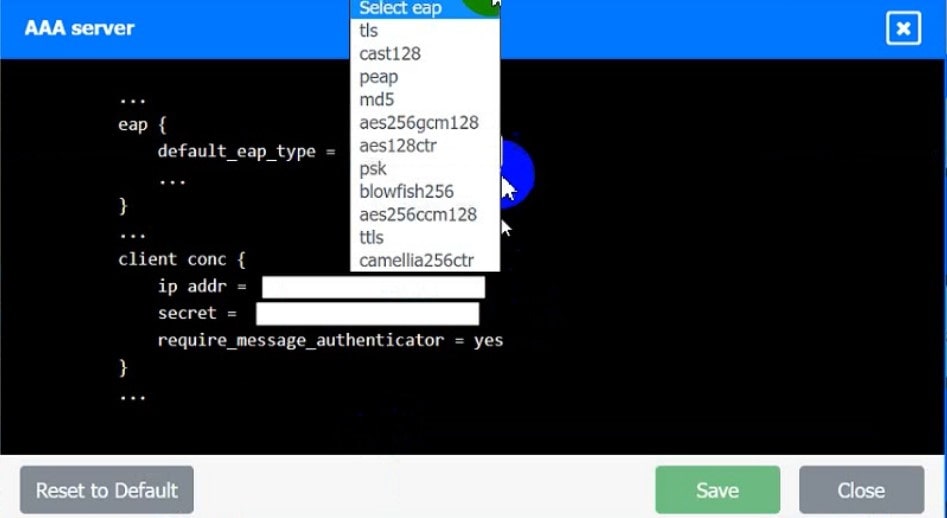
Complete the configuration files to meet the following requirements:
1.
The EAP method must use mutual certificate-based authentication (With issued client certificates).
2.
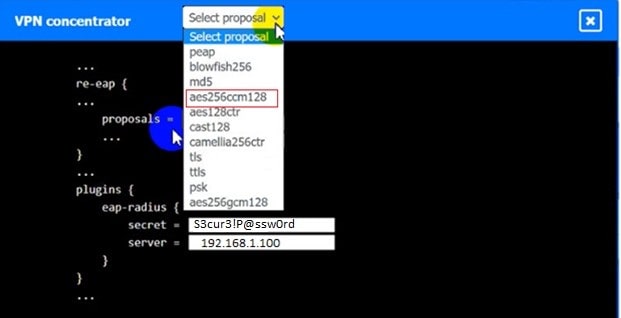
The IKEv2 Cipher suite must be configured to the MOST secure authenticated mode of operation,
3.
The secret must contain at least one uppercase character, one lowercase character, one numeric character, and one special character, and it must meet a minimum length requirement of eight characters,
INSTRUCTIONS
Click on the AAA server and VPN concentrator to complete the configuration.
Fill in the appropriate fields and make selections from the drop-down menus.
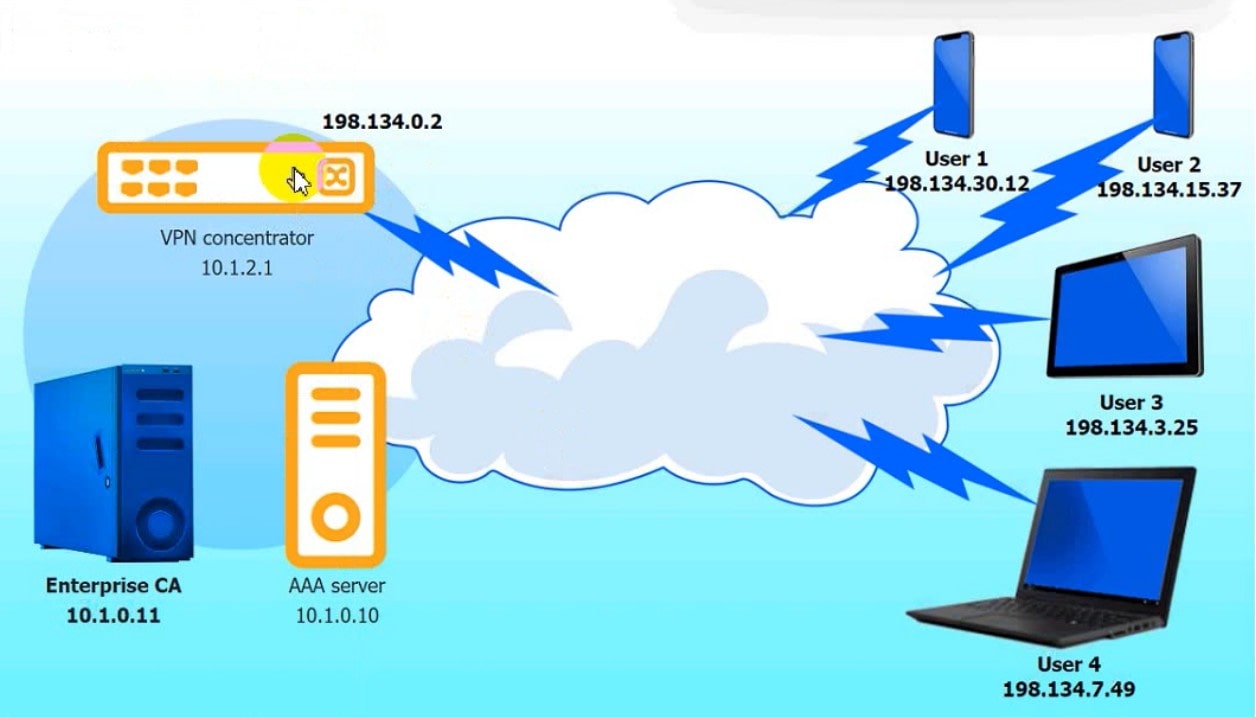
VPN Concentrator:
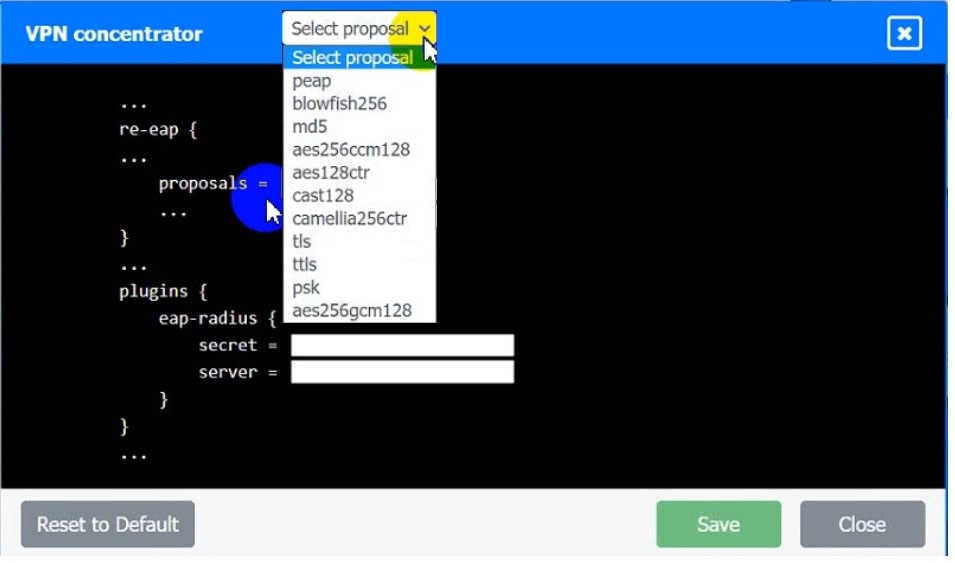
AAA Server:
A. See the complete solution below in Explanation.
B. PlaceHolder
C. PlaceHolder
D. PlaceHolder
A security professional is investigating a trend in vulnerability findings for newly deployed cloud systems Given the following output:
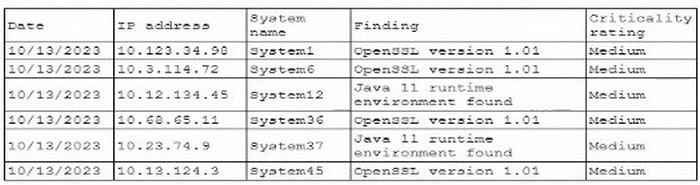
Which of the following actions would address the root cause of this issue?
A. Automating the patching system to update base Images
B. Recompiling the affected programs with the most current patches
C. Disabling unused/unneeded ports on all servers
D. Deploying a WAF with virtual patching upstream of the affected systems
A security review revealed that not all of the client proxy traffic is being captured. Which of the following architectural changes best enables the capture of traffic for analysis?
A. Adding an additional proxy server to each segmented VLAN
B. Setting up a reverse proxy for client logging at the gateway
C. Configuring a span port on the perimeter firewall to ingest logs
D. Enabling client device logging and system event auditing
A security analyst wants to use lessons learned from a poor incident response to reduce dwell lime in the future The analyst is using the following data points
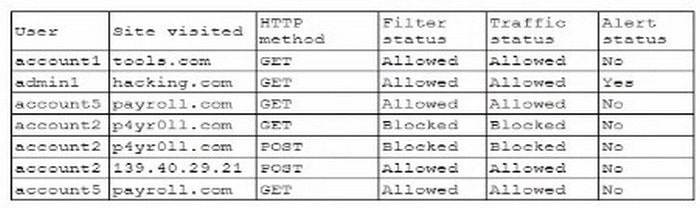
Which of the following would the analyst most likely recommend?
A. Adjusting the SIEM to alert on attempts to visit phishing sites
B. Allowing TRACE method traffic to enable better log correlation
C. Enabling alerting on all suspicious administrator behavior
D. utilizing allow lists on the WAF for all users using GFT methods
After an incident response exercise, a security administrator reviews the following table:
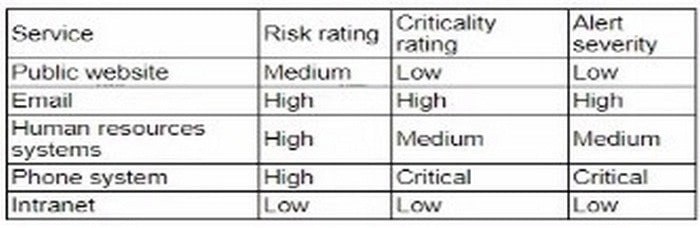
Which of the following should the administrator do to beat support rapid incident response in the future?
A. Automate alerting to IT support for phone system outages.
B. Enable dashboards for service status monitoring
C. Send emails for failed log-In attempts on the public website
D. Configure automated Isolation of human resources systems
A company uses a CSP to provide a front end for its new payment system offering. The new offering is currently certified as PCI compliant. In order for the integrated solution to be compliant, the customer:
A. must also be PCI compliant, because the risk is transferred to the provider.
B. still needs to perform its own PCI assessment of the provider's managed serverless service.
C. needs to perform a penetration test of the cloud provider's environment.
D. must ensure in-scope systems for the new offering are also PCI compliant.
An organization needs to disable TLS 1.0 on a retail website. Which of the following best explains the reason for this action?
A. Payment card industry compliance requires the change.
B. Digital certificates are dependent on a newer protocol.
C. Most browser manufacturers are ending legacy support.
D. The application software no longer supports TLS 1.0.
An incident response team completed recovery from offline backup for several workstations. The workstations were subjected to a ransomware attack after users fell victim to a spear-phishing campaign, despite a robust training program. Which of the following questions should be considered during the lessons-learned phase to most likely reduce the risk of reoccurrence? (Choose two.)
A. Are there opportunities for legal recourse against the originators of the spear-phishing campaign?
B. What internal and external stakeholders need to be notified of the breach?
C. Which methods can be implemented to increase speed of offline backup recovery?
D. What measurable user behaviors were exhibited that contributed to the compromise?
E. Which technical controls, if implemented, would provide defense when user training fails?
F. Which user roles are most often targeted by spear phishing attacks?
A commercial OSINT provider utilizes and reviews data from various sources of publicly available information. The provider is transitioning the subscription service to a model that limit's the scope of available data based on subscription tier. Which of the following approaches would best ensure subscribers are only granted access to data associated with their tier? (Choose two.)
A. Storing collected data on separate physical media per tier
B. Controlling access to data based on the role of users
C. Employing attribute-based access control
D. Implementing a behavior-based IDS positioned at the storage network gateway
E. Establishing a classification and labeling scheme
F. Implementing a mandatory access control scheme
A Chief Information Security Officer (CISO) received a call from the Chief Executive Officer (CEO) about a data breach from the SOC lead around 9:00 a.m. At 10:00 a.m. The CEO informs the CISO that a breach of the firm is being reported on national news. Upon investigation, it is determined that a network administrator has reached out to a vendor prior to the breach for information on a security patch that failed to be installed. Which of the following should the CISO do to
prevent this from happening again?
A. Properly triage events based on brand imaging and ensure the CEO is on the call roster.
B. Create an effective communication plan and socialize it with all employees.
C. Send out a press release denying the breach until more information can be obtained.
D. Implement a more robust vulnerability identification process.

Home | Contact Us | About Us | FAQ | Guarantee & Policy | Privacy & Policy | Terms & Conditions | How to buy
Copyright © 2026 pass4itsure.com. All Rights Reserved