 TESTED 13 Jul
C2090-614 Online Practice Questions and Answers
Which table configuration CANNOT utilize multi-temperature storage?
A. A range-partitioned table utilizing multiple table spaces that map to DMS containers.
B. Multiple tables containing the same data at different ages placed into the same table space.
C. Multiple tables containing the same data at different ages placed into separate table spaces.
D. A range-partitioned table utilizing multiple table spaces that map to individual storage groups.
What is the preferred method for reclaiming unused storage in a DMS table space?
A. Perform an ALTER TABLESPACE...REDUCE operation.
B. Perform a REORG on each table within the table space, then perform an ALTER TABLESPACE...REDUCE operation.
C. Perform an ALTER TABLESPACE...LOWER HIGH WATER MARK operation, and then an ALTER TABLESPACE...REDUCE operation.
D. Perform a REORG on each table within the table space, then perform an ALTER TABLESPACE...LOWER HIGH WATER MARK operation.
A storage group named HOT_SG was created as follows:
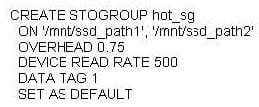
What does the DATA TAG 1 clause do?
A. It indicates that the multiple storage paths referenced in the HOT_SG storage group definition exist in one physical location.
B. It tells the DB2 Optimizer that database objects stored in the HOT_SG storage group are to be given preference over other objects when data access plans are generated.
C. It indicates that the value 1 is to be assigned to data stored in the HOT_SG storage group, which Workload Manager (WLM) can then use to determine the processing priority to assign to database activities that interact with this data.
D. It assigns a unique identifier to the instance of the HOT_SG storage group being defined; this identifier can then be used when moving table spaces to and from the storage group, when dropping the storage group, or when commenting on the storage group.
A DBA wants to create a table named SALES that has the following characteristics:
Data for the first half of the year will reside in table space TBSP1; the index for this data will reside in table space TBSP21.
Data for the second half of the year will reside in table space TBSP2; the index for this data will reside in table space TBSP22. Which clause must be used with the CREATE TABLE statement to define this table?
A. DISTRIBUTE BY HASH
B. PARTITION BY RANGE
C. ORGANIZE BY DIMENSIONS
D. ORGANIZE BY KEY SEQUENCE
Which Range-Clustered Tables (RCT) statement is correct?
A. Reverse scans on RCTs are not supported.
B. Clustering indexes are compatible with RCTs.
C. The Design Advisor can recommend the use of RCTs.
D. The IMPORT utility can be used with the REPLACE option to populate RCTs.
A DBA wants to create a table named SALES that has the following characteristics:
Effective data clustering and management of space utilization. Rows in the table should be clustered based on when they are added to the table. Which clause must be used with the CREATE TABLE statement to define this table?
A. ORGANIZE BY DIMENSIONS
B. ORGANIZE BY INSERT TIME
C. ORGANIZE BY TIME PERIOD
D. ORGANIZE BY KEY SEQUENCE
Which index(es) are created when a multidimensional clustering (MDC) table is defined with only one dimension?
A. One composite block index and one unique index.
B. One composite clustering index and one dimension block index.
C. One index that serves as both the dimension block index and the composite block index.
D. One index that serves as both the dimension block index and the composite clustering index.
A database named TEST and a storage group named SG_1 were created with these statements:
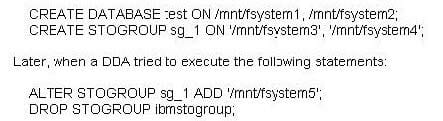
an error was produced.Why did the error occur?
A. The current default storage group cannot be dropped.
B. New storage paths cannot be added to existing storage groups.
C. The storage group IBMSTOGROUP cannot be dropped because it is a system-defined storage group.
D. The storage group SG_1 was not the current default storage group at the time a new storage path was being added to it.
In which situation would you NOT use a redirected restore?
A. To redefine the paths of a defined storage group.
B. To move table space containers onto different physical devices.
C. To restore a backup image from one operating system to another.
D. To restore a backup image to a target machine that is different from the source machine.
If the AUDIT_BUF_SZ configuration parameter is set to zero (0), what will happen?
A. The audit facility writes records to disk at the same time the statements generating the audit records are executing.
B. Statements generating audit records must wait for the records to be written to disk before they can complete execution.
C. The writing of audit records to disk will be delayed until a minimum number of records (based on record size and memory available in the database heap) have been generated.
D. There is no limit to how many audit records can be stored in an internal memory buffer for one single statement generating audit records.

Home | Contact Us | About Us | FAQ | Guarantee & Policy | Privacy & Policy | Terms & Conditions | How to buy
Copyright © 2026 pass4itsure.com. All Rights Reserved