 TESTED 13 Jul
C2040-911 Online Practice Questions and Answers
Chris wants to do performance tuning in his mobile theme. What would be the first step he should take to achieve this task?
A. Apply caching rules to the HTTP server.
B. Use a third-party minification tool to compress the JavaScript files.
C. Change dynacache settings.
D. Configure cache manifest file.
Which of the following is a false statement about limitations for a WSRP producer portlet?
A. WSRP producer portlets cannot use PUMA SPI for accessing user information.
B. WSRP producer portlets cannot access portlet render parameters.
C. WSRP producer portlets cannot use IBM WebSphere Portal internals in portlets such as engine objects or engine tags.
D. WSRP producer portlets do not support edit_defaults_compatibility portlet mode.
The following code defines the selectEmployee() method in a portlet:
@processAction(name=select) void selectEmployee(ActionRequest, ActionResponse) throws PortletException, java.io.IOException { }
To use the portlet action dispatching, which of the following key-value pairs must be set as a parameter in the HTML form?
A. processAction / select
B. processAction / selectEmployee
C. javax.portlet.action / select
D. javax.portlet.action / selectEmployee
Evan wants to develop a portlet to act as a target using click-to-action. He wants to develop a client-side click-to-action handler. Which best describes the ways that he can get the source data submitted by the source portlet?
A. He can retrieve the source form and the input inside from the page Document Object Model.
B. He can retrieve the source data from the window.ibm.portal.c2a.event.value global variable.
C. Either of the above.
D. None of the above.
PreferencePortlet is Portlet Specification 2.0-compliant and the system is running IBM WebSphere Portal 8.0.
What is the output of the following code?
public PreferencePortlet extends GenericPortlet{ protected void processAction(ActionRequest actionRequest, ActionResponse){ actionRequest.getPreferences().setValue("test","ViewModePreferenceValue"); actionRequest.getPreferences ().store(); } protected void doView(RenderRequest renderRequest, RenderResponse renderResponse) throws PortletException, IOException { // Generate action URL }
A. The container throws java.lang.IllegalStateException because it is not allowed to change preferences in the processAction() method.
B. The code compiles and executes fine. It stores a "test" preference at the end of the processAction() method call.
C. The container throws javax.portlet.ReadOnlyException because it is only allowed to view preferences in the processAction() method.
D. This code results in a compiler error because PortletPreference does not have the store() method.
The XYZ company has a custom portlet that provides access to data from the company's mainframe. Twice a day, the mainframe performs a batch process to update the data. During the batch process, the portlet cannot access the data. Which one of the following options allows Sara to hide the portlet during the batch processing times?
A. Use the Policy editor to create a portlet availability policy, then use the Page Layout editor to assign the policy to the portlet.
B. Use the Policy editor to create a portlet availability policy and to assign the policy to the portlet.
C. Use the Personalization editor to create a portlet visibility rule, then use the Page Layout editor to assign the rule to the portlet.
D. Use the Personalization editor to create a portlet visibility rule and to assign the rule to the portlet.
The following code sample is an excerpt from an implementation of a custom ExplicitLoginFilter.
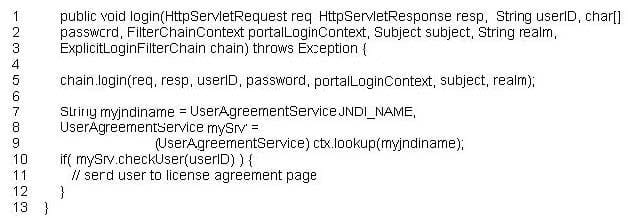
Evan needs to implement custom logic to check whether the user needs to accept an updated user agreement. Which one of the following lines of code allows the user to be sent the friendly IBM WebSphere Portal URL 'acceptAgreement,' if the checkUser method returns true?
A. resp.sendRedirect("/wps/myportal/acceptAgreement");
B. portalLoginContext.setRedirectURL("/wps/myportal/acceptAgreement");
C. RequestDispatcher rd = req.getRequestDispatcher("/wps/myportal/acceptAgreement"); rd.forward(req, resp);
D. RequestDispatcher rd = req.getRequestDispatcher("/wps/myportal/acceptAgreement"); rd.include(req, resp);
Corrie needs to create several iWidgets that will interact with each other. She is evaluating the mechanisms that she can use to share state information between the iWidgets. Which one of the following options is the best way to accomplish this?
A. Use the JSR 286 defined event and payload mechanism.
B. Store state information in the user's session.
C. Implement public render parameters.
D. Declare the state sharable in the ItemSet definition and register listeners in the individual iWidgets to be informed when shared state changes.
Steve wants to hide a menu item in the action menu. This menu item may be needed for later use. What is the best way to accomplish this?
A. Declare the menu item as not visible in the server-side feed. Declare the menu item as visible in the client-side code, and then stop and restartthe custom theme application.
B. Declare the menu item as visible in the server-side feed then override in the client-side's visibilityFn.
C. Use the IBM WebSphere Integrated Solutions console to edit the Dynamic Content Spot to update the menu definition and restart the customtheme application.
D. Update the shelfActions.json using the WebDAV located inside the menuDefinitions folder and then register the changes inside the theme.js filelocated inside the js folder.
Which of the following options is not a valid parameter of the login() method of the Portlet Login service (interface com.ibm.portal.portlet.service.login.LoginService)?
A. char[] password - The password of the user.
B. java.lang.String userID - The user ID of the user.
C. java.net.URL redirectURL - The login redirect URL.
D. javax.security.auth.Subject subject - A security subject to be passed to the WebSphere Application Server login modules that can be null if notneeded.

Home | Contact Us | About Us | FAQ | Guarantee & Policy | Privacy & Policy | Terms & Conditions | How to buy
Copyright © 2026 pass4itsure.com. All Rights Reserved