 TESTED 24 Jul
AZ-720 Online Practice Questions and Answers
HOTSPOT
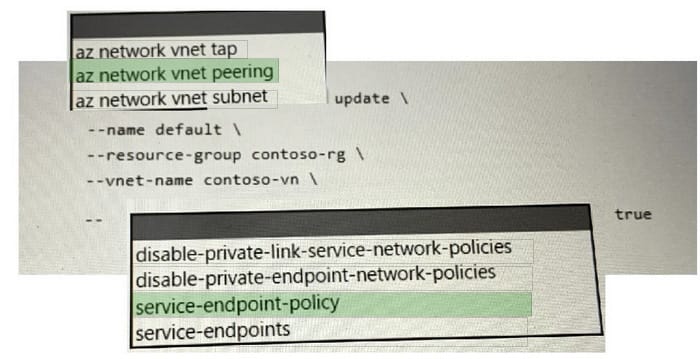
A company named Contoso connects to Azure PaaS services using Azure Private Link. The company has a virtual network named contoso-vn in a resource group named contoso- rg.
An engineer modifies the Private Link service by using Azure CLI. They are unable to use a source IP address from a subnet named default.
You need to resolve the issue.
How should you complete the command?
Hot Area:

A company has two virtual networks (VNets) that reside in the same Azure region.
An administrator reports that virtual machines (VMs) in each VNet are unable to connect to VMs in the other VNet.
You need to configure a connection between the two networks that maximizes throughput and minimizes latency.
What should you do?
A. Configure a VPN gateway.
B. Create a site-to-site VPN connection.
C. Configure virtual network peering.
D. Create a point-to-site VPN connection.
A company has an Azure Active Directory (Azure AD) tenant. The company provisions an Azure Active Directory Domain Services (Azure AD DS) instance.
Users report that they are unable to sign into Azure AD DS after being provisioned from Azure AD. You verify the user accounts exist in Azure AD DS.
You need to resolve the issue.
What should you do?
A. Delete the Azure application named AzureActiveDirectoryDomainControllerServices and then enable Azure AD DS again.
B. Deploy Azure AD Connect.
C. Delete the Azure application named Azure AD Domain Services Sync and then enable Azure AD DS again.
D. Instruct the users to change their password in Azure AD.
A company deploys an ExpressRoute circuit.
You need to verify accepted peering routes from the ExpressRoute circuit.
Which PowerShell cmdlet should you run?
A. Get-AzExpressRouteCrossConnectionPeering
B. Get-AzExpressRouteCircuit
C. Get-AzExpressRouteCircuitPeeringConfig
D. Get-AzExpressRouteCircuitRouteTable
E. Get-AzExpressRouteCircuitStats
A company connects their on-premises network by using Azure VPN Gateway. The on- premises environment includes three VPN devices that separately tunnel to the gateway by using Border Gateway Protocol (BGP).
A new subnet should be unreachable from the on-premises network.
You need to implement a solution.
Solution: Configure subnet delegation.
Does the solution meet the goal?
A. Yes
B. No
A company migrates existing Ubuntu Linux servers from their on-premises vSphere infrastructure to Azure.
The virtual machines (VMs) are experiencing a low network throughput of 20 Mbps. The VMs are expected to sustain 300 Mbps.
You need to ensure that the VMs are compatible with Azure.
Which change should you make?
A. Install a kernel name that ends with -azure.
B. Configure the network interfaces to 1000 Mbps/full duplex.
C. Redeploy the VM with Accelerated Networking enabled.
D. Increase the TCP buffers and window size kernel parameters.
A company migrates an on-premises Windows virtual machine (VM) to Azure. An administrator enables backups for the VM by using the Azure portal.
The company reports that the Azure VM backup job is failing.
You need to troubleshoot the issue.
Solution: Create a new manual backup in Backup center.
Does the solution meet the goal?
A. Yes
B. No
A company migrates an on-premises Windows virtual machine (VM) to Azure. An administrator enables backups for the VM by using the Azure portal.
The company reports that the Azure VM backup job is failing.
You need to troubleshoot the issue.
Solution: Enable replication and create a recovery plan for the backup vault.
Does the solution meet the goal?
A. Yes
B. No
A company has a pay-as-you-go subscription named Subl1.
The company has a virtual machine (VM) named VM1 in a subnet named Subnet1.
You create the following network security group (NSG) named NSG1 and associate it with Subnet1.

You observe that an application on VM1 is unable to send email to recipient outside the company
You need to resolve the issue.
What should you do?
A. Configure the protocol for the NSG1 rule with priority of 100 to TCP.
B. Configure the source and destination ports for the NSG1 rule with a priority of 100 to 587.
C. Migrate Sub1 to a cloud service provider subscription
D. Remove the NSG1 rule with a priority of 2000.
E. Assign NSG1 to the network interface on VM1.
A company deploys an Azure Virtual Network gateway. The company connects to the gateway by using a site-to-site VPN connection.
The company's on-premises VPN gateway is reporting an issue with the Phase 1 proposal from the Azure Virtual Network gateway.
You need to resolve the issue with VM10.
What should you do?
A. Add an outbound security rule to NSG1 that allows outbound traffic from ASG1 to ASG10. Configure the rule to use a priority of 100.
B. In the NSG10 inbound security rule that has a priority of 100, change the destination to ASG10.
C. In the NSG10 inbound security rule that has a priority of 100, change the protocol to Any.
D. In NSG10, remove the inbound security rule that has a priority of 100.

Home | Contact Us | About Us | FAQ | Guarantee & Policy | Privacy & Policy | Terms & Conditions | How to buy
Copyright © 2026 pass4itsure.com. All Rights Reserved