 TESTED 14 Jul
AZ-220 Online Practice Questions and Answers
Note: This question is part of a series of questions that present the same scenario. Each question in the series contains a unique solution that might meet the stated goals. Some question sets might have more than one correct solution, while
others might not have a correct solution.
After you answer a question in this question, you will NOT be able to return to it. As a result, these questions will not appear in the review screen.
You have devices that connect to an Azure IoT hub. Each device has a fixed GPS location that includes latitude and longitude.
You discover that a device entry in the identity registry of the IoT hub is missing the GPS location.
You need to configure the GPS location for the device entry. The solution must prevent the changes from being propagated to the physical device.
Solution: You add the desired properties to the device twin.
Does the solution meet the goal?
A. Yes
B. No
You have an existing Azure IoT hub.
You use IoT Hub jobs to schedule long running tasks on connected devices.
Which three operations do the IoT Hub jobs support directly? Each correct answer presents a complete solution.
NOTE: Each correct selection is worth one point.
A. Trigger Azure functions.
B. Invoke direct methods.
C. Update desired properties.
D. Send cloud-to-device messages.
E. Disable IoT device registry entries.
F. Update tags.
Note: This question is part of a series of questions that present the same scenario. Each question in the series contains a unique solution that might meet the stated goals. Some question sets might have more than one correct solution, while
others might not have a correct solution.
After you answer a question in this section, you will NOT be able to return to it. As a result, these questions will not appear in the review screen.
You have a Standard tier Azure IoT hub and a fleet of IoT devices.
The devices connect to the IoT hub by using either Message Queuing Telemetry Transport (MQTT) or Advanced Message Queuing Protocol (AMQP).
You need to send data to the IoT devices and each device must respond. Each device will require three minutes to process the data and respond.
Solution: You use direct methods and check the response.
Does this meet the goal?
A. Yes
B. No
Note: This question is part of a series of questions that present the same scenario. Each question in the series contains a unique solution that might meet the stated goals. Some question sets might have more than one correct solution, while
others might not have a correct solution.
After you answer a question in this section, you will NOT be able to return to it. As a result, these questions will not appear in the review screen.
You are developing a custom Azure IoT Edge module.
The module needs to identify the device ID of the local device.
Solution: You configure the module to read the ProductInfo property of ModuleClient.
Does this meet the goal?
A. Yes
B. No
Note: This question is part of a series of questions that present the same scenario. Each question in the series contains a unique solution that might meet the stated goals. Some question sets might have more than one correct solution, while
others might not have a correct solution.
After you answer a question in this section, you will NOT be able to return to it. As a result, these questions will not appear in the review screen.
You are developing a custom Azure IoT Edge module.
The module needs to identify the device ID of the local device.
Solution: You configure the module to read the device ID of the device twin.
Does this meet the goal?
A. Yes
B. No
You need to visualize Azure IoT Hub telemetry data by using Microsoft Power BI. Which service should you connect to the IoT hub?
A. Azure Event Grid
B. SendGrid
C. Azure Stream Analytics
D. Azure Notification Hubs
You have an loT solution that includes an Azure IoT hub named Hub1 and 20 loT devices.
Hub1 sends cloud-to-device messages to the 10T devices.
You need to track the number of messages that are resubmitted for delivery to an IoT device. Which metric should you monitor?
A. C2D messages abandoned
B. C2D Messages Expired
C. C2D messages rejected
D. C2D message deliveries completed
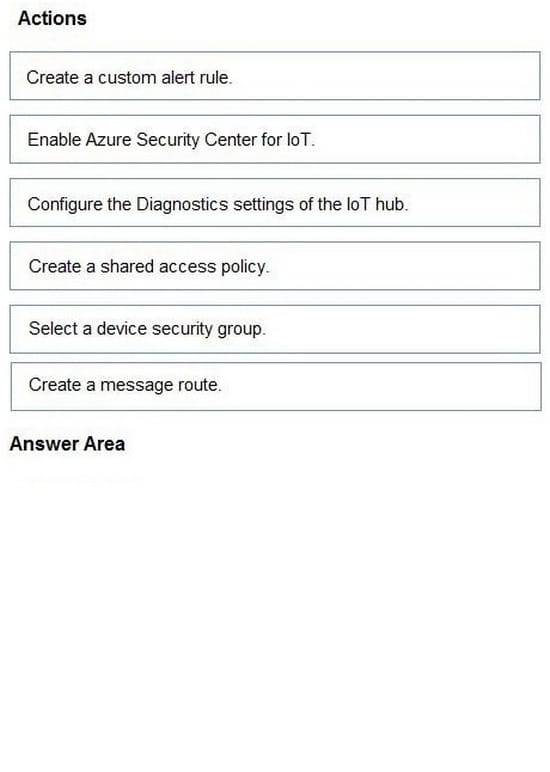
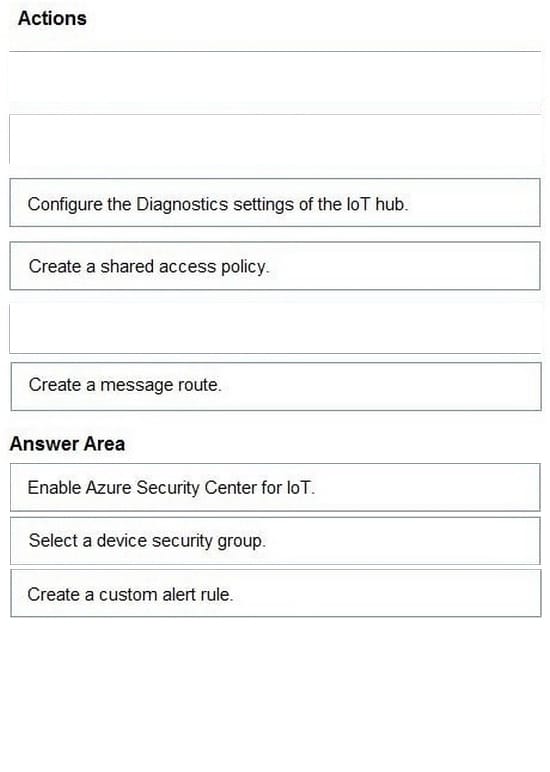
DRAG DROP
You have 100 devices that connect to an Azure IoT hub.
You need to be notified about failed local logins to a subnet of the devices.
Which three actions should you perform in sequence? To answer, move the appropriate actions from the list of actions to the answer area and arrange them in the correct order.
Select and Place:
HOTSPOT
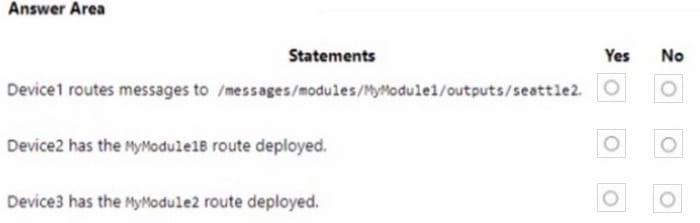
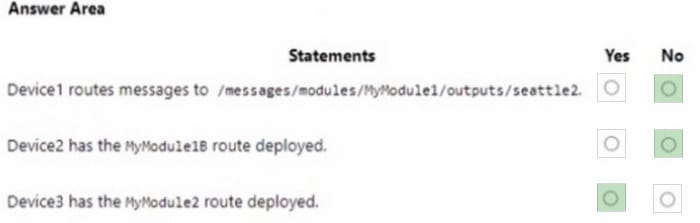
You have an Azure IoT hub and three Azure IoT Edge devices. The device twin code for each device is shown in the following table.
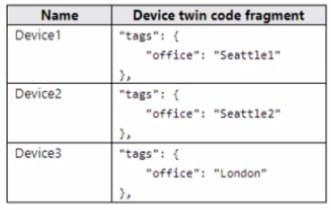
A standard automatic deployment is already applied.
You have three layered deployments. The deployment code for each deployment is shown in the following table.
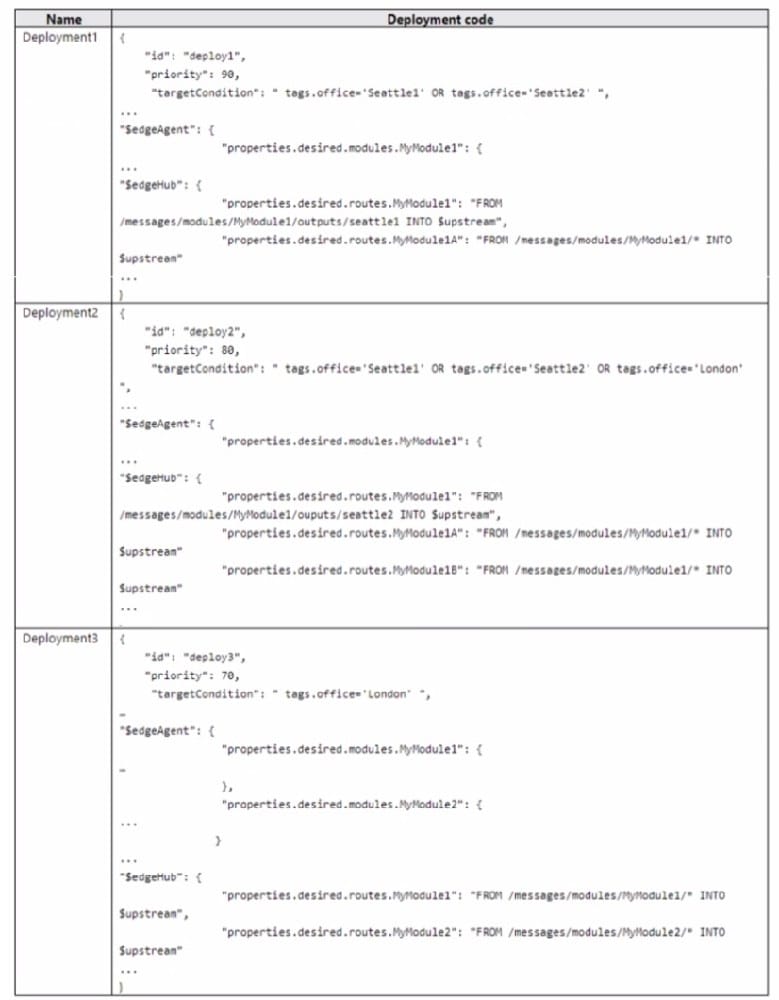
For each of the following statements, select Yes if the statement is true. Otherwise select No. NOTE: Each correct selection is worth one point.
Hot Area:
HOTSPOT
You create a new IoT device named device1 on iothub1. Device1 has a primary key of Uihuih76hbHb.
How should you complete the device connection string? To answer, select the appropriate options in the answer area.
NOTE: Each correct selection is worth one point.
Hot Area:



Home | Contact Us | About Us | FAQ | Guarantee & Policy | Privacy & Policy | Terms & Conditions | How to buy
Copyright © 2026 pass4itsure.com. All Rights Reserved