 TESTED 13 Jul
MLS-C01 Online Practice Questions and Answers
A Machine Learning Specialist trained a regression model, but the first iteration needs optimizing. The Specialist needs to understand whether the model is more frequently overestimating or underestimating the target.
What option can the Specialist use to determine whether it is overestimating or underestimating the target value?
A. Root Mean Square Error (RMSE)
B. Residual plots
C. Area under the curve
D. Confusion matrix
A Data Science team is designing a dataset repository where it will store a large amount of training data commonly used in its machine learning models. As Data Scientists may create an arbitrary number of new datasets every day the
solution has to scale automatically and be cost-effective. Also, it must be possible to explore the data using SQL.
Which storage scheme is MOST adapted to this scenario?
A. Store datasets as files in Amazon S3.
B. Store datasets as files in an Amazon EBS volume attached to an Amazon EC2 instance.
C. Store datasets as tables in a multi-node Amazon Redshift cluster.
D. Store datasets as global tables in Amazon DynamoDB.
A manufacturer of car engines collects data from cars as they are being driven. The data collected includes timestamp, engine temperature, rotations per minute (RPM), and other sensor readings. The company wants to predict when an engine is going to have a problem, so it can notify drivers in advance to get engine maintenance. The engine data is loaded into a data lake for training.
Which is the MOST suitable predictive model that can be deployed into production?
A. Add labels over time to indicate which engine faults occur at what time in the future to turn this into a supervised learning problem Use a recurrent neural network (RNN) to train the model to recognize when an engine might need maintenance for a certain fault.
B. This data requires an unsupervised learning algorithm Use Amazon SageMaker k-means to cluster the data
C. Add labels over time to indicate which engine faults occur at what time in the future to turn this into a supervised learning problem Use a convolutional neural network (CNN) to train the model to recognize when an engine might need maintenance for a certain fault.
D. This data is already formulated as a time series Use Amazon SageMaker seq2seq to model the time series.
A Machine Learning Specialist is working for an online retailer that wants to run analytics on every customer visit, processed through a machine learning pipeline. The data needs to be ingested by Amazon Kinesis Data Streams at up to 100 transactions per second, and the JSON data blob is 100 KB in size.
What is the MINIMUM number of shards in Kinesis Data Streams the Specialist should use to successfully ingest this data?
A. 1 shards
B. 10 shards
C. 100 shards
D. 1,000 shards
A Data Scientist is building a linear regression model and will use resulting p-values to evaluate the statistical significance of each coefficient. Upon inspection of the dataset, the Data Scientist discovers that most of the features are normally distributed. The plot of one feature in the dataset is shown in the graphic.
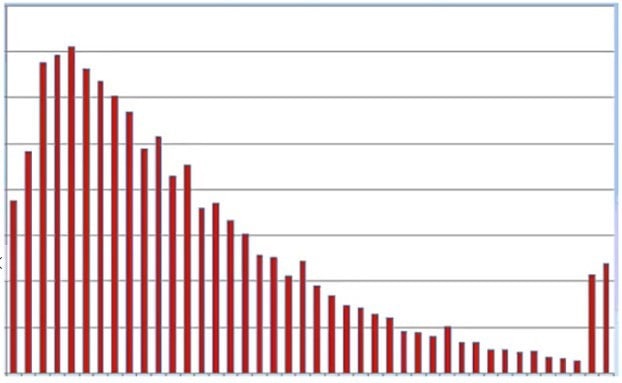
What transformation should the Data Scientist apply to satisfy the statistical assumptions of the linear regression model?
A. Exponential transformation
B. Logarithmic transformation
C. Polynomial transformation
D. Sinusoidal transformation
An agricultural company is interested in using machine learning to detect specific types of weeds in a 100-acre grassland field. Currently, the company uses tractor-mounted cameras to capture multiple images of the field as 10x10 grids. The company also has a large training dataset that consists of annotated images of popular weed classes like broadleaf and non-broadleaf docks.
The company wants to build a weed detection mode! that will detect specific types of weeds and the location of each type within the field. Once the model is ready, it will be hosted on Amazon SageMaker endpoints. The model will perform real-time inferencing using the images captured by the cameras.
Which approach should a Machine Learning Specialist take to obtain accurate predictions?
A. Prepare the images in RecordIO format and upload them to Amazon S3. Use Amazon SageMaker to train, test, and validate the model using an image classification algorithm to categorize images into various weed classes.
B. Prepare the images in Apache Parquet format and upload them to Amazon S3. Use Amazon SageMaker to train, test, and validate the model using an object-detection single-shot multibox detector (SSD) algorithm.
C. Prepare the images in RecordIO format and upload them to Amazon S3. Use Amazon SageMaker to train, test, and validate the model using an object-detection single-shot multibox detector (SSD) algorithm.
D. Prepare the images in Apache Parquet format and upload them to Amazon S3. Use Amazon SageMaker to train, test, and validate the model using an image classification algorithm to categorize images into various weed classes.
A data scientist is training a large PyTorch model by using Amazon SageMaker. It takes 10 hours on average to train the model on GPU instances. The data scientist suspects that training is not converging and that resource utilization is not optimal.
What should the data scientist do to identify and address training issues with the LEAST development effort?
A. Use CPU utilization metrics that are captured in Amazon CloudWatch. Configure a CloudWatch alarm to stop the training job early if low CPU utilization occurs.
B. Use high-resolution custom metrics that are captured in Amazon CloudWatch. Configure an AWS Lambda function to analyze the metrics and to stop the training job early if issues are detected.
C. Use the SageMaker Debugger vanishing_gradient and LowGPUUtilization built-in rules to detect issues and to launch the StopTrainingJob action if issues are detected.
D. Use the SageMaker Debugger confusion and feature_importance_overweight built-in rules to detect issues and to launch the StopTrainingJob action if issues are detected.
An ecommerce company has developed a XGBoost model in Amazon SageMaker to predict whether a customer will return a purchased item. The dataset is imbalanced. Only 5% of customers return items.
A data scientist must find the hyperparameters to capture as many instances of returned items as possible. The company has a small budget for compute.
How should the data scientist meet these requirements MOST cost-effectively?
A. Tune all possible hyperparameters by using automatic model tuning (AMT). Optimize on {"HyperParameterTuningJobObjective": {"MetricName": "validation:accuracy", "Type": "Maximize"}}.
B. Tune the csv_weight hyperparameter and the scale_pos_weight hyperparameter by using automatic model tuning (AMT). Optimize on {"HyperParameterTuningJobObjective": {"MetricName": "validation'll", "Type": "Maximize"}}.
C. Tune all possible hyperparameters by using automatic model tuning (AMT). Optimize on {"HyperParameterTuningJobObjective": {"MetricName": "validation:f1", "Type": "Maximize"}}.
D. Tune the csv_weight hyperparameter and the scale_pos_weight hyperparameter by using automatic model tuning (AMT). Optimize on {"HyperParameterTuningJobObjective": {"MetricName": "validation:f1", "Type": "Minimize"}}.
A company decides to use Amazon SageMaker to develop machine learning (ML) models. The company will host SageMaker notebook instances in a VPC. The company stores training data in an Amazon S3 bucket. Company security policy states that SageMaker notebook instances must not have internet connectivity.
Which solution will meet the company's security requirements?
A. Connect the SageMaker notebook instances that are in the VPC by using AWS Site-to-Site VPN to encrypt all internet-bound traffic. Configure VPC flow logs. Monitor all network traffic to detect and prevent any malicious activity.
B. Configure the VPC that contains the SageMaker notebook instances to use VPC interface endpoints to establish connections for training and hosting. Modify any existing security groups that are associated with the VPC interface endpoint to allow only outbound connections for training and hosting.
C. Create an IAM policy that prevents access the internet. Apply the IAM policy to an IAM role. Assign the IAM role to the SageMaker notebook instances in addition to any IAM roles that are already assigned to the instances.
D. Create VPC security groups to prevent all incoming and outgoing traffic. Assign the security groups to the SageMaker notebook instances.
A tourism company uses a machine learning (ML) model to make recommendations to customers. The company uses an Amazon SageMaker environment and set hyperparameter tuning completion criteria to MaxNumberOfTrainingJobs.
An ML specialist wants to change the hyperparameter tuning completion criteria. The ML specialist wants to stop tuning immediately after an internal algorithm determines that tuning job is unlikely to improve more than 1% over the objective
metric from the best training job.
Which completion criteria will meet this requirement?
A. MaxRuntimeInSeconds
B. TargetObjectiveMetricValue
C. CompleteOnConvergence
D. MaxNumberOfTrainingJobsNotImproving

Home | Contact Us | About Us | FAQ | Guarantee & Policy | Privacy & Policy | Terms & Conditions | How to buy
Copyright © 2026 pass4itsure.com. All Rights Reserved