 TESTED 13 Jul
ASVAB-SECTION-3 Online Practice Questions and Answers
The mechanical advantage of two meshing gears is calculated by dividing __________.
A. the number of teeth on the driving gear by the number of teeth on the driven gear.
B. the number of teeth on the driven gear by the number of teeth on the driving gear.
C. the number of teeth on the driving gear by the rotational speed.
D. the diameter of the driven gear by the number of teeth on the driving gear.
The ideal mechanical advantage of a gear is the ratio of the number of teeth in the load gear to the number of teeth in the __________.
A. effort gear
B. loaded gear
C. lifting gear
D. spiral gear
A valve is used to perform which of the following functions?
A. increase the temperature of a liquid
B. control the flow of a liquid
C. aid evaporation of a liquid
D. decrease the density of a liquid
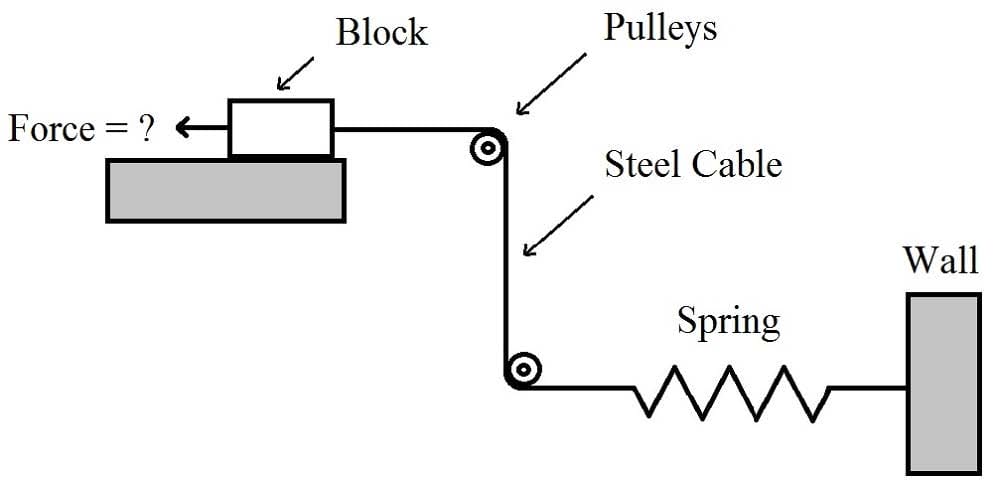
In the diagram shown above, the spring is very stiff and can be stretched 1 inch by a pulling force of 100 pounds.
How much force must be applied to the block in order to move the box 3.5 inches to the left?
A. 150 pounds
B. 250 pounds
C. 350 pounds
D. 450 pounds
A __________ should be applied if gear shafts are not parallel to one another.
A. shifting gear
B. third gear
C. bevel gear
D. stopping gear
A string of six gears exists, with each gear turning in conjunction with one another.
Which gears operate in the same rotation?
A. Gears 1, 2, and 3
B. Gears 1, 3, and 5
C. Gears 3, 4, and 5
D. Gears 2, 4, and 5
What is the definition of a "concurrent force"?
A. A force system requiring concurrent movement.
B. A force system described as having multiple sources of force.
C. A system requiring all systems to pass through the same point.
D. A series of forces requiring simultaneous movement.
Which of the following materials serves as a conductor?
A. Metal
B. Wood
C. Acrylic
D. Paper
Which of the following will happen when a mass of air contracts?
A. The air remains at the same temperature
B. The air gets colder
C. The air gets warmer
D. The air moves faster
An axe is an example of what type of simple machine.
A. Lever
B. Inclined plane
C. Wedge
D. None of the above

Home | Contact Us | About Us | FAQ | Guarantee & Policy | Privacy & Policy | Terms & Conditions | How to buy
Copyright © 2026 pass4itsure.com. All Rights Reserved