 TESTED 13 Jul
AD0-E100 Online Practice Questions and Answers
custom field. However, the developer encountered an issue and noticed that the value of the custom field is not displaying on a component.
What is a possible cause of this issue?
A. The namespace 'myProject' isn't registered.
B. The text field does NOT accept special characters.
C. The property name 'myProject:photographer' is too long.
D. The property 'myProject:photographer' already exists and is causing conflicts.
A user has created a custom metadata schema that includes a multi value text field. After modifying the file that the metadata has been applied to, the user discovers that the property corresponding to the multi value text field contains a new value. What does this mean?
A. Another metadata schema that was previously applied to the asset is causing a conflict.
B. The multi value text field was simultaneously updated by a different AEM Assets user.
C. The multi value text field is configured as a required field in the metadata schema.
D. Another field in the metadata schema maps to the same property as the multi value text field.
A developer modified the default jpeg metadata schema and removed the "Product" tab. When testing with an existing JPEG image asset, the developer noticed that the Product tab still exists.
What could be causing this issue?
A. The Product tab is inherited from the parent image schema.
B. The old metadata schema is cached by the browser.
C. The updated schema will only be applied to new uploaded assets.
D. Default tabs cannot be removed from the metadata schema.
A developer wrote the following code to programmatically update the asset metadata.
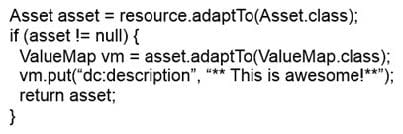
When testing, the developer noticed that the asset metadata never gets updated. What are two reasons for this error? (Choose two.)
A. The ValueMap needs to be converted to a writable ValueMap.
B. The property value does not allow special characters.
C. The session was not saved after the asset was updated.
D. The asset metadata already has the "dc:description" property.
A client needs AEM Assets to detect files with identical contents at the time of upload.
What should a developer change to meet this requirement?
A. Develop a custom OSGi service to detect duplicate files, and deploy that OSGi service to the AEM instance.
B. Update the Day CQ DAM Asset Upload Restriction OSGi service configuration to detect duplicate files.
C. Update the Day CQ DAM Create Asset Servlet OSGi service configuration to detect duplicate files.
D. Update the Adobe CQ DAM Asset Index Update Monitor OSGi service configuration to detect duplicate files.
A user group is created to upload new Assets to AEM Assets. Tins group has the Read and Create permissions for the path /content/dam set to Allow. The members of this group are able to browse all of the content in the DAM when they log into AEM Assets. Members do not see the option to upload a new Asset. What should be done to resolve this issue?
A. The group should also have the Modify permission for /content/dam set to Allow.
B. The group should also have the Replicate permission for/content/dam set to Allow.
C. The group should also have the Create permission for / set to Allow.
D. The group should also have the Create permission for /content set to Allow.
A developer implements a custom assets upload component for their AEM site to allow authorized end users to upload their company logos (*.png, *.jpg) to the DAM to create custom branded portals.
The developer is testing the custom servlet (/bin/companyX/uploadDealerLogo) by uploading the new asset on the publish instance but is receiving a 403 forbidden error during upload.
What are two potential reasons for this error? (Choose two.):
A. The MIME types of the logos are NOT allowed in Day CQ DAM Asset Upload Restriction.
B. Apache Sling Referrer Filter's Allow Hosts needs to be setup in OSGi configurations.
C. Remove "Post" from Adobe Granite CSRF Filter's Filter Methods in the OSGi configurations.
D. The dispatcher needs to be configured under /filter {/type "allow" /url "/bin/companyX/*"}
A user would like to take an image in AEM Assets and send a copy of the image to an external system. The copy of the image that is sent must have a specific height and width. The client cannot have rendition with the dimensions preserved in AEM.
Assuming the external system includes a REST API that supports file uploads, which step in the workflow model will you do after resizing the image?
A. Apply the image profile to the folder and run the smart crop workflow.
B. Upload the image to the external system; then, delete the rendition from the JCR.
C. Modify the update asset workflow to delete the rendition from the JCR.
D. Call the REST API from the external system.
A developer is attempting to remove a custom metadata profile that is currently assigned to a folder in the DAM. Which is a possible outcome of this action?
A. All existing metadata values will be removed from the assets.
B. All metadata values that were inherited from the previous profile will be removed.
C. The metadata values of the assets will persist even after removing the metadata profile.
D. The current metadata profile can only be replaced with another metadata profile.
All assets a client has have XMP metadata applied. The client would like to capture this metadata in AEM at the time of the upload. Which would you recommend as a workflow strategy to accomplish this task?
A. Implement a workflow process to extract the relevant metadata and save it as tags. Modify the DAM Update Asset workflow model to include this workflow process.
B. Modify the DAM Update Asset workflow model to include the Extract Meta Data process.
C. Create a new workflow model that includes the Extract Meta Data process, and run this workflow on the desired assets.
D. Implement a workflow process to extract the relevant metadata and save it as tags. Create a new workflow model that includes this process and run this workflow on the desired assets.

Home | Contact Us | About Us | FAQ | Guarantee & Policy | Privacy & Policy | Terms & Conditions | How to buy
Copyright © 2026 pass4itsure.com. All Rights Reserved