 TESTED 22 Jun
A00-212 Online Practice Questions and Answers
Given the following scenario:
The SAS libraries LIBRARY and MYLIB are successfully defined in your current SAS session.
There is a SAS Data Set named WORK.GENDERS with a column called MF containing single character values.
The SAS program on the left is submitted and the desired output is shown in the right.
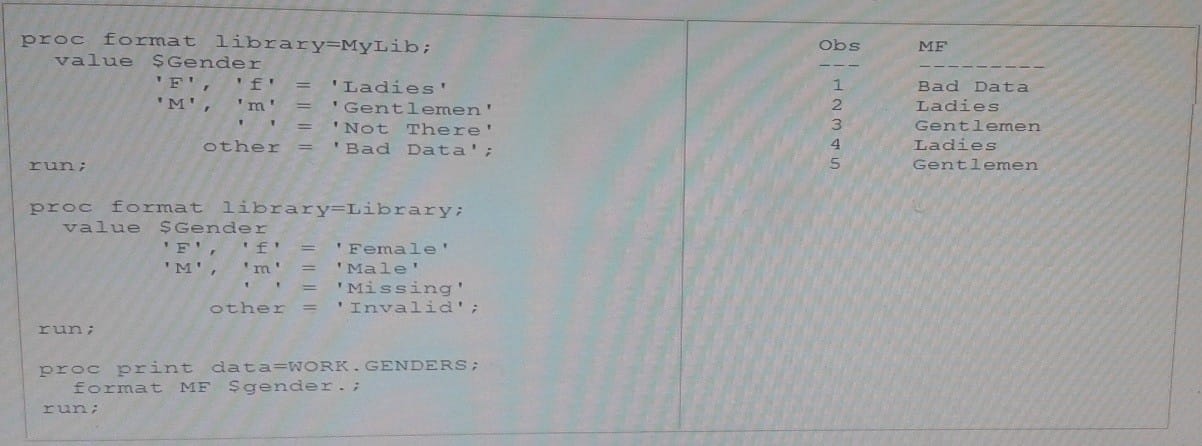
Which statement is true?
A. The statement OPTIONS FMTSEARCH = (Mylib Library); is required before the PRINT procedure to attain the resulting output
B. The statement OPTIONS FMSEARCH = (Library Mylib); is required before the PRINT procedure to attain the resulting output
C. No OPTIONS FMSEARCH ( ) statement is needed to attain resulting output
D. The statement OPTIONS FMSEARCH = (Mylib); is required before the print procedure to attain the resulting output
Given the following SAS data set SASUSER.HIGHWAY:
SASUSER.HIGHWAY
STEERING SEATBELT SPEED STATUS COUNT
absent no 0-29 serious 31
absent no 0-29 not 1419
absent no 30-49 serious 191
absent no 30-49 not 2004
absent no 50+ serious 216
The following SAS program is submitted:
%macro highway;
proc sql noprint;
select count(distinct status)
into :numgrp
from sasuser.highway;
%let numgrp = andnumgrp;
select distinct status
into :group1-:groupandnumgrp
from sasuser.highway;
quit;
%do i = 1 %to andnumgrp;
proc print data = sasuser.highway;
where status = "andandgroupandi" ;
run;
%end;
%mend;
%highway
How many reports are produced by the above program?
A. 0
B. 1
C. 2
D. 5
Which PUT statements will be the log if the program is submitted at the beginning of a new SAS session?
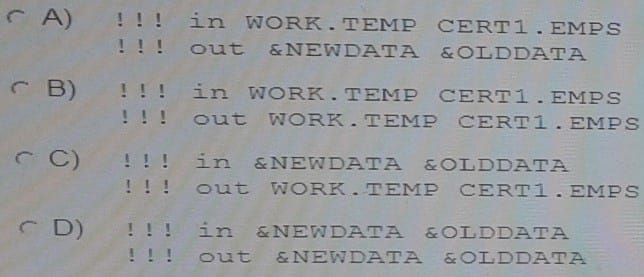
A. Option A
B. Option B
C. Option C
D. Option D
The following SAS program is submitted:
data new(bufsize = 6144 bufno = 4);
set old;
run;
What is the difference between the usage of BUFFSIZE= and BUFNO= options?
A. BUFSIZE=specifies the size of the output buffer in kilobytes; BUFNO=specifies the number of output buffers
B. BUFSIZE= specifies the size of the input buffer in bytes; BUFFNO= specifies the number of input buffers
C. BUFSIZE= specifies the size of the input buffer in kilobytes; BUFNO=specifies the number of input buffers
D. BUFSIZE= specifies the size of the output buffer in bytes; BUFNO= specifies the number of output buffers
Which DICTIONARY table provides information on all the tables containing a variable named LASTNAME?
A. DICTIONARY.COLUMNS
B. DICTIONARY.VARIABLES
C. DICTIONARY.MEMBERS
D. DICTIONARY.TABLES
Which SAS procedure changes the name of a permanent format for a variable stored in a SAS data set?
A. DATASETS
B. MODIFY
C. FORMAT
D. REGISTRY
The following SAS program is submitted:
%let first = yourname;
%let last = first;
%put andandandlast;
Which one of the following is the result in the log of the %PUT statement?
A. first
B. andfirst
C. yourname
D. andyourname
Given the SAS data set ONE: ONE
NUM VAR
1 A
2 B
3 C
Which SQL procedure program deletes the data set ONE?
A. proc sql; Drop table one; Quit;
B. proc sql; Remove table one; Quit;
C. proc sql; Delete table one; Quit;
D. proc sql; Delete from one; Quit;
The following SAS program is submitted:
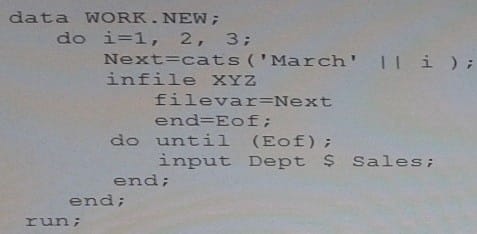
The purpose of FILEVAR = option on the INFILE statement is to name the variable next, whose value:
A. Points to a new input file
B. Points to an aggregate storage location
C. Is output to the SAS data set WORK.NEW
D. Is an input SAS data set reference
The following SAS program is submitted:
%macro check(num=4);
%let result=%sysevalf(andnum+0.5);
%put result is andresult;
%mend;
%check(num=10)
What is the written to the SAS log?
A. result is
B. result is 10
C. result is 10.5
D. result is 10+0.5

Home | Contact Us | About Us | FAQ | Guarantee & Policy | Privacy & Policy | Terms & Conditions | How to buy
Copyright © 2026 pass4itsure.com. All Rights Reserved