 TESTED 13 Jul
7230X Online Practice Questions and Answers
A customer called in stating they cannot place WebRTC calls. You discover that when the WebRTC snap-in sends an Invite to Avaya Aura® Media Server (AAMS), Avaya Breeze ™ is not sending the correct information in the Request URI to match a regular expression in Session Manager. Where do you configure the Media Server URI (ce-msml@avaya.com) that Avaya Breeze ™ will send to AAMS via Avaya Aura® Session Manager (SM)?
A. Use Avaya Aura® System Manager web GUI to access the Engagement Development Platform > Configuration > Attributes.
B. Use SSH to Avaya Breeze ™ and edit the “/etc/config.properties” file.
C. Use Avaya Aura® System Manager web GUI to access the Inventory > Manage Elements, and then edit the Avaya Breeze ™ element.
D. Use Avaya Aura® System Manager web GUI to access the Engagement Development Platform > Configuration > Avaya Aura® Media Server.
You are troubleshooting an IM and Presence problem, and discover all application processes are not running on the Avaya Breeze TM platform.
How can the application processes be started?
A. SSH to Avaya Breeze ™, and execute the start –a command.
B. SSH to Avaya Breeze ™, and execute the service presence start command.
C. Accept Service on the cluster using Avaya Aura? System Manager web GUI.
D. SSH to Avaya Breeze ™, and execute the service ps start command.
You are troubleshooting a TLS link down message between Avaya Aura® Session Manager (SM) and
Avaya Session Border Controller for Enterprise (SBCE). Tracing on SM and SBCE reveals a Fatal Error
Unknown CA message being sent by SBCE when it receives the Server Identity certificate from SM.
To solve this problem, which two actions need to be completed? (Choose two.)
A. Install the Certificate Authority certificate that signed SBCE identity certificate into SM.
B. Export the SBCE identity certificate, and import it into SM.
C. Install the Certificate Authority certificate that signed SM identity certificate into SBCE.
D. Add Certificate Authority certificate into the TLS profile Peer Verification List.
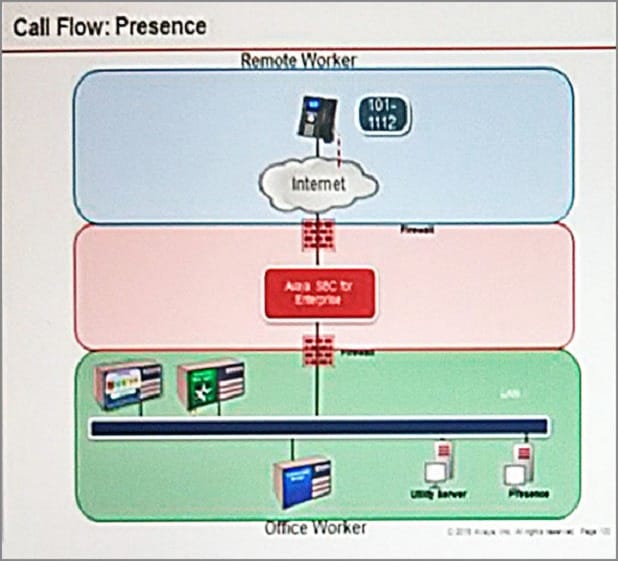
Refer to the exhibit.
SIP endpoint 101-1112 is updating its Presence status with the Avaya Aura® Presence (PS).
Based on the exhibit, which statement about the message flow is true?
A. Avaya Aura® Presence sends Notify to the telephone via Avaya Aura® Session Manager.
B. Phone sends Register message to Avaya Aura® Session Manager via Avaya Session Border Controller for Enterprise.
C. The telephone sends Subscribe message to Avaya Aura® Session Manager via Avaya Session Border Controller for Enterprise.
D. Avaya Aura® Presence sends Notify to the SIP endpoint via Avaya Session Border Controller for Enterprise.
A Maintenance Engineer logs onto the Command Line Interface (CLI) of Avaya Aura® Messaging (AAM) and issues the vmstat command.
What information will the display present?
A. statistical information about voicemail boxes
B. information about the volatile memory
C. status information about the virtual machine
D. count of mailbox password violation attempts
Which types of certificates can be verified from the Avaya Aura? Application Enablement Services (AES) web console?
A. common a default Avaya SIP certificates
B. only Avaya server certificates
C. common and default Avaya server certificates
D. default certificates and Avaya server certificates
You are trying to connect to the Avaya Session Border Controller (SBC) using the SSH client. After several attempts you cannot do it and realize that it is because you are using the wrong port.
Which port should you use to connect to the SBC using an SSH client?
A. 5022
B. 2222
C. 222
D. 822
E. 22
traceSBC is a tool that can be used to trace the calls that cross through the Avaya Session Border Controller (SBC), calls to the public network, or calls from the public network.
Which two statements describe another function of traceSBC? (Choose two.)
A. traceSBC can only be used to view PPM messages if they are transported using HTTP instead HTTPS
B. traceSBC can trace SIP trunk calls but not Remote Workers calls at the same time
C. traceSBC command can be used from CLI ipsec user
D. traceSBC can be used to view STUN/TURN messages.
E. traceSBC parses Avaya SBCE log files and displays SIP and PPM messages, you can use the tool even in case of TLS and HTTPS
To validate the initial system status of Avaya Breeze ™ with the WebRTC Snap-in, which three components should be checked? (Choose three.)
A. Configured certificates
B. Licensing mode
C. Cluster Status
D. Installation status
E. WebRTC Service within Service Management > Services
You need to make a traceSBC in order to find a SIP trunk issue.
After logging into the Session Border Controller (SBC) as user ipcs, in which two valid ways can you issue the traceSBC command? (Choose two.)
A. traceSBC -trunk
B. su sroot, then enter
C. su root, then enter
D. traceSBC -now
E. sudo traceSBC

Home | Contact Us | About Us | FAQ | Guarantee & Policy | Privacy & Policy | Terms & Conditions | How to buy
Copyright © 2026 pass4itsure.com. All Rights Reserved