 TESTED 13 Jul
5V0-11.21 Online Practice Questions and Answers
An environment is running a VMware Cloud on AWS software-defined data center (SDDC) with six i3.metal hosts. Storage space usage has increased and the administrator is required to add storage capacity. Which two approaches can the administrator take to add storage capacity? (Choose two.)
A. Deploy Amazon Elastic File System (EFS) file shares from the AWS console and attach them to the i3.metal hosts. Use VMware Storage vMotion to migrate the storage-bound virtual machines to the Amazon EFS data stores.
B. Deploy Amazon Elastic Block Store (EBS) storage volumes (GP2) from the AWS console and attach them to the i3.metal hosts. Allow VMware vSAN extend the storage capacity automatically.
C. Deploy an additional cluster based on i3en.metal hosts and migrate the storage-bound virtual machines to the i3en.metal hosts.
D. Add additional i3.metal hosts to increase the total vSAN storage space.
E. Add additional i3en.metal hosts and migrate the storage-bound virtual machines to the i3en.metal hosts.
An administrator deploys a virtual machine and configures it to perform backups to an AWS Simple Storage Service (S3) bucket. After the first month of use, the administrator receives a bill from AWS indicating egress charges were applied to the backup traffic leaving the software-defined data center (SDCC), destined for the AWS S3 bucket. What can the administrator do to ensure backup traffic travels to the linked Amazon Virtual Private Cloud (VPC) through the Elastic Network Interface?
A. Configure the S3 bucket with a public endpoint accessible over the Internet through HTTPS.
B. Configure Direct Connect to a private virtual interface for access to AWS services.
C. Create a gateway endpoint in the linked AWS VPC and configure it for use with the S3 bucket.
D. Configure a route-based virtual private network (VPN) for the SDDC to the VPC.
An administrator runs an analysis on all workloads using Live Optics and confirms there are a variety of applications, including Microsoft SQL server and Oracle databases. The Microsoft SQL workloads are averaging 4,000 IOPS per virtual machine, approximately 50% writes. The Oracle workloads are averaging 3,000 IOPS per virtual machine, and approximately 80% writes. Which method should be used to input the data into the VMware Cloud on AWS Sizer for the most accurate results?
A. Use the Advanced Sizer in 'database' mode. Create workload profiles for the analyzed virtual machines, including profiles for Microsoft SQL and Oracle. Set the values for vCPU, vRAM, utilized storage, IOPS and I/O profile manually.
B. Use the Quick Sizer. Set the values for vCPU, vRAM, utilized storage, IOPS and I/O profile manually.
C. Use the Advanced Sizer in 'import' mode. Import the Live Optics data and let the Advanced Sizer set the values for vCPU, vRAM, utilized storage, IOPS and I/O automatically.
D. Use the Advanced Sizer in 'manual' mode. Create workload profiles for the analyzed virtual machines, including profiles for Microsoft SQL and Oracle. Use the default values for the SQL and Oracle workload profiles.
What are two benefits of completing a full data center evacuation to VMware Cloud on AWS? (Choose two.)
A. Reduce the risk of migrating applications to the cloud by removing the need for application transformation.
B. Maintain existing investment in skills and toolsets.
C. Provide a hybrid cloud management solution.
D. Provide a seamless way to expand the on-premises software-defined data center (SDDC) into the cloud.
E. Diversify the risk associated with migrating applications to the cloud by automatically deploying workloads to multiple regions.
Refer to the exhibit.
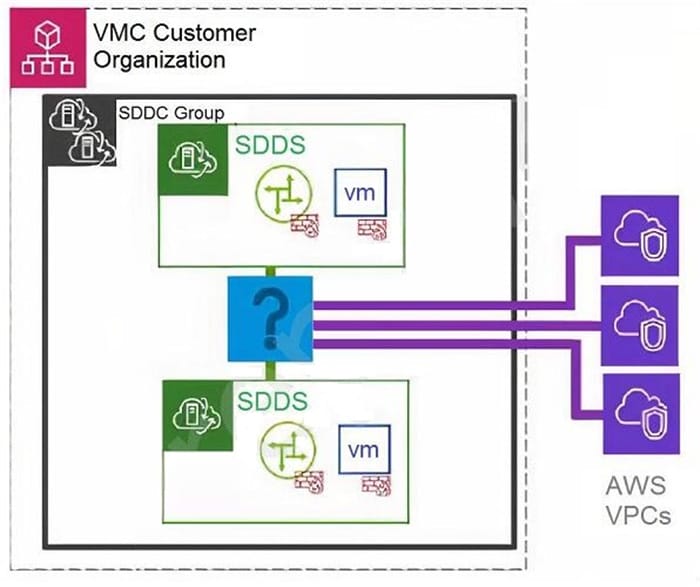
An administrator builds a software-defined data center (SDDC) group to enable connectivity to native Amazon Virtual Private Clouds (VPCs). Which connectivity option is needed to enable connectivity across environments?
A. Tier-0 (T0) Router
B. Transit Gateway
C. Virtual Private Network
D. The Default Storage Scale-Out policy storage threshold is set 5% higher than the other Elastic DRS storage policies.
A user with an Organization Member role would like to add another user to an organization. How would this be accomplished?
A. Only users with an Organization Owner role can invite and add users to the organization.
B. The user with an Organization Member role needs to have CloudAdmin permissions in order to add a new user.
C. The user with an Organization Member role will be able to add a new user through the Identity and Access Management page.
D. Users with an Organization Member role are automatically granted access to all roles within VMware Cloud on AWS.
Which statement is true regarding how vSphere High Availability (HA) provides rapid recovery from outages in VMware Cloud on AWS?
A. Sphere HA restarts virtual machines if their host becomes isolated on the VMware vSAN network.
B. vSphere HA restarts impacted virtual machines on another host when an application fails.
C. vSphere HA is enabled by default in VMware Cloud on AWS but can be disabled or modified.
D. vSphere HA restarts impacted virtual machines (VMs) on another host when a VM stops sending heartbeats or the VM process fails (vmx).
Standard security practice for a company requires that all administrator-level user accounts have their passwords changed every 60 days. The cloudadmin@vmc.local account password is changed by an administrator through the VMware vSphere Cliento adhere to the security policy. When the administrator attempts to log into the VMware Cloud on AWS vCenter Server through the VMware vSphere Client a few days later as cloudadmin@vmc.local using the account credentials copied from the VMware Cloud console, the administrator's access is denied. What is the likely cause of this issue?
A. The cloudadmin@vmc.local account password should not be changed through the VMware vSphere Client. In order to prevent unauthorized access to VMware Cloud on AWS by non-authorized individuals, VMware will lock the account out.
B. When the password for cloudadmin@vmc.local is updated from the VMware vSphere Client, the updated password is not reflected in the VMware Cloud console.
C. The cloudadmin@vmc.local password change confirmation email has not been approved by an Organization Owner.
D. The cloudadmin@vmc.local account password should only be changed through the appliance management interface of the VMware vCenter Server.
An administrator is reducing a five-node cluster down to four. What happens to all virtual machines (VMs) when a host is removed from a cluster?
A. All VMs on the host being removed are deleted.
B. All VMs are powered off.
C. All VMs are migrated from the host.
D. All VMs are unregistered from VMware vCenter.
Upon connecting a VMware Managed Transit Gateway (VTGW), the administrator discovers that there is an overlapping workload CIDR bleck. How will the software-defined data center (SDDC) handle the overlapping IP space?
A. It will reject the remote IP space.
B. It will isolate the overlapping segment in the cloud.
C. It will allow the overlapping IP space.
D. It will ensure both CIDR blocks work in both locations.

Home | Contact Us | About Us | FAQ | Guarantee & Policy | Privacy & Policy | Terms & Conditions | How to buy
Copyright © 2026 pass4itsure.com. All Rights Reserved