 TESTED 13 Jul
4A0-100 Online Practice Questions and Answers
What problems was Spanning Tree Protocol (STP) primarily designed to solve? (Choose two):
A. Providing path redundancy.
B. Preventing loops.
C. Handling collisions.
D. Allowing flooding of multicast traffic.
Which of the following are correct statements about MPLS labels (Choose three)?
A. A series of labels from one LER to another LER represent a logical tunnel known as an LSP.
B. Labels used for a LSP may be static but are usually signaled dynamically with an MPLS label signaling protocol.
C. Labels are locally significant to the MPLS router which means its possible for two routers on the LSP path to use the same label.
D. Labels are globally significant to the MPLS network which means all labels on the LSP path must be unique.
E. Labels used for an LSP must be statically assigned by the service provider.
Which statement best describes a SAP?
A. The Service ATM Point is used for ATM connections to a PE.
B. The Service Access Point is defined on the PE device and is the customers access to the service.
C. The Service Access Point is defined on the P device and is the customers access to the service.
D. The Service Access Point is defined on the CE device and is the customers access to the service.
Which of the following statements is FALSE when describing a Virtual Private LAN Service?
A. A VPLS emulates a virtual switch or bridge.
B. The VPLS performs MAC learning on MAC addresses seen from SAPs and SDPs.
C. When a VPLS receives a frame with an unknown MAC destination, the frame will be dropped.
D. MAC address forwarding database (FDB) is maintained for each VPLS.
What is the function of Layer 2?
A. Layer 2 is responsible for encapsulating packets into frames for transmission on physical media.
B. Layer 2 is responsible for encapsulating packets into IP datagrams and routing them.
C. Layer 2 is responsible for encapsulating application data into TCP/UDP messages.
D. Layer 2 is responsible for the timing of the signals on physical media.
Which of the following is required if devices on different VLANs wish to communicate with each other?
A. Devices on different VLANs cannot communicate with each other.
B. Devices on different VLANs can communicate with each other if they are connected to the same switch.
C. Devices on different VLANs can communicate with each other if the switches are connected using a single high-bandwidth port.
D. Devices on different VLANs can communicate with each other if there is a router to connect the VLANs.
Which of the following protocols is used to exchange routes between routers R1 and R2, and between routers R4 and R5?
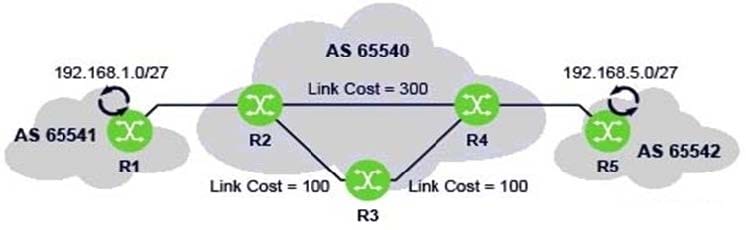
A. RIPv2
B. IS-IS
C. OSPF
D. BGP
Which of the following about the displayed IP filter is TRUE?
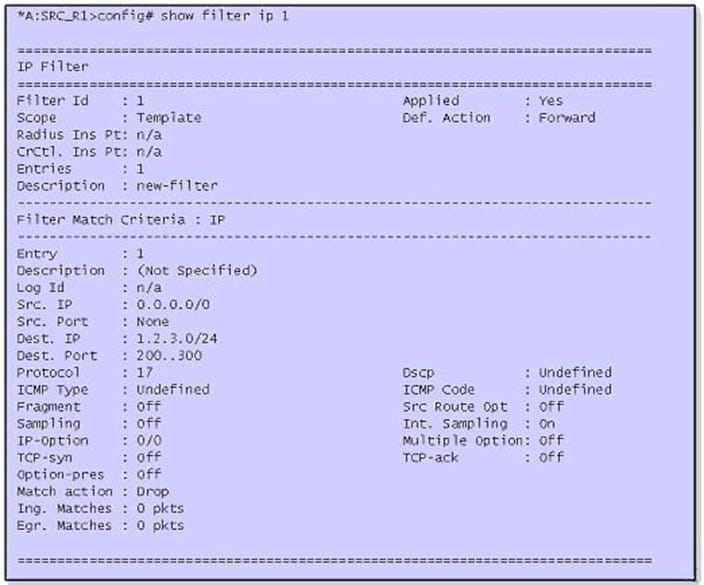
A. UDP (protocol 17) packets with destination IP address 1.2.3.0/24 and destination port number between 200 and 300 are forwarded.
B. UDP (protocol 17) packets with destination IP address 1.2.3.0/24 and destination port number between 200 and 300 are dropped.
C. UDP (protocol 17) packets with destination IP address 1.2.3.0/24 or destination port numbers 200 or 300 are dropped.
D. UDP (protocol 17) packets with destination IP address 1.2.3.0/24 and source port number between 200 and 300 are dropped.
When forwarding a packet, which field in the following table determines the egress interface?
A. Preference
B. Metric
C. Next-hop
D. Cost
Which of the MPLS routers is responsible for pushing new labels for LSP A and LSP B?
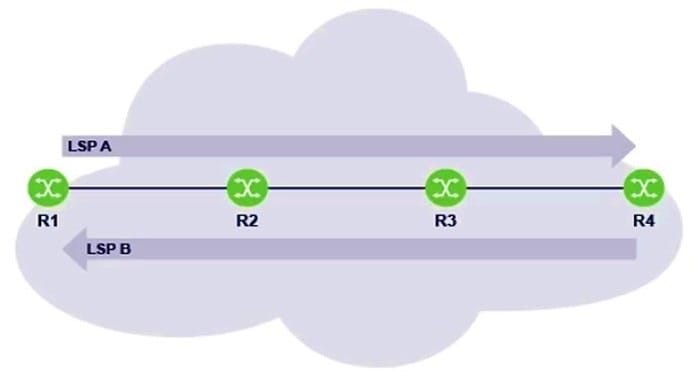
A. Router R1 pushes labels for both LSP A and LSP B.
B. Router R4 pushes labels for both LSP A and LSP B.
C. Router R1 pushes labels for LSP A, while router R4 pushes labels for LSP B.
D. Router R4 pushes labels for LSP A, while router R1 pushes labels for LSP B.

Home | Contact Us | About Us | FAQ | Guarantee & Policy | Privacy & Policy | Terms & Conditions | How to buy
Copyright © 2026 pass4itsure.com. All Rights Reserved