 TESTED 20 Jul
352-001 Online Practice Questions and Answers
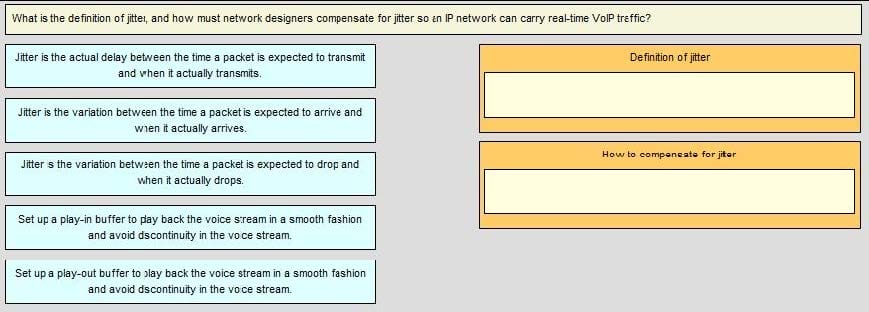
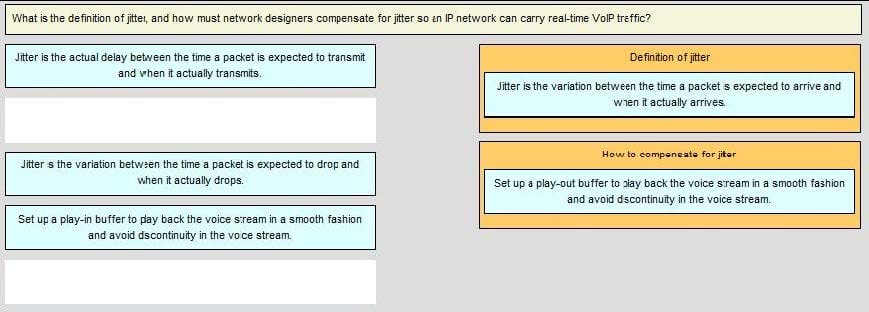
Refer to the exhibit.
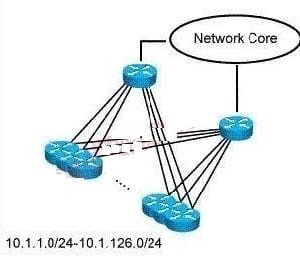
The network administrator of a large-scale EIGRP network has found that one hub- andspoke topology in the network is incurring a lot of link flaps. While several attempts have been made to reduce the number of link flaps, it does not appear that the stability of the hub-and-spoke topology can be improved.
The reason for this is that most failures seem to result from power outages in a number of locations.
Which course of action should the network administrator follow?
A. switch routing protocols to OSPF, then create area boundaries to reduce the size of fault domains
B. summarize the routes advertised into the core of the network to reduce the impact of these frequent failures
C. demand that uninterruptible power supplies be installed at every point in the network to prevent future outages
D. switch routing protocols to IS-IS, which handles large neighbor counts better and supports Partial SPF by default
Company A has grown nationwide in the U.S., and each new remote branch has a Metro Ethernet circuit provisioned back to the data center at the headquarters on the West Coast. The operations team says that it cannot manage hundreds of circuits as the company continues to grow. You review the topology and notice that many of the branches are close to each other in geographical zones. How can you redesign this network to improve manageability and increase scalability?
A. Add an aggregation layer router in each geographical zone.
B. Add a redundant data center on the East Coast to serve some of the traffic there.
C. Add a default route in each branch toward the data center on the West Coast.
D. Use Optimized Edge Routing at the data center.
E. Build an overlay MPLS network with Layer 3 VPN.
What is a design aspect regarding multicast transport for MPLS Layer 3 VPNs using the Rosen Draft implementation?
A. LDP is the multicast control plane protocol.
B. Multicast traffic is forwarded over GRE tunnels.
C. Multicast traffic is forwarded over LDP or RSVP signaled LSPs.
D. Using the MDT SAFI in BGP ensures that PIM can be disabled in the core.
Which two OSPF network type combinations can you use in the design of a Phase 3 DMVPN that requires spoke-to-spoke direct traffic? (Choose two.)
A. hub as point-to-multipoint and spokes as non-broadcast
B. hub as point-to-multipoint and spokes as point-to-point
C. hub as broadcast and spokes as non-broadcast
D. hub as point-to-point and spokes as point-to-point
A large retail bank is designing a unified communications solution to be deployed to its 200 branches. Its current network traffic consists of a web-based portal, Internet browsing, and general file server access. Each branch has between 15 and 20 users. The current WAN is based on Layer 3 MPLS and the customer manages its own CE routers. The WAN circuit interface to the service provider is Gigabit Ethernet, although the MPLS service that is contracted from the service provider is 10 Mb/s. The design is to use a DSCP-based four- class QoS policy to manage traffic demands. From the options below, which two QoS design options that should be implemented on the customer side will meet the requirement? (Choose two.)
A. Shape traffic to 10 Mb/s on the CE router.
B. Police traffic to drop outbound traffic that exceeds 10 Mb/s.
C. Classify DSCP value EF for call signaling and voice packets, and place traffic in a strict priority queue.
D. Priority queue traffic to demand up to 80% of total bandwidth.
E. Enable DSCP-based WRED on all AF classes.
Which design option reduces the occurrence of IGP microloops?
A. Deploy LSA throttle.
B. Tune the SPF hold time to be lower than the SPF runtime on all nodes.
C. Tune the SPF runtime to be lower than the SPF hold time on all nodes.
D. Deploy LFA.
A hosted service provider is designing an IPS solution to protect its DMZ segment. The goal is to detect and prevent anomalous activities and, at the same time, give the security operations team visibility into any attempted attacks against the organization. Which IPS solution should you deploy in the Internet perimeter to accomplish this goal?
A. Deploy IPS as inline mode between the firewall and the servers
B. Deploy IPS as promiscuous mode between the firewall and the servers
C. Deploy IPS as inline mode between the firewall and the internet gateway
D. Deploy IPS as promiscuous mode between the firewall and the internet gateway

You must make IGP redesign recommendations for a client that has old equipment, with low CPU power and memory, that they do not have budget replace. They are very concerned about CPU load on routers. They are using IS-IS as the
IGP in a single l1 area and all routers are connected to each other with point-to-point links.
Which method do you recommend to reduce or limit CPU overhead caused by IS-IS?
A. Use mesh groups to limit flooding of LSAs
B. Implement wide style metrics for IS-IS on all routers
C. Select a router to act as a pseudowire to limit topology synchronization
D. Divide the router into multiple areas and implement address summarization
An network is designed to use OSPF to reach eBGP peers.
Which condition should be avoided in the design to potentially prevent the eBGP peers do not flap continuously in case of link failure?
A. Disable BGP synchronization.
B. Advertise IP addresses used on eBGP peer statement via a non-backbone OSPF area.
C. Advertise via eBGP IP addresses used on eBGP peer statements.
D. Use an ACL to block BGP in one direction.

Home | Contact Us | About Us | FAQ | Guarantee & Policy | Privacy & Policy | Terms & Conditions | How to buy
Copyright © 2026 pass4itsure.com. All Rights Reserved