 TESTED 16 Jun
300-825 Online Practice Questions and Answers
DRAG DROP
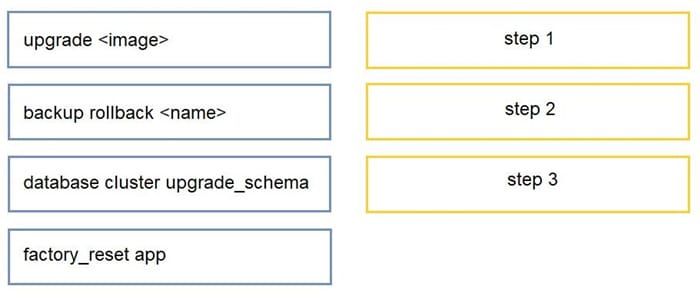
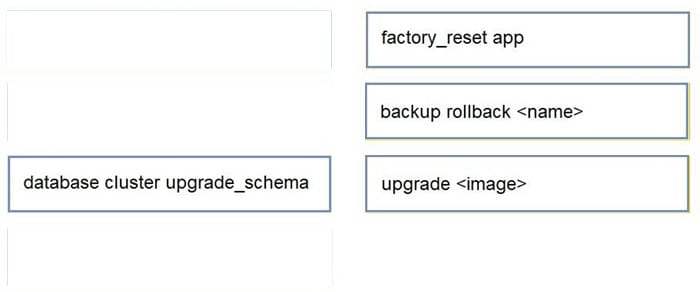
A Cisco Meeting Server administrator upgrades a cluster but encounters an issue that requires downgrading to a previous version. Drag and drop the MMP commands from the left into the order on the right to perform the downgrade. Not all options are used.
Select and Place:
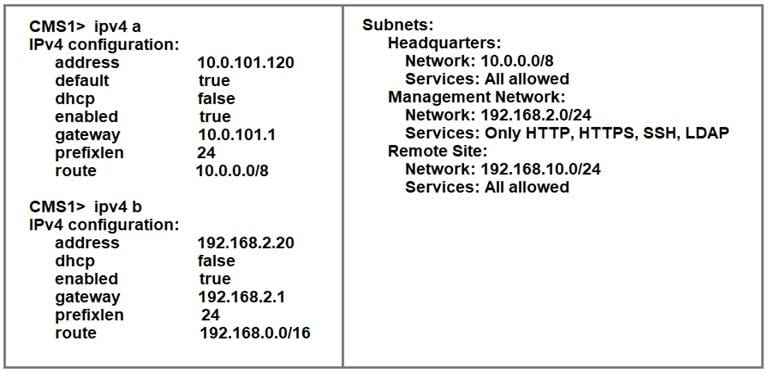
Refer to the exhibit. An administrator troubleshoots an issue with Cisco Meeting Server. Endpoints that call from the remote site cannot connect, but endpoints that call from headquarters can connect. What should the administrator do to resolve this issue?
A. Add a route for 192.168.10.0/24 to interface b.
B. Set interface b as the default interface.
C. Remove the route for 192.168.0.0/16 from interface b.
D. Enable DHCP on interface a but not on interface b.
Content-Type: application/sdp Content-Length: 4938 v=0 o=Acano 0 0 IN IP4 10.0.101.120 s=c=IN IP4 10.0.101.120 b=CT:16 t=0 0 m=audio 50262 RTP/AVP 108 107 109 110 9 99 111 100 104 103 0 8 15 102 18 13 118 101 a=crypto:1 AEAD_AES_128_GCM ************************************************|2^48 a=crypto:2 AEAD_AES_256_GCM ********************************************************************|2^48 a=crypto:3 AES_CM_128_HMAC_SHA1_80 *******************************************************|2^48 a=crypto:4 AES_CM_128_HMAC_SHA1_32 *******************************************************|2^48
Refer to the exhibit. Users report that they do not see a high-quality picture on the high-definition endpoints when they call into Cisco Meeting Server. An engineer must extract the SDP that is offered by Cisco Meeting Server from the SIP traces to troubleshoot. What is the cause of this issue?
A. Cisco Meeting Server is not configured for H.265 to support high-definition video calling.
B. The AES ciphers are not compatible with high-definition video calling.
C. The Content-Length value in the SDP does not support high-definition video calling.
D. The SIP call bandwidth is not at a value that supports high-definition video calling.
An engineer must configure Cisco Meeting Server integration to Cisco UCM. Which DNS A record must be configured to accomplish this goal?
A. Call Bridge
B. SRV
C. Conference Name
D. Cisco UCM Subscriber
An administrator notices that the Cluster section is not available under the configuration menu in the Cisco Meeting Server web interface. There are three Cisco Meeting Server servers that must run Call Bridge and database services in a single cluster. Which configuration should be completed?
A. Certificates must be configured on the Call Bridge.
B. Call Bridge groups must be created in the API.
C. Call Bridges must be connected to a database cluster.
D. Call Bridge clustering must be configured in the CLI.
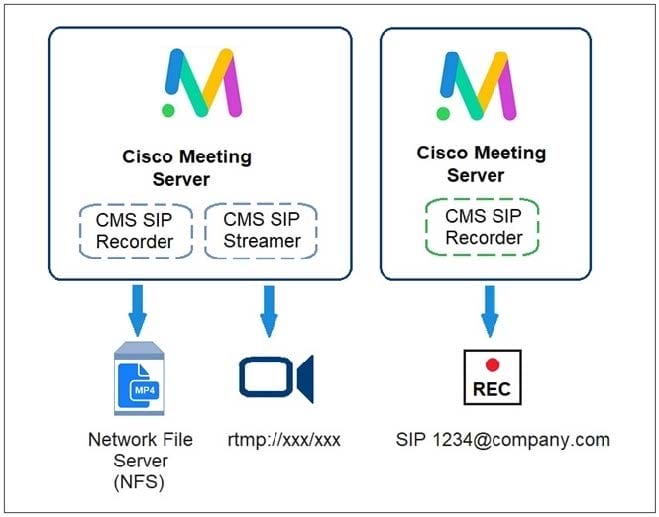
Refer to the exhibit. Which two features are supported in the Cisco Meeting Server recording and streaming solution? (Choose two.)
A. editing recordings
B. portal to access recordings
C. 1080p resolution for streaming
D. changing layouts
E. closed captioning in streaming
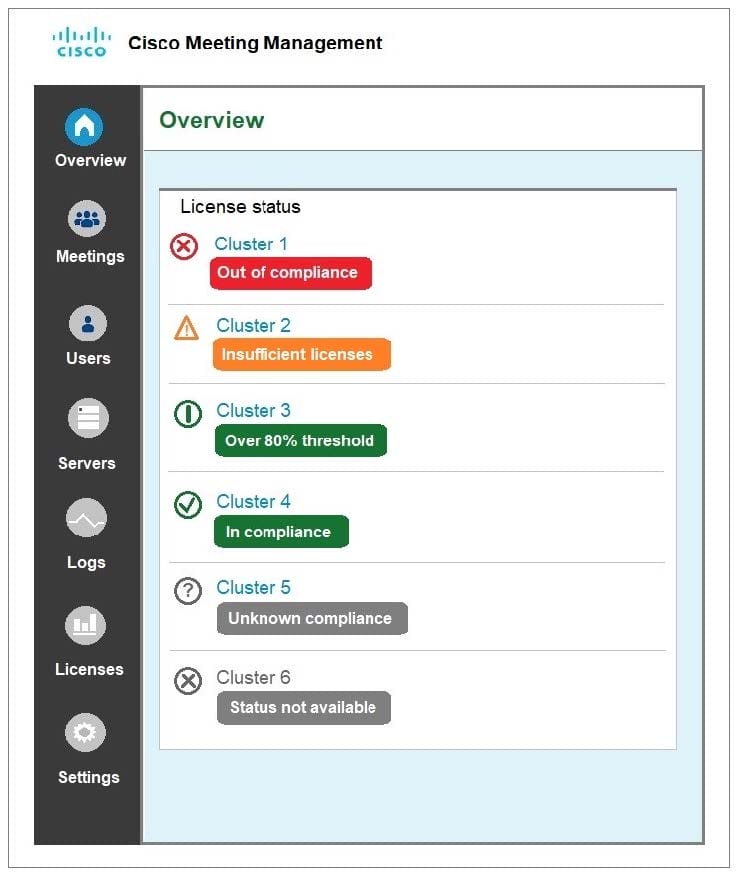
Refer to the exhibit. What does this notification indicate about activity over the last 90 days?
A. In cluster 2, more licenses have been used than are installed for less than 15 days.
B. In cluster 3, the license agreement will remain in compliance for 20 more days.
C. In cluster 4, at least 5 percent of the installed licenses have not been used.
D. In cluster 6, the license agreement has been out of compliance for more 30 days.

Refer to the exhibit. An administrator tries to access Cisco TMS GUI and sees this error message. Which step resolves this issue?
A. Restart the Windows server that hosts Cisco TMS.
B. Connect to the Windows server that hosts Cisco TMS and manually review the service logs.
C. Navigate directly to the Cisco TMS server maintenance page and download diagnostic files.
D. Restart World Wide Web Publishing Service on the Windows server that hosts Cisco TMS.
outgoing SIP TLS data to 10.0.101.111:5061 from 10.0.101.121:43332, size 5430: BEGINNING OF MESSAGE INVITE sip:jabberuser@pod1.local SIP/2.0 Via: SIP/2.0/TLS 10.0.101.121:5061;branch=z9hG4bK6e7932e8ae287a80ee699eb04a6155a2 Call-ID: cf600c54-974c-48e5-92e2-95b1d4b9218f CSeq: 1199885731 INVITE Max-Forwards: 70 Contact:
incoming SIP TLS data from 10.0.101.111:5061 to 10.0.101.121:43332, size 402: BEGINNING OF MESSAGE SIP/2.0 403 Forbidden Via: SIP/2.0/TLS 10.0.101.121:5061;branch=z9hG4bK6e7932e8ae287a80ee699eb04a6155a2 From: "CCNP Collaboration"
Refer to the exhibit. Some calls fail to connect after an engineer implements load balancing for a Cisco Meeting Server cluster. The engineer determines that if a call leaves Cisco UCM using the Cisco Meeting Server 1 SIP trunk, but the conference is already hosted on Cisco Meeting Server 2, then the call fails. If the call leaves Cisco UCM using the Cisco Meeting Server 2 SIP trunk, but the conference is already hosted on Cisco Meeting Server 1, then the call fails. What is the cause of the issue?
A. Cisco UCM is configured with the wrong X.509 certificate name for the Call Bridge.
B. Cisco UCM is sending calls to a Cisco Meeting Server when the calls are hosted on another Call Bridge in the same cluster.
C. The Cisco UCM SIP trunk security profile is not configured to accept the replaces header.
D. Cisco UCM does not have a SIP trunk to the Call Bridge.
An administrator sets up conference resources by using a clustered Cisco Meeting Server deployment for video endpoints that are registered to Expressway. The administrator must ensure that no single server gets overloaded within the cluster. What should be configured to accomplish this goal?
A. a record with the cluster FQDN of the Cisco Meeting Server in the external DNS servers.
B. Expressway-C as the traversal client to Expressway-E.
C. Cisco Meeting Server and Expressway-C in the same domain.
D. a separate zone for Cisco Meeting Server servers in the cluster.

Home | Contact Us | About Us | FAQ | Guarantee & Policy | Privacy & Policy | Terms & Conditions | How to buy
Copyright © 2026 pass4itsure.com. All Rights Reserved