 TESTED 24 Jun
2VB-601 Online Practice Questions and Answers
Which statement accurately describes cache tier sizing guidance for an all-flash vSAN cluster that will be supporting write-intensive workloads?
A. Multiple disk groups with larger cache devices should be used.
B. Multiple disk groups with two cache devices per disk group should be used.
C. A single disk group with a small cache device should be used to minimize de-staging write amplification.
D. Two cache devices per disk group should be configured for redundancy.
Which format for desktops does vSAN support?
A. vmfsSparse
B. SE Sparse Disk
C. Horizon Sparse
D. vSAN Sparse
Which three of the listed objects types can be viewed in the vSAN Used Capacity Breakdown user interface? (Choose three.)
A. Swap objects
B. Disk groups
C. File system overhead
D. Virtual disks
E. Physical disks
A cache tier device experiences a permanent disk failure.
Which of the below represents a valid process for replacing the failed disk?
A. 1. The hot spare disk replaces the failed disk immediately.
2. Physically replace the failed disk.
B. 1. Using the vSphere Web Client, replace the failed disk with the hot spare disk.
2. Physically replace the failed disk.
C. 1. Using the vSphere Web Client, delete the failed disk from the vSAN cluster.
2.
Physically replace the failed disk.
3.
Using the vSphere Web Client, re-create the disk group.
D. 1. Physically replace the failed disk and vSAN automatically takes care of the rest of the process.
When can a change to a storage policy be made?
A. Only when creating a new policy, because policies become protected objects after creation.
B. A change to SPBM policies can be made at any time.
C. A change to a policy can be made at any time, but only if there are no VMs using that policy.
D. After shutting down any VMs using that policy to ensure data integrity.

The following are configuration details for a three-node vSAN cluster:
1.
Each host has two disk groups and each disk group has 7x1.2TB 10K SAS drives.
2.
Each host has 16.8TB of raw capacity and the three-node cluster has 50.4TB of raw capacity.
3.
Deduplication and compression are not enabled.
Based on the following FTT Values in the storage policy, what is the total usable capacity?
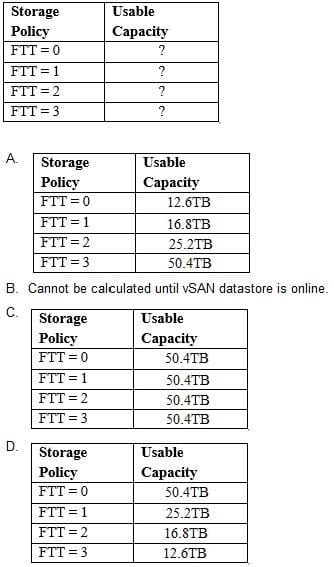
A. Option A
B. Option B
C. Option C
D. Option D
Which three sources can be queried to retrieve storage policy components? (Choose three.)
A. vSphere API for IO Filtering (VAIO)
B. Virtual Volumes (VVols)
C. vCenter
D. vSAN
E. Storage IO Control (SIOC)
Which vSAN health check category displays information about vSAN object health?
A. Online Health
B. Data
C. Limits
D. Performance Service
What is the result of powering on a virtual machine that is not compliant with its storage policy?
A. The virtual machine powers on in read-only mode.
B. The virtual machine becomes inaccessible.
C. The virtual machine powers on in a suspended state.
D. The virtual machine powers on successfully.
With the Default vSAN Storage Policy applied to all virtual machines, which statement is true about a vSAN three-node configuration?
A. RAID-5/6 erasure coding can be enabled to save space in an all-flash vSAN configuration.
B. It can migrate all data from a node during maintenance.
C. It requires a witness appliance.
D. It can tolerate only one host failure.

Home | Contact Us | About Us | FAQ | Guarantee & Policy | Privacy & Policy | Terms & Conditions | How to buy
Copyright © 2026 pass4itsure.com. All Rights Reserved