 TESTED 21 Jul
1Z0-997 Online Practice Questions and Answers
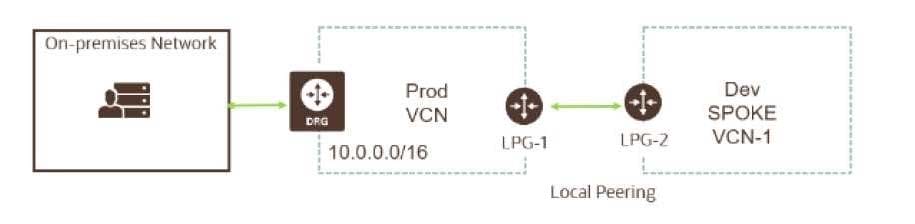
Your customer recently ordered for a 1-Gbps Fast Connect connection In ap-tokyo-1 region of Oracle Cloud Infrastructure (OCI). They will us this to one Virtual cloud Network (VCN) in their production (OC1) tenancy and VCN In their development OC1 tenancy As a Solution Architect, how should yon configure and architect the connectivity between on premises and VCNs In OCI?
A. Create two private virtual circuits on the FastConnect link. Create two Dynamic Routing Gateways, one for each VCNs. Attach the virtual circuits to the dynamic routing gateways.
B. You cannot achieve connectivity using single FastConnect link as the production and the development VCNs-are in separate tenancies. Request one more FastConnect connection.
C. Create a single private virtual circuit over FastConnect and attach fastConnect to either of the
D. Create a hub-VCN that uses Dynamic Routing Gateway (DRG) to communicate with on-premises network over FastConnect. Connect the hub-VCN to the production VCN spoke and with development VCN spoke, each peered via their respective local Peering Gateway (LPG)
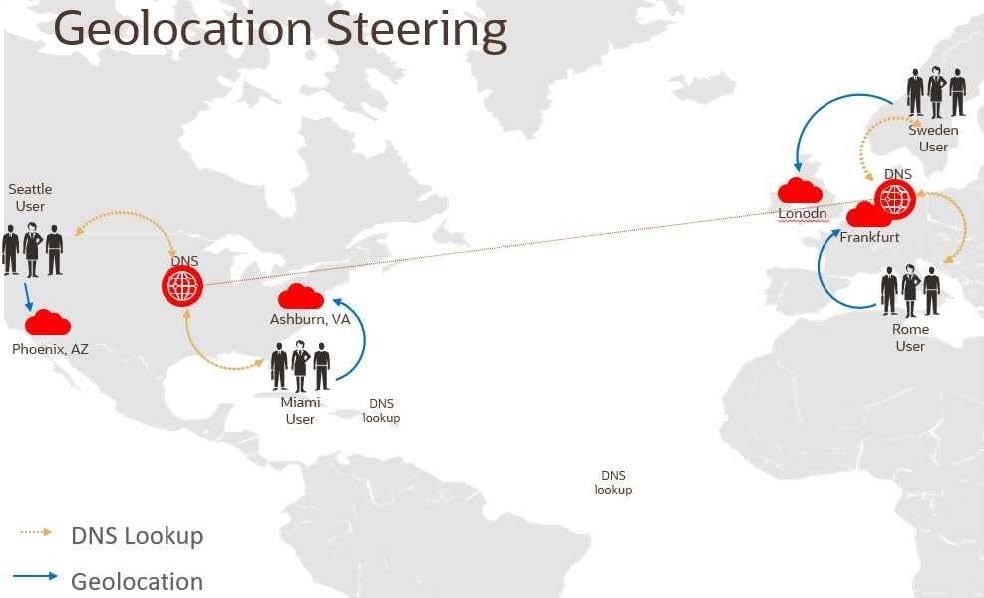
A global retailer is setting up the cloud architecture to be deployed in Oracle Cloud infrastructure (OCI) which will have thousands of users from two major geographical regions: North America and Asia Pacific. The requirements of the services are:
*
Service needs to be available 27/7 to avoid any business disruption
*
North American customers should be served by application running In North American regions
*
Asia Pacific customers should be served by applications running In Asia Pacific regions
*
Must be resilient enough to handle the outage of an entire OCI region
A.
OCl DNS, Traffic Management with Failover steering policy
B.
OCl DNS, Traffic Management with Geolocation steering policy. Health Checks
C.
OCl DNS, Traffic Management with Geolocation steering policy
D.
OCl DNS,' Traffic Management with Load Balancer steering policy, Health Checks
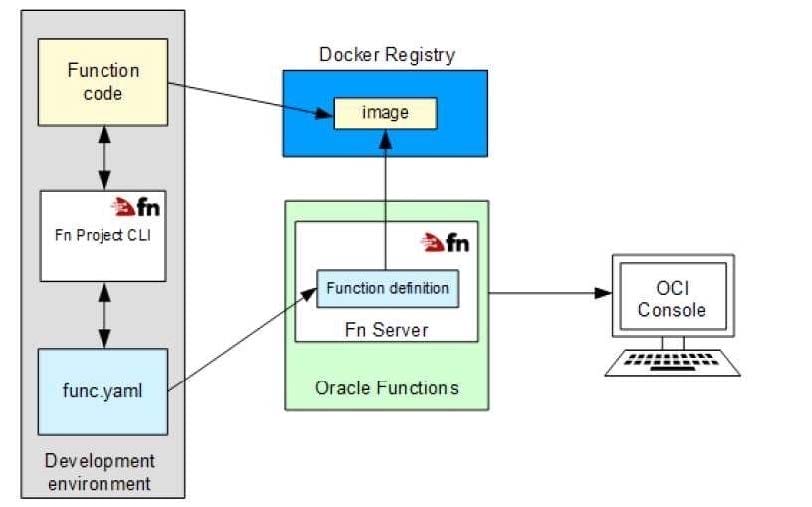
A global retailer has decided to re-design its e-commerce platform to have a micro-services architecture.
They would like to decouple application architecture into smaller, independent services using Oracle Cloud
Infrastructure (OCI). They have decided to use both containers and servers technologies to run these
application instances.
Which option should you recommend to build this new platform?
A. Install a kubernetes cluster on OCI and use OCI event service.
B. Use Oracle Container Engine for kubernetes, OCI Registry and OCI Functions.
C. Use OCI Resource Manager to automate compute Instances provisioning and use OCI Streaming service.
D. Use OCI functions, OCI object storage and OCI event service.
An organization has its IT infrastructure in a hybrid setup with an on-premises environment and an Oracle Cloud Infrastructure (OCI) Virtual Cloud Network (VCN) in the us-phonix-1 region. The on- premise applications communications with compute instances inside the VPN over a hardware VPN connection. They are looking to implement an Intrusion detected and Prevention (IDS/IPS) system for their OCI environment. This platform should have the ability to scale to thousands of compute of instances running inside the VCN. How should they architect their solution on OCI to achieve this goal?
A. Set up an OCI Private Load Balance! and configure IDS/IPS related health checks at TCP and/or HTTP level to inspect traffic
B. Configure each host with an agent that collects all network traffic and sends that traffic to the IDS/IPS platform to inspection
C. There Is no need to implement an IPS/IDS system as traffic coming over IPSec VPN tunnels Is already encrypt
D. Configure autoscaling on a compute Instance pool and set vNIC to promiscuous mode to called traffic across the vcn and send it IDS/IPS platform for inspection.
You are working as a cloud engineer for an IoT startup company which is developing a health monitoring pet collar for dogs and cats. The company collects biometric Information of the pet every second and then sends it to Oracle Cloud Infrastructure (OCI) Your task is to come up with an architecture which will accept and process the monitoring data as well as provide complete trends and health reports to the pet owners. The portal should be highly available, durable, and scalable with an additional feature for showing real time biometric data analytics. which architecture will help you meet this requirement?
A. Use OCI Streaming Service to collect the incoming biometric data. Use Oracle Functions to process the date and show the results on a real-time dashboard and store the results lo OCI Object Storage Store the data In OCI Autonomous Data warehouse (ADW) to handle analytics.
B. Launch an open source Hadoop cluster to collect the Incoming biometrics data Use an Open source Fluentd cluster to analyze the- data me results to OCI Autonomous Transaction Processing (ADW)to handle complex analytics
C. Create an OCI Object Storage bucket to collect the incoming biometric data from the smart pet collar Fetch the data horn OC\ Object storage to OCI Autonomous Data Warehouse (ADW) every day and run analytics Jobs with it
D. Use OCI Streaming Service to collect the incoming biometric data. Use an open source Hadoop cluster to analyze the data horn streaming service. Store the results to OCI Autonomous Data warehouse (ADW) to handle complex analytics.
To serve web traffic for a popular product, your cloud engineer has provisioned four BM.Standard2.52 instances, event spread across two availability domains in the us-asburn-1 region: LoadBalancer is used to deliver the traffic across instances. After several months, the product grows even more popular and you need additional compute capacity. As a result, an engineer provisioned two additional VM.Standard2.8 instances. You register the two VM. Standard2. 8 Instances with your load Balancer Backend sot and quickly find that the VM Standard2.8 Instances running at 100% of CPU utilization but the BM.Standard2 .52 instances have significant CPU capacity that's unused. Which option is the most cost effective and uses instances capacity most effectively?
A. Configure your Load Balance, with weighted round robin policy to distribute traffic to the compute instances, with more weight assigned to bare metal instances.
B. Configure Autoscaling instance pool with LoadBalancer to add up to 3 more BM.Standard2.52 Instances when triggered. Shut off VM.Standard2.8 instances.
C. Route traffic to BM.Standard2.52 and VM Standard2.8 instances directly using DNS and Health Checks. Shut off the load Balances.
D. Configure LoadBalancer with two VM Standard2.8 instances and use Autoscalling Instant pool to add up to two additional VM instances. Shut off BM.Standard2.52 instances.
Give this compartment structure:
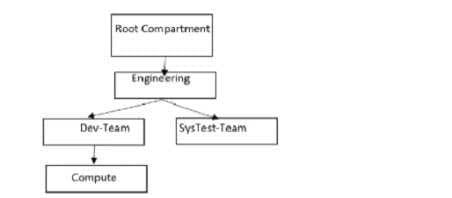
You want to move a compute instance that is in 'Compute' compartment to 'SysTes-Team'. You login to your Oracle Cloud Infrastructure (OCI)account and use the 'Move Resource' option. What will happen when you attempt moving the compute resource?
A. The move will be successful though Compute Instance and its Public and Private IP address will stay the same. The Compute instance VNIC will need to be moved separately. The Compute instance will still be associated with the original VCN.
B. The move will fail and you will be prompted to move the VCN first. Once VCN is moved to the target compartment, the Compute instance can be moved.
C. The move will be successful though Compute Instance Public and Private IP address changed, and it will be associated to the VCN in target compartment.
D. The move will be successful though Compute Instance and its Public and Private IP address will stay the same. The Compute instance VNIC will still be associated with the original VCN.
A new International hacktivfst group based in London, launched a wide scale cyber attacks Including SQL Injection and Cross-Site Scripting (XSS) across multiple websites which are hosted in Oracle Cloud Infrastructure (OCI). As an IT consultant, you must configure a Web Application Firewall (WAF) to protect these website against the attacks. How should you configure your WAF to protect the website against those attacks?
A. Enable an Access Rule that contains XSS Filters Categories and SQL Filters Categories.
B. Enable a Protection Rule to block the attacks based on HTTP Headers that contain XSS and SQL strings.
C. Enable a Protection Rule that contains XSS Filters Categories and SQL Filters Categories.
D. Enable an Access Rule to block the IP Address range from London.
E. Enable a Protection Rule to block requests that came from London.
You are running a legacy application In a compute Instance on Oracle Cloud Infrastructure (OCI). To provide enough space for it to store internal data, a block volume is attached to the instance in paravirtualized mode. Your application is not resilient to crash-consistent backup. What should you do to securely backup the block volume?
A. Create a volume group, add the block volume and boot volume and then run the volume group backup.
B. Before creating a backup, save your application data and detach the block volume.
C. Create a backup, detach the block volume and save your application data.
D. Use the block volume clone feature to save cost and speed up the backup process.
You are working with a customer who needs to attach an Oracle Cloud Infrastructure (OCI) block volume to a VM instance with read/write access type. The customer wants to know if the number of IOPS and throughput performance differs between the following two choices: ?Option A: attach a single 1 TB block volume to the VM instance ?Option B: attach two separate 500 GB block volumes In a RAID 0 array configuration to the VM instance You can assume that the customer is using iSCSI attachment type to attach the volumes to the instance. In addition, you can assume 1 MB block size for throughput and 4 KB block size for IOPS consideration.
How should you respond to the customer?
A. Option B provides higher level of throughput, but lower level of IOPS performance.
B. Both options provide the same number of IOPS and throughput performance.
C. Option A provides better IOPS, but lower throughput performance.
D. Option B provides better IOPS and throughput performance.

Home | Contact Us | About Us | FAQ | Guarantee & Policy | Privacy & Policy | Terms & Conditions | How to buy
Copyright © 2026 pass4itsure.com. All Rights Reserved