 TESTED 13 Jul
1Z0-815 Online Practice Questions and Answers
Given:
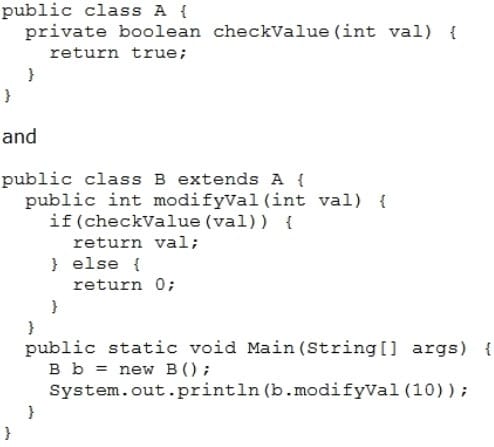
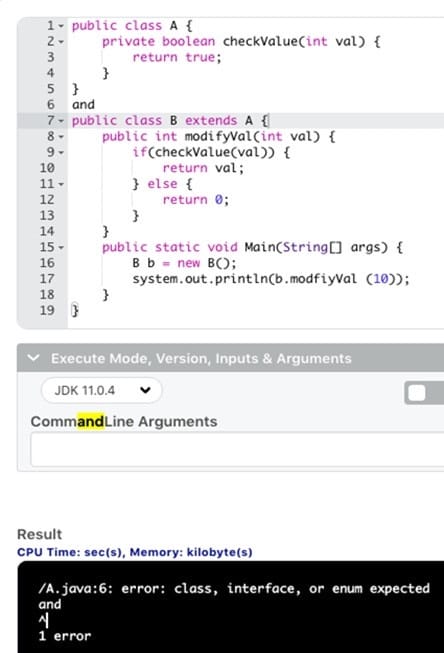
What is the result?
A. nothing
B. It fails to compile.
C. 0
D. A java.lang.IllegalArgumentException is thrown.
E. 10
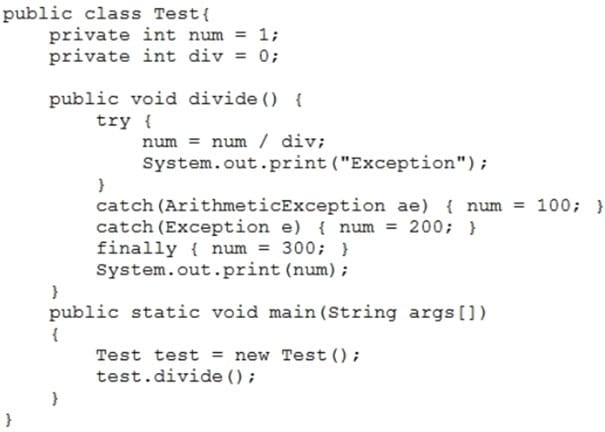
Given:
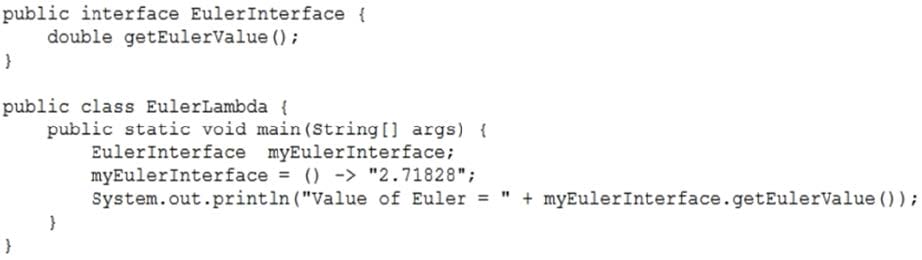
What is the result?
A. It throws a runtime exception.
B. Value of Euler = 2.71828
C. The code does not compile.
D. Value of Euler = "2.71828"
Which two statements are true about Java modules? (Choose two.)
A. Modular jars loaded from --module-path are automatic modules.
B. Any named module can directly access all classes in an automatic module.
C. Classes found in –classpath are part of an unnamed module.
D. Modular jars loaded from –classpath are automatic modules.
E. If a package is defined in both the named module and the unnamed module, then the package in the unnamed module is ignored.
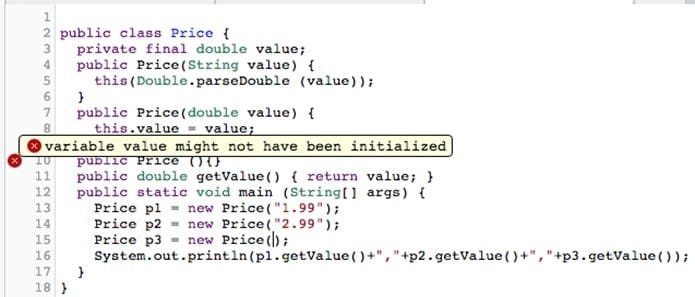
Given: What is the result?
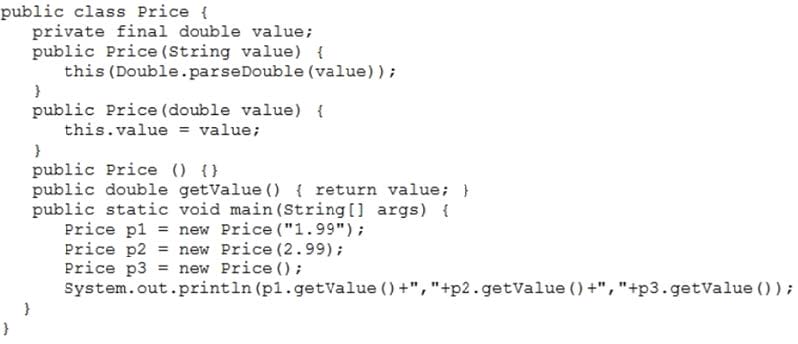
A. The compilation fails.
B. 1.99,2.99,0
C. 1.99,2.99,0.0
D. 1.99,2.99
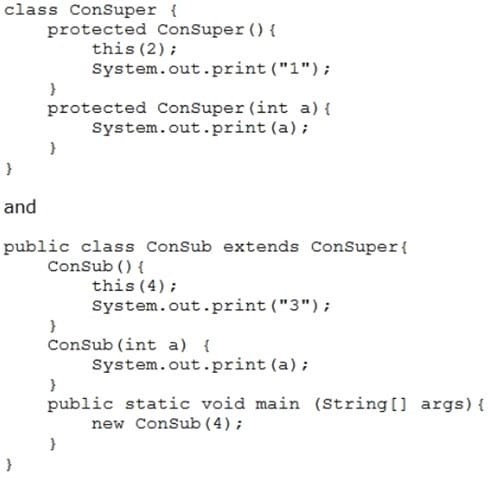
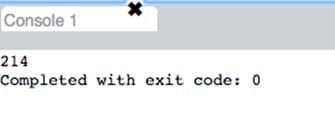
Given:
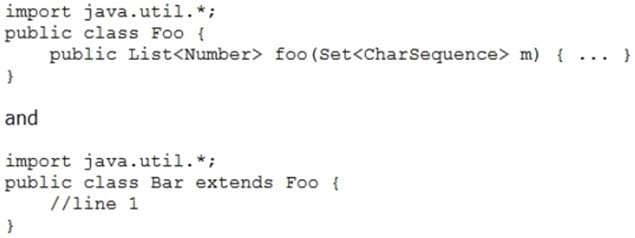
Which two statements can be added at line 1 in Bar to successfully compile it? (Choose two.)
A. public List
B. public ArrayList
C. public List
D. public List
E. public List
F. public ArrayList
Which describes an aspect of Java that contributes to high performance?
A. Java prioritizes garbage collection.
B. Java has a library of built-in functions that can be used to enable pipeline burst execution.
C. Java monitors and optimizes code that is frequently executed.
D. Java automatically parallelizes code execution.
Which command line runs the main class com.acme.Main from the module com.example?
A. java --module-path mods com.example/com.acme.Main
B. java –classpath com.example.jar com.acme.Main
C. java --module-path mods -m com.example/com.acme.Main
D. java -classpath com.example.jar –m com.example/com.acme.Main
Which three initialization statements are correct? (Choose three.)
A. int x = 12_34;
B. short sh = (short)`A';
C. String contact# = "(+2) (999) (232)";
D. boolean true = (4 == 4);
E. float x = 1.99;
F. int[][] e = {{1,1},{2,2}};
G. byte b = 10; char c = b;

Home | Contact Us | About Us | FAQ | Guarantee & Policy | Privacy & Policy | Terms & Conditions | How to buy
Copyright © 2026 pass4itsure.com. All Rights Reserved