 TESTED 22 Jun
1Z0-511 Online Practice Questions and Answers
Refer to the exhibit.
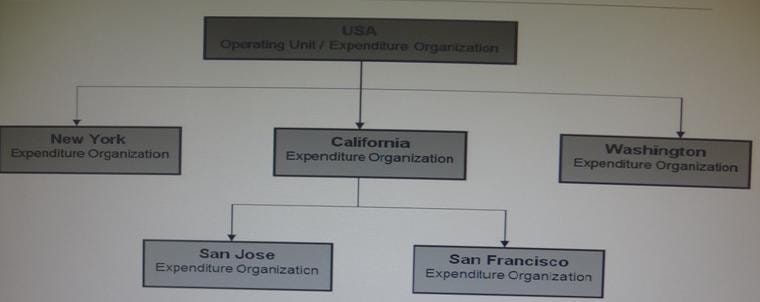
In your company's Expenditure/Event Organization Hierarchy, organization labor costing rules are assigned to all organizations except San Jose. What happens when you run the "PRC: Distribute labor costs" program for a timecard transaction entered by an employee from the San Jose organization?
A. Therule assignedfor SanFranciscotakes precedence and the transaction will hesuccessfully a distributed.
B. The rule assigned for USA takes precedence and thetransaction will he successfully cost distributed.
C. The rule assigned for California takes precedence and the transaction will be successfullycostdistributed.
D. The program ignores this transaction, because no labor costing ruleis assigned for San Jose.andcompletesnormally.
E. The program completes normally. However, the output will have this transaction under the exceptions sectionwith a message "No Labor costing rule assigned for organization."
Your client has expressed a desire to produce and summarize invoice lines for Non-Labor transactions by type of expenditure based on high level tasks of the project. Which invoice formal grouping should he used to achieve this?
A. TopTask,ExpenditureType
B. TopTask,Employee
C. Revenue Category,Expenditure Category, Top Task
D. TopTask,Expenditure Category
E. TopTask, Revenue Category, Expenditure Category,Expenditure Type
A project is enabled for Burdening by setting up a burden schedule at the project type level. A Miscellaneous expenditure Item Is charged to the project with a raw cost of $100 and expenditure type "Overhead." The "Overheads" expenditure type is excluded from all cost bases in the burden structure.
What happens when the "PRC: Distribute usage and Miscellaneous Costs" program is run for this project?
A. The program errorswith the message "Missing Expenditure type."
B. The program completes successfully; Raw Cost = $100, Burden Cost=$0,TotalBurdened cost=$100.
C. Theprogram completes successfully; Raw Cost=$100, Burden Cost= $100,TotalBurdened cost=$100.
D. Theprogram completes successfully; Raw Cost =$100, Burden Cost=$0, Total Burdened cost= $0.
A project has two customer billing elements. One part of the project is based on a fixed fee and the other part is a variable based on a cost plus basis. The customer requires separate invoices for fixed fee elements and variable works elements. How can agreements be used to provide separate invoices?
A. Createeach element as a top task and implement top task billing for the project.
B. Create each element as a top task on the project and create an agreement for variable works and onefor fixed fee.Then fund the project at the top task level.
C. Have one agreement and create an invoice grouping rule in Accounts Receivable.
D. Create oneagreement and fund the project.
E. Use billing events and create separate events per purchase order.
A company requires advance payments for their contract projects. How would they ensure that for specific types of work they always have an advance payment?
A. Create a specific agreement type and use the advance receipts required extension toensure that theseagreements require advancepayments.
B. Set the customer profilein Accounts Receivable to require advance payments.
C. Createa transaction control for specificagreement types to ensure thatadvance paymentsare received.
D. Entera negative agreement value andfunded amount.
E. Fund the projects with a dummy agreement.
A customer needs to enable all employees to enter timecards through the web against projects and tasks. What needs to be implemented to allow time to be recorded in Projects?
A. Project CostingOracleTime andLaborHuman Resources
B. OracleTime andLaborPayrollPurchasing
C. Project CostingProject ManufacturingHuman Resources
D. Projects Resource ManagementOracleTime and LaborHuman Resources
E. Project CostingOracle Time and LaborHuman ResourcesPayroll
A project manager wants to create a revenue budget based on the project agreement and allocated funding. How can this be achieved?
A. by manually creatingarevenue budget
B. by selecting Funding revaluation in the systemimplementation options.
C. by selecting the "baseline project without budget" option, which will createa revenue budgetautomatically based on project funding
D. by selecting Invoiceat top taskfor the project
E. by setting transaction controls
Identify two ways to ensure that correct class category codes are recorded against relevant projects.
A. Define as single template that has the class category already defined.
B. Define the class category as mandatory on relevant project types.
C. Define the class category as mandatory In the quick entry of the relevant templates.
D. Define a project status workflow that checks whether the class category is definedbeforechanging a project status.
E. Includea"Not applicable" code in the class category definition.
An organization has specific departments that manage capital projects. How would you ensure that only these departments own capital projects?
A. Use the transaction control Functionality at the project level.
B. Use the settings in "Additional Details" of the Project/Task owning organization classification.
C. Remove the asset definition options from the templates used by departments that arenot managing capital projects.
D. Use the Project/Task owning organization hierarchy in the implementation options.
E. Set up a separate organization hierarchy for the departments that are managing capital projects.
A customer is planning to upgrade from 11/to R12 to use Subledger Accounting (SLA). Identify the three options available to the customer.
A. Configure SLA without using the existing AutoAccountingsetup.SLAgenerates accountingcombinations without AutoAccounting.
B. Continue to use the existing AutoAccounting setup. SLAuses the default flexfield valuesgenerated byAutoAccounting.
C. Define alternative accounting rulesin SLA to overwrite the defaultvalues provided byAutoAccounting.
D. Use the existingAutoAccountingsetup at the point of upgrade. Evaluate the benefits ofSLA and migrate to SLA when and if beneficial.
E. Use the existingAutoAccountingsetup only. SLA is not applicable to Projects because Oracle Projects hasAutoAccounting.

Home | Contact Us | About Us | FAQ | Guarantee & Policy | Privacy & Policy | Terms & Conditions | How to buy
Copyright © 2026 pass4itsure.com. All Rights Reserved