 TESTED 15 Jul
1Z0-149 Online Practice Questions and Answers
Examine this table in the SH schema:
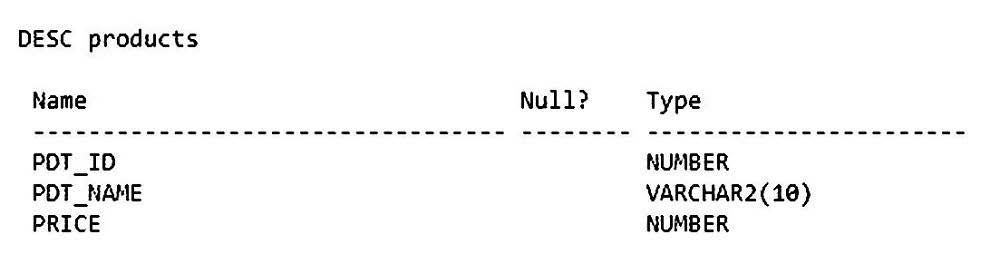
Now, examine this code:
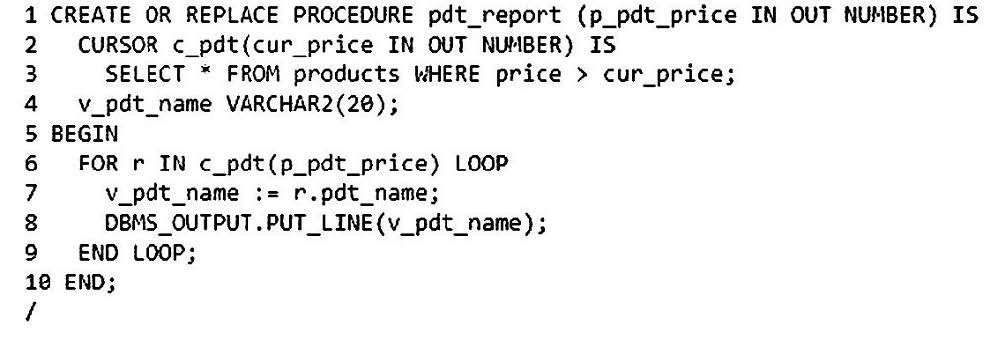
Which two changes are required to ensure that PDT_REPORT executes successfully? (Choose two.)
A. In line 1, change IN OUT mode to IN mode.
B. In line 2, change IN OUT mode to IN mode.
C. In line 3, replace CUR_PRICE with P_PDT_PRICE in the query condition.
D. In line 1, add the default parameter DEFAULT 2000.
E. In line 6, replace P_PDT_PRICE parameter name with CUR_PRICE.
F. In line 2, add the default parameter DEFAULT 2000.
Which two blocks of code display a numerical zero? (Choose two.)
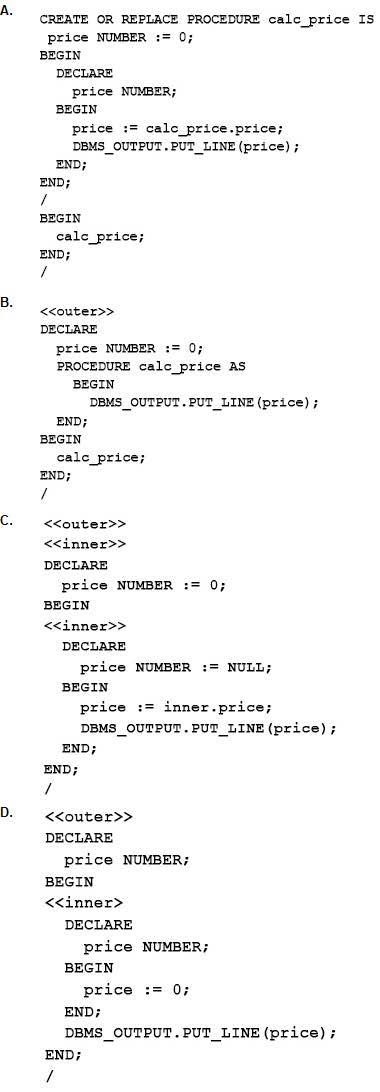
A. Option A
B. Option B
C. Option C
D. Option D
Which three are true about the procedure overloading feature? (Choose three.)
A. Each procedure can be a nested subprogram.
B. Each procedure's formal parameters can differ in data type or name.
C. Each procedure must use named notation to specify the corresponding actual parameters.
D. Each procedure's formal parameters must differ in name.
E. Each procedure can be a packaged subprogram.
F. Each procedure must use positional notation to specify the corresponding actual parameters.
G. Each procedure can be a standalone subprogram.
Which is true about counter variables in a FOR loop?
A. It must explicitly be declared.
B. It can be modified in the body of the loop.
C. It cannot be NULL.
D. It is accessible outside the body of the loop.
User ORA41 executes these statements successfully:
Now, examine this statement which is executed successfully by user ORA61 after a successful login:
EXECUTE ora41.update_emp_proc(100,25000);
Which two are true? (Choose two.)
A. The salary will be changed for employee 100 in the EMPLOYEES table owned by ORA41.
B. No update happens even though the procedure executes successfully.
C. The salary will be changed for employee 100 in the EMPLOYEES table owned by ORA61.
D. The UPDATE privilege on ORA41.EMPLOYEES is not inherited by ORA61 through the procedure.
E. ORA61 will have been granted the UPDATE privilege explicitly on ORA41.EMPLOYEES before executing the statement.
Which three are true about DDL triggers? (Choose three.)
A. They cannot include the WHEN clause.
B. They must be created in an enabled state.
C. They can be fired when a table is truncated.
D. They fire only when a DDL statement is executed by the owner of the trigger.
E. They can be fired either before or after a DDL statement executes.
F. They can be fired when a privilege is granted to a user.
G. They must be created in a disabled state.
Which three statements are true about passing parameters to subprograms? (Choose three.)
A. PL/SQL assigns values to actual parameters in subprograms with unhandled exceptions.
B. IN parameters passed to subprograms act like constants, to which values cannot be assigned by the subprogram.
C. IN OUT parameters pass initial values to subprograms and return values updated by subprograms to the caller.
D. The actual parameter must be a variable when calling a subprogram with an OUT parameter.
E. IN parameters passed to subprograms act like variables, to which values can be assigned by the subprogram.
F. OUT parameters returning values to calling subprograms act like constants in the called subprogram.
G. Actual parameters corresponding to IN OUT formal parameters can be constants or expressions.
Examine these statements issued by user SH which execute successfully:
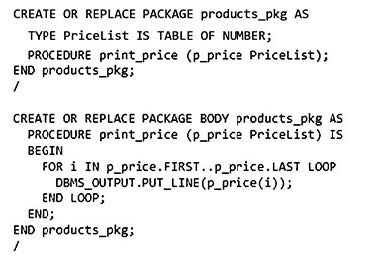
DBMS_OUTPUT.PUT_LINE(p_price(i)); END LOOP; END; END products_pkg; / Now, examine this anonymous block executed by SH:
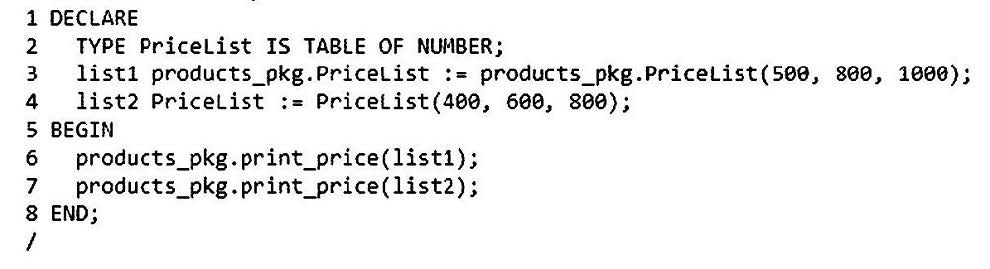
Which is true about the anonymous block?
A. It will execute successfully only if PriceList is removed from the DECLARE section and defined as a standalone collection type.
B. It will execute successfully only if PriceList is defined as an associative array in the package and anonymous block.
C. It will fail at lines 6 and 7.
D. It will fail only at line 7.
Examine this table in the SH schema:
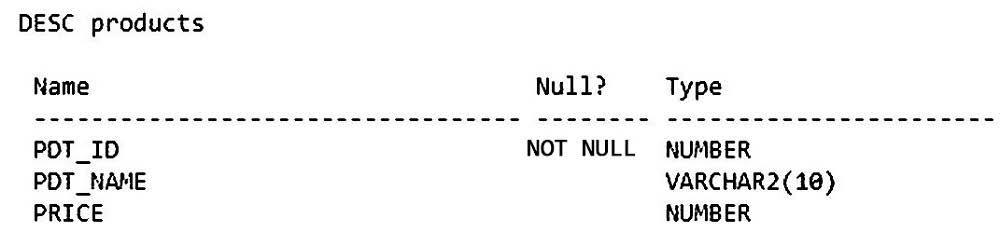
User SH executes this code:
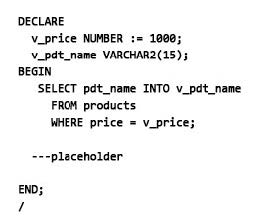
The program must terminate with a user-defined message and no rows displayed if more than one product's price is 1000. With which option must "---placeholder" be replaced?
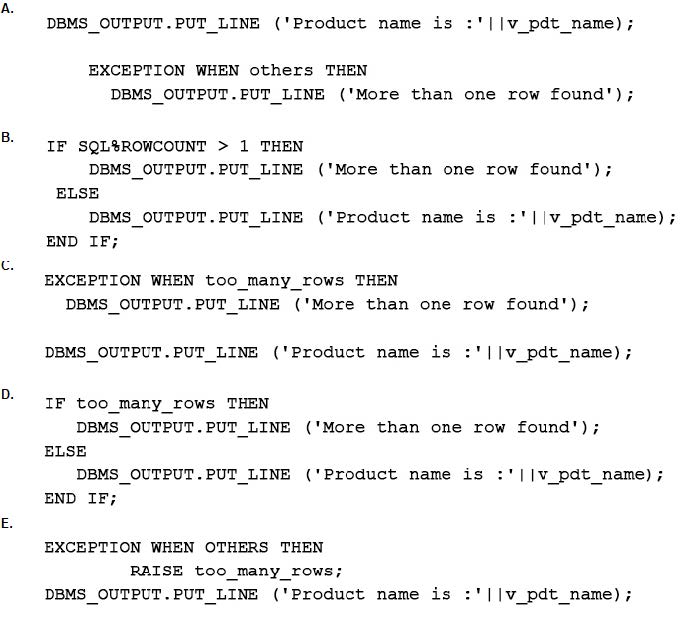
A. Option A
B. Option B
C. Option C
D. Option D
E. Option E
Which two are true about exception handling? (Choose two.)
A. Internally defined exceptions can be handled only by the OTHERS exception handler.
B. All declared exceptions are raised implicitly by the runtime system.
C. User-defined exceptions can be defined in the declarative part of any PL/SQL anonymous block, subprogram, or package.
D. Only predefined exceptions and user-defined exceptions can have a user-declared name associated with them.
E. Predefined exceptions are globally declared in the standard package.

Home | Contact Us | About Us | FAQ | Guarantee & Policy | Privacy & Policy | Terms & Conditions | How to buy
Copyright © 2026 pass4itsure.com. All Rights Reserved