 TESTED 13 Jul
1Z0-117 Online Practice Questions and Answers
Which type of SQL statement would be selected for tuning by the automatic SQL framework?
A. Serial queries that are among the costliest in any or all of the four categories: the past week, any day in the past week, any hour in the past week, or single response, and have the potential for improvement
B. Serial queries that have been tuned within the last 30days and have been SQL profiled by the SQL tuning Advisor.
C. Serial and parallel queries that top the AWR Top SQL in the past week only and have been SQL profiled by the SQL Tuning Advisor.
D. Serial queries that top the AWR Top SQL in the past week only and whose poor performance can be traced to concurrency issues.
E. Serial and parallel queries that are among the costliest in any or all of the four categories: the past week, and day in the past week, any hour in the past week, or a single response, and that can benefit from access method changes.
One of your databases supports a mixed workload.
When monitoring SQL performance, you detect many direct paths reads full table scans.
What are the two possible causes?
A. Histograms statistics not available
B. Highly selective filter on indexed columns
C. Too many sort operations performed by queries
D. Indexes not built on filter columns
E. Too many similar type of queries getting executed with cursor sharing disabled
You are logged in as the HR user and you execute the following procedure:
SQL > exec DBMS_STATS.SET_TABLE_PREFS (`HR', `EMPLOYEES', `PUBLISH', `FALSE'); SQL> exec DBMS_STATS.GATHER_TABLE_STATS (`HR', `EMPLOYEES');
Which statement is true about the newly gathered statistics?
A. They are temporary and purged when the session exits.
B. They are used by the optimizer for all sessions.
C. They are locked and cannot be overwritten.
D. They are marked as pending and stored in the pending statistics table.
A database supports three applications: CRM, ERP, and ACC. These applications connect to the database by using three different services: CRM_SRV for the
CRM application, ERP_SRV for the ERP application, and ACC_SRV for the ACC application.
You enable tracing for the ACC_SRV service by issuing the following command:
SQL> EXECUTE DBMS for the ACC_SRV service by issuing the following command:
SQL> EXECUITIVE DBMS_MONITOR. SERV_MOD_ACT_TRACE_ENABLE
(service_name => `ACC_SRV', waits => TRUE, binds = > FALSE, instance_name = > `inst1');
Which statement is true?
A. All trace information for the service connection to inst1 will be stored in a single trace file.
B. A trace file is not created because the module name is not specified.
C. A single trace file is created for each session that uses the ACC_SRV service.
D. Only those SQL statements that are identified with the ACC_SRV service executed on the inst1 instance are recorded in trace files.
E. All trace information for the ACC_SRV service connected to inst1 is stored in multiple trace files, which can be consolidated by using the tkprof utility.
You plan to bulk load data using INSERT /*+PARALLEL*/ INTO . . . . SELECT FROM statements.
Which four types of operations can execute in parallel on tables that have no bitmapped indexes or materialized views defined on term?
A. Direct path insert of a million rows into a partitioned, index-organized table containing one million rows.
B. Direct path insert of a million rows into a partitioned, index-organized table containing 10 million rows.
C. Direct path insert of a million rows into a nonpartitioned, index-organized table containing one million rows.
D. Direct path insert of a million rows into a nonpartitioned, heap-organized table containing 10 million rows.
E. Direct path insert of a million rows into a nonpartitioned, heap-organized table containing one million rows.
Which two statements are true about the trcsess utility?
A. It merges multiple trace files and produces a formatted output file.
B. It merges multiple trace files from a particular session into one single trace file.
C. It produces multiple files only for DBA sessions, which can be consolidated into one formatted file using the tkprof utility.
D. It produces multiple files for a service, which can be consolidated into one formatted file using the tkprof utility.
E. It merges files pertaining to a user session scattered across different processes in a shared server configuration.
See the table below:
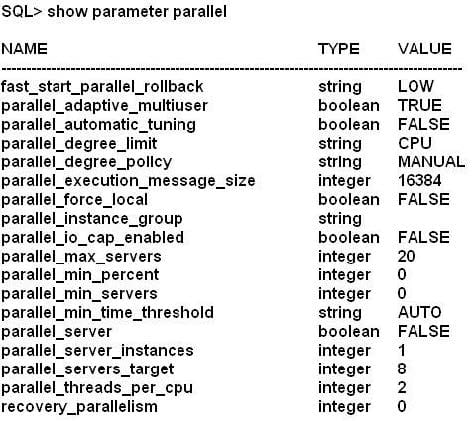
All execution servers are currently available and the sessions use defaults for all parallel settings.
In which two cases will statements execute in parallel?
A. When parallel hints are used but only if estimated serial execution takes more than 10 seconds.
B. When parallelism is defined at the statement level.
C. When the degree of parallelism is explicitly defined in the data dictionary for tables and indexes accessed by a query.
D. Parallel DDL statements but only if estimated serial DDL execution time is greater than 10 seconds.
E. When the degree of parallelism is explicitly defined for tables and indexes but only if estimated serial execution takes more than 10 seconds.
Examine the query and its execution plan: Which two statements are true regarding the execution plan?
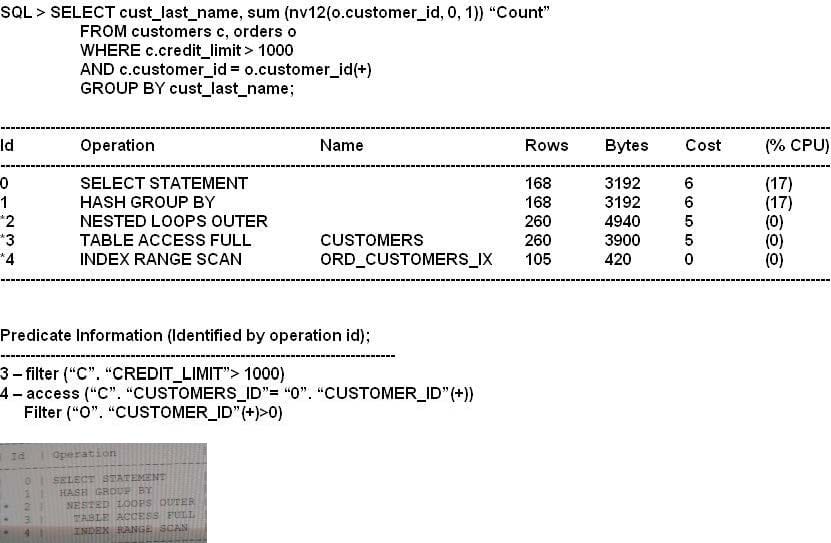
A. For every row of CUSTOMERS table, the row matching the join predicate from the ORDERS table are returned.
B. An outer join returns NULL for the ORDERS table columns along with the CUSTOMERS table rows when it does not find any corresponding rows in the ORDER table.
C. The data is aggregated from the ORDERS table before joining to CUSTOMERS.
D. The NESTED LOOP OUTER join is performed because the OPTIMZER_MODE parameter is set to ALL_ROWS.
Examine the Exhibit1 to view the structure of an indexes for the EMPLOYEES table.
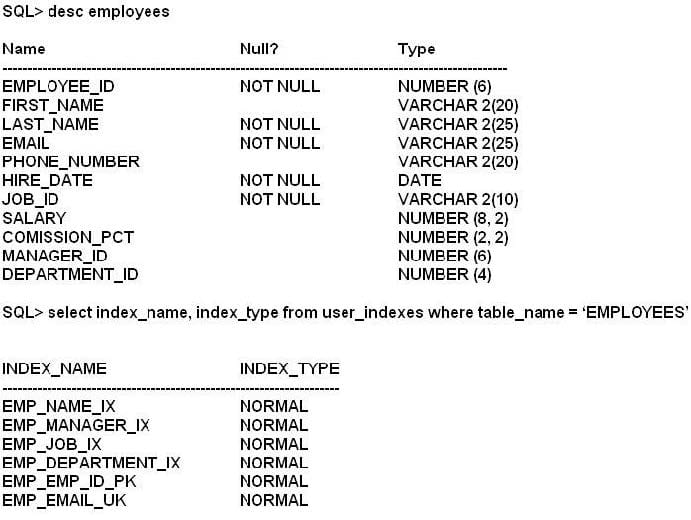
Examine the query:
SQL> SELECT * FROM employees WHERE employees_id IN (7876, 7900, 7902);
EMPLOYEE_ID is a primary key in the EMPLOYEES table that has 50000 rows.
Which statement is true regarding the execution of the query?
A. The query uses an index skip scan on the EMP_EMP_ID_PK index to fetch the rows.
B. The query uses the INLIST ITERATOR operator to iterate over the enumerated value list, and values are evaluated using an index range scan on the EMP_EMP_ID_PK index.
C. The query uses the INLIST ITERATOR operator to iterate over the enumerated value list, and values are evaluated using a fast full index scan on the EMP_EMP_ID_PK index.
D. The query uses the INLIST ITERATOR operator to iterate over the enumerated value list, and values are evaluated using an index unique scan on the EMP_EMP_ID_PK index.
E. The query uses a fast full index scan on the EMP_EMP_ID_PK index fetch the rows.
Examine the Exhibit to view the structure of and indexes for the EMPLOYEES and DEPARTMENTS tables:
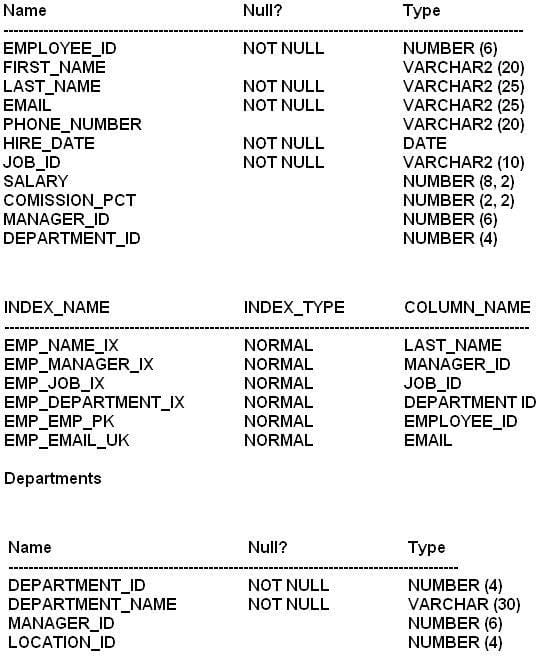
EXAMINE the SQL statement and its execution plan:
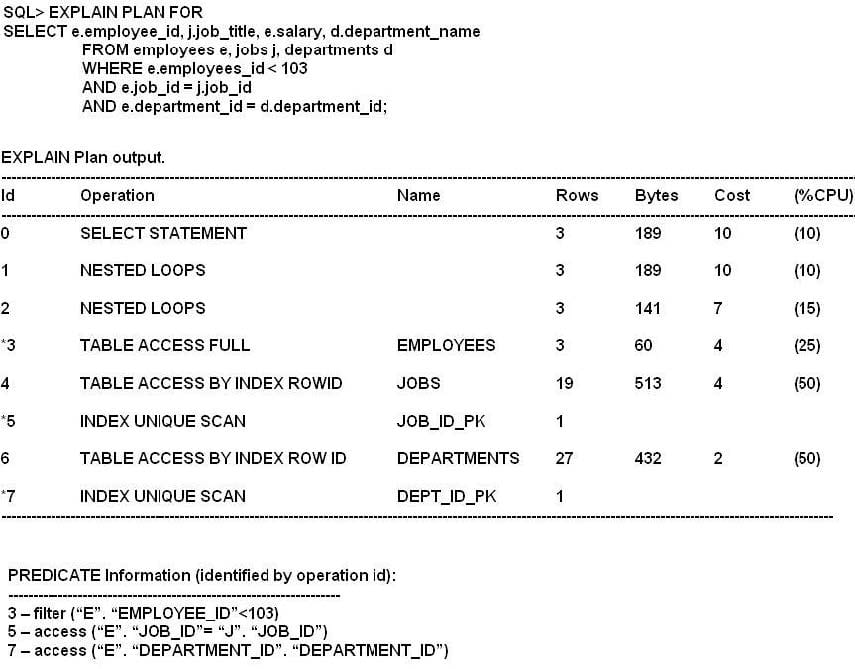
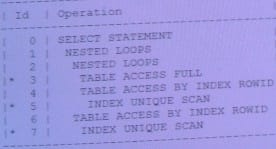
Which two statements are correct regarding the execution plan?
A. Step 2 is performing nested operation on JOB_ID column of the JOBS table, which is the driven table and the EMPLOYEES table is the driven table.
B. In step 2 for every row returned by the JOBS table matching rows from the EMPLOYEES table are accessed.
C. Step 1 is performing nested loop operation on the DEPARTMENT_ID column of the DEPARTMENTS table, which is the driven table and results returned by step 2 in the driving resultset.
D. The performance of the query can be improved by creating bitmap index on the JOB_ID column of the EMPLOYEES table.
E. The performance of the query can be improved by creating bitmapped index on the DEPARTMENT_ID column of the EMPLOYEES table.

Home | Contact Us | About Us | FAQ | Guarantee & Policy | Privacy & Policy | Terms & Conditions | How to buy
Copyright © 2026 pass4itsure.com. All Rights Reserved