 TESTED 21 Jul
1Z0-1084-20 Online Practice Questions and Answers
You are working on a serverless DevSecOps application using Oracle Functions. You have deployed a Python function that uses the Oracle Cloud Infrastructure (OCI) Python SDK to stop any OC1 Compute instance that does not comply with your corporate security standards There are 3 non compliant OCI Compute instances. However, when you invoke this function none of the instances were stopped. How should you troubleshoot this?
A. There is no way to troubleshoot a function running on Oracle Functions.
B. Enable function logging in the OCI console, include some print statements in your function code and use logs to troubleshoot this.
C. Enable function remote debugging in the OCI console, and use your favorite IDE to inspect the function running on Oracle Functions.
D. Enable function tracing in the OCI console, and go to OCI Monitoring console to see the function stack trace.
Which is NOT a valid option to execute a function deployed on Oracle Functions?
A. Send a signed HTTP requests to the function's invoke endpoint
B. Invoke from Oracle Cloud Infrastructure CLI
C. Invoke from Docker CLI
D. Trigger by an event in Oracle Cloud Infrastructure Events service
E. Invoke from Fn Project CLI
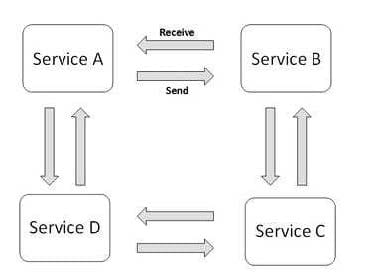
Which two statements are true for service choreography?
A. Service choreographer is responsible for invoking other services.
B. Services involved in choreography communicate through messages/messaging systems.
C. Service choreography relies on a central coordinator.
D. Service choreography should not use events for communication.
E. Decision logic in service choreography is distributed.
You are developing a polyglot serverless application using Oracle Functions. Which language cannot be used to write your function code?
A. PL/SQL
B. Python
C. Node.js
D. Java
Which is NOT a supported SDk Oracle Cloud Infrastructure (OCI)?
A. Go SDK
B. Java SDK
C. NET SDK
D. Ruby SDK
E. Python SDK
In the sample Kubernetes manifest file below, what annotations should you add to create a private load balancer In oracle Cloud infrastructure Container Engine for Kubermetes?
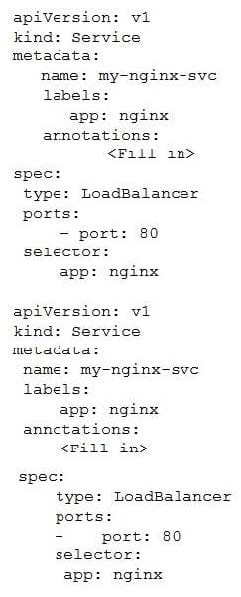
A. service.beta.kubernetes.io/oci-load-balancer-private:"true"
B. service.beta.kubernetes.io/oci-load-balancer-private: "true" service.beta.kubernetes.io/oci-load-balancer-subnet1: "ocid1.subnet.oc1..aaaaa....vdfw"
C. service.beta.kubernetes.io/oci-load-balancer-internal: "true"
D. service.beta.kubernetes.io/oci-load-balancer-internal: "true" service.beta.kubernetes.io/oci-load-balancer-subnet1: "ocid1.subnet.oc1..aaaaa....vdfw"
Which testing approaches is a must for achieving high velocity of deployments and release of cloud- native applications?
A. Integration testing
B. A/B testing
C. Automated testing
D. Penetration testing
You have created a repository in Oracle Cloud Infrastructure Registry in the us-ashburn-1 (iad) region in
your tenancy with a namespace called "heyci.
Which three are valid tags for an image named "myapp"?
A. iad.ocir.io/heyoci/myproject/myapp:0.0.1
B. us-ashburn-l.ocirJo/heyoci/myapp:0.0.2-beta
C. us-ashburn-l.ocir.io/heyoci/myproject/myapp:0.0.2-beta
D. us-ashburn-l.ocir.io/myproject/heyoci/myapp:latest
E. iad.ocir.io/myproject/heyoci/myapprlatest
F. iad.ocir.io/heyoci/myapp:0.0.2-beta
G. iad.ocir.io/heyoci/myapp:latest
You are implementing logging in your services that will be running in Oracle Cloud Infrastructure Container Engine for Kubernetes. Which statement describes the appropriate logging approach?
A. Each service logs to its own log file.
B. All services log to an external logging system.
C. All services log to standard output only.
D. All services log to a shared log file.
Your organization uses a federated identity provider to login to your Oracle Cloud Infrastructure (OCI)
environment. As a developer, you are writing a script to automate some operation and want to use OCI CLI
to do that. Your security team doesn't allow storing private keys on local machines.
How can you authenticate with OCI CLI?
A. Run oci setup keys and provide your credentials
B. Run oci session refresh --profile
C. Run oci session authenticate and provide your credentials
D. Run oci setup oci-cli-rc --file path/to/target/file

Home | Contact Us | About Us | FAQ | Guarantee & Policy | Privacy & Policy | Terms & Conditions | How to buy
Copyright © 2026 pass4itsure.com. All Rights Reserved