 TESTED 25 Jul
1Z0-1055-21 Online Practice Questions and Answers
Which two statements are true about processing corporate card expenses? (Choose two.)
A. Conversion rate defaults apply only to cash expenses, not to corporate card expenses.
B. Usage policy for expense category tolerances does not apply to credit card expenses.
C. Card transactions will be paid directly from Expenses Cloud.
D. You can process payment for credit card using Electronic funds transfer, check, or wire.
E. Conversion rate defaults are applicable to corporate card expenses, just as they are applicable to cash expenses.
Identify two ways the invoice imaging solution works in the Cloud. (Choose two.)
A. Customers cannot use invoice imaging in the Cloud.
B. Customers scan and store the invoice images on-premise and attach them during invoice entry.
C. Customers ask their suppliers to scan and email the invoice.
D. Customers ask suppliers to send electronic invoices.
E. Customers scan the invoice on-premise and email the images.
An installment for $2,000 USD is due for payment on July 31, 2018. The installment has two discounts: the first discount date is June 15, 2018 for $150 USD and the second discount date is June 30, 2018 for $50 USD. You submit a Payment Process Request with the following criteria: Payment Date = June 20, 2018 Pay Through Date = July 30, 2018 Date Basis = Due Date What will be the resulting status of the installment and discount?
A. The installment is not selected because the discount dates are before the Pay Through Date.
B. The installment is selected and no discount is applied.
C. The installment is not selected because the due date is after the Pay Through Date.
D. The installment is selected and a discount of $50 USD is applied.
E. The installment is selected and a discount of $150 USD is applied.
What is the difference between subject areas that append the word "Real Time" and those that do not?
A. The "Real Time" subject areas are based on real-time transactions and those that are not, are based on historical data.
B. The "Real Time" subject areas are based on real-time transactions in the applications, and those that are not, are based on data stored in the Oracle Business Intelligence Applications data warehouse.
C. There is no difference.
D. The "Real Time" subject areas are based on subledger transactions and the ones that are not are based on general ledger balances.
While entering an expense report for your corporate card transactions, you notice that the conversion rate
defined in the Manage Conversion Rates and Policies page is not used.
What is the reason?
A. You did not define conversion rates for your business unit.
B. You did not specify a default expense template.
C. Only cash transactions use those settings.
D. You did not define conversion rates in the General Ledger Cloud.
An Office supplies company requires an advance payment of $8000 for the office supplies you wish to order. You enter and pay a prepayment type invoice for $8000. You enter the standard invoice to book the expense which totals $10000 and you apply the prepayment to the standard invoice. What are the
accounting entries for that standard invoice with the prepayment application?
A. Invoice accounting - Dr Prepayment Account 10000 Cr AP Liability Account 10000.The prepayment application has no impact on the Invoice.
B. Invoice accounting - Dr Expense Account 10000 Cr AP Liability Account 10000.Prepayment application
-Dr AP Liability 8000 Cr Prepayment Account 8000.
C. Invoice Accounting - Dr Prepayment Account 10000 Cr AP Liability Account 10000.Prepayment application - Dr Expense Account 8000 Cr Prepayment Account 8000.
D. Invoice accounting - Dr Expense Account 10000 Cr AP Liability Account 10000.Prepayment application
-Dr AP Liability Account 2000 Cr Prepayment Account 2000.
You need to route invoices to three different approvers at the same time, and only one approver needs to
approve the invoice.
Which approval ruleset should you use?
A. SingleTypeParticipantInParallelModeRuleSet
B. FyiTypeParticipantInParallelModeRuleSet
C. InvoiceApprovalRuleSet
D. ParallelTypeParticipantInParallelModeRuleSet
Your customer has requested a modification to the payment file to meet the acceptable bank standards. The changes were based on a format of a seeded payment process profile which is already in use. The only changes made are to the field positions. What two steps can make these changes work?
A. No change in the template is needed as we can achieve this using user-defined validations to move the positions as required.
B. Keep the payment process profile and leave the format programs unchanged.
C. Copy and modify the existing template to alter the positions as requested by the bank.
D. Create a newpayment process profile and a new format program.
E. Create a new template to make changes as requested by the bank.
F. Oracle Data Integrator or Golden Gate can be used to map the fields as required.
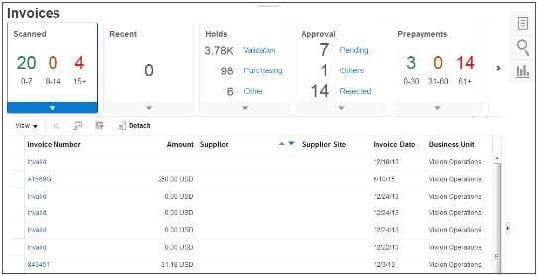
Which three attributes are captured during the scanning of invoice images?
A. Invoice Date
B. Invoice Number
C. Terms Date
D. PO Number
E. Payment Method
A company has a requirement to pay small suppliers outside of Payables, but it does not want to manually
record each payment.
Which solution should you implement?
A. Create payments by using the Check Payment method for those suppliers and then destroy those checks.
B. Create payments by using Electronic Funds Transfer (EFT) for those suppliers but do not send the electronic file to the bank.
C. Create payments by using a clearing payment method for thosesuppliers because this payment method does not generate a file.
D. Create a payment by using a wire payment method for those suppliers.

Home | Contact Us | About Us | FAQ | Guarantee & Policy | Privacy & Policy | Terms & Conditions | How to buy
Copyright © 2026 pass4itsure.com. All Rights Reserved