 TESTED 20 Jul
1Z0-062 Online Practice Questions and Answers
To implement Automatic Management (AMM), you set the following parameters: When you try to start the database instance with these parameter settings, you receive the following error message:
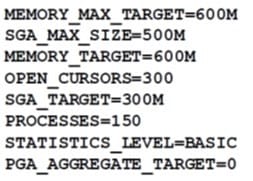
SQL > startup ORA-00824: cannot set SGA_TARGET or MEMORY_TARGET due to existing internal settings, see alert log for more information.
Identify the reason the instance failed to start.
A. The PGA_AGGREGATE_TARGET parameter is set to zero.
B. The STATISTICS_LEVEL parameter is set to BASIC.
C. Both the SGA_TARGET and MEMORY_TARGET parameters are set.
D. The SGA_MAX_SIZE and SGA_TARGET parameter values are not equal.
You created an encrypted tablespace:
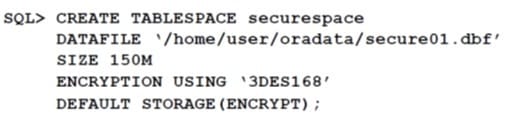
You then closed the encryption wallet because you were advised that this is secure.
Later in the day, you attempt to create the EMPLOYEES table in the SECURESPACE tablespace with the
SALT option on the EMPLOYEE column.
Which is true about the result?
A. It creates the table successfully but does not encrypt any inserted data in the EMPNAME column because the wallet must be opened to encrypt columns with SALT.
B. It generates an error when creating the table because the wallet is closed.
C. It creates the table successfully, and encrypts any inserted data in the EMPNAME column because the wallet needs to be open only for tablespace creation.
D. It generates error when creating the table, because the salt option cannot be used with encrypted tablespaces.
In your multitenant container database (CDB) containing same pluggable databases (PDBs), you execute the following commands in the root container:

Which two statements are true? (Choose two.)
A. The C # # ROLE1 role is created in the root database and all the PDBs.
B. The C # # ROLE1 role is created only in the root database because the container clause is not used.
C. Privileges are granted to the C##A_ADMIN user only in the root database.
D. Privileges are granted to the C##A_ADMIN user in the root database and all PDBs.
E. The statement for granting a role to a user fails because the CONTAINER clause is not used.
Your multitenant container database (CDB) contains pluggable databases (PDBs), you are connected to
the HR_PDB. You execute the following command:
SQL > CREATE UNDO TABLESPACE undotb01
DATAFILE `u01/oracle/rddb1/undotbs01.dbf' SIZE 60M AUTOEXTEND ON;
What is the result?
A. It executes successfully and creates an UNDO tablespace in HR_PDB.
B. It falls and reports an error because there can be only one undo tablespace in a CDB.
C. It fails and reports an error because the CONTAINER=ALL clause is not specified in the command.
D. It fails and reports an error because the CONTAINER=CURRENT clause is not specified in the command.
E. It executes successfully but neither tablespace nor the data file is created.
Which two statements are true about Oracle Data Pump export and import operations? (Choose two.)
A. You can detach from a data pump export job and reattach later.
B. Data pump uses parallel execution server processes to implement parallel import.
C. Data pump import requires the import file to be in a directory owned by the oracle owner.
D. The master table is the last object to be exported by the data pump.
E. You can detach from a data pump import job and reattach later.
Which two statements are true about standard database auditing? (Choose two.)
A. DDL statements can be audited.
B. Statements that refer to standalone procedure can be audited.
C. Operations by the users logged on as SYSDBA cannot be audited.
D. Only one audit record is ever created for a session per audited statement even though it is executed more than once.
Your production database uses file system storage. You want to move storage to Oracle Automatic Storage Management (ASM).
How would you achieve this?
A. by using a transportable database
B. by using the Database Upgrade Assistant (DBUA)
C. by using Data Pump
D. by using RMAN
You want to distribute a set of structured data to your customers who can integrate this data into their existing databases irrespective of the platform.
Which method provides the fastest way of achieving this?
A. using the DBVERIFY utility
B. using direct-path INSERT SQL statements
C. using SQL*Loader
D. using RMAN transportable tablespace operation
Which three statements are true about user account administration? (Choose three.)
A. A user's current session is not affected when the user's profile is changed.
B. Only users with the SYSDBA privilege can change the tablespace quota for other users.
C. A new user account can be created only by SYS or SYSTEM users.
D. A user's quota can be set for any permanent tablespace but not for the default temporary tablespace.
E. A user requires only the CREATE SESSION privilege to change his or her own password.
An employee salary in the non-partitioned EMPLOYEES table, has been updated but the transaction is
uncommitted.
Which two types of lock are held by the transaction? (Choose two.)
A. a row level lock on the row being updated
B. a null lock on the row being updated
C. a row shared lock on the EMPLOYEES table
D. an exclusive lock on the EMPLOYEES table
E. a null lock on the EMPLOYEES table

Home | Contact Us | About Us | FAQ | Guarantee & Policy | Privacy & Policy | Terms & Conditions | How to buy
Copyright © 2026 pass4itsure.com. All Rights Reserved