 TESTED 13 Jul
1Z0-053 Online Practice Questions and Answers
Which two are the uses of the ASM metadata backup and restore (AMBR) feature? (Choose two.)
A. It can be used to back up all data on ASM disks.
B. It can be used to recover the damaged ASM disk group along with the data.
C. It can be used to gather information about a pre-existing ASM disk group with disk paths, disk name, failure groups, attributes, templates, and alias directory structure.
D. It can be used to re-create the ASM disk group with its attributes.
You installed Oracle Database 11g at fresh.
Which statements are true regarding the default audit settings in this database? (Choose all that apply.)
A. The audit trail is stored in an operating system file.
B. Auditing is disabled for all privileges.
C. The audit trail is stored in the database.
D. Auditing is enabled for all privileges.
E. Auditing is enabled for certain privileges related to database security.
View the exhibit and examine the output. Which statement can be an inference from the output? Exhibit:
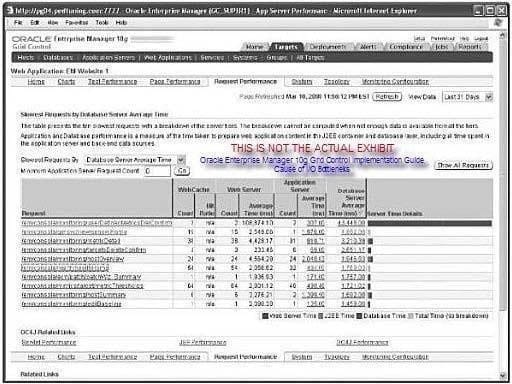
A. The FRA disk group has an asynchronous I/O bottleneck
B. The least number of I/Os are performed on the last data file in the list
C. The number of times that the backup or restore process directed the OS to wait until an I/O was complete is the highest for the last data file in the list
D. The number of times that the backup or restore process made an OS call to poll for I/O completion in Nonblocking mode is the least for the FRA disk group
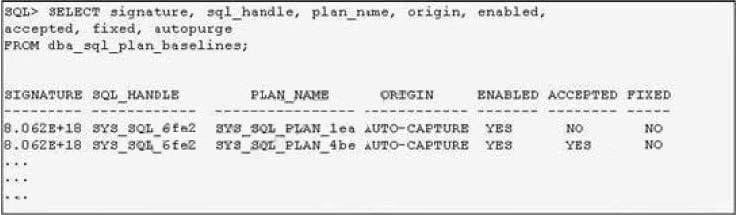
View the Exhibit1 to examine the series of SQL commands. View the Exhibit2 to examine the plans available in the SQL plan baseline. The baseline in the first row of the Exhibit is created when OPTIMIZER_MODE was set to FIRST_ROWS.
Which statement is true if the SQL query in exhibit1 is executed again when the value of OPTIMIZER_MODE is set to FIRST_ROWS?
parameter-optimizer (exhibit):
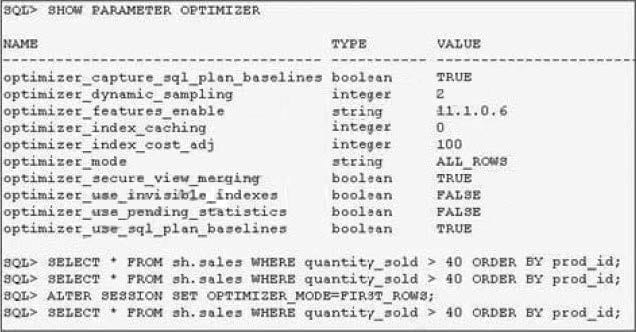
A. The optimizer uses a new plan because none of the plans in the exhibit2 are fixed plans.
B. The optimizer uses the plan in the second row of the exhibit2 because it is an accepted plan.
C. The optimizer uses the plan in the first row of the exhibit2 because it is the latest generated plan.
D. The optimizer uses the plan in the first row of the exhibit2 because OPTIMIZER_MODE was set to
FIRST_ROW during its creation.
Which two statements about Oracle Direct Network File System (NFS) are true? (Choose two.)
A. It bypasses the OS file system cache.
B. A separate NFS interface is required for use across Linux, UNIX, and Windows platforms.
C. It uses the operating system kernel NFS layer for user tasks and network communication modules.
D. File systems need not be mounted by the kernel NFS system when being served through Direct NFS.
E. Oracle Disk Manager can manage NFS on its own, without using the operating system kernel NFS driver.
Which of the following is NOT an advantage of block media recovery (BMR)?
A. Reduced MTTR.
B. Datafiles remain offline while corrupt blocks are repaired.
C. Datafiles remain online while corrupt blocks are repaired.
D. A and C
Examine the following commands and their output:
SQL> SELECT ename, sal FROM emp WHERE ename='JAMES';
ENAME SAL
JAMES 1050
SQL> UPDATE emp SET sal=sal+sal*1.2 WHERE ename='JAMES'; 1 row updated.
SQL> SELECT ename, sal FROM emp WHERE ename='JAMES';
ENAME SAL
JAMES 2310
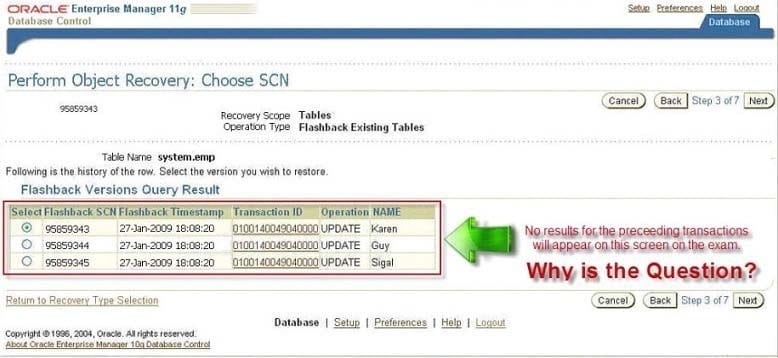
View the exhibit and examine the Flashback Version Query that was executed after the preceding commands.
What could be the possible cause for the query not displaying any row?
Exhibit:
A. Flashback logging is not enabled for the database.
B. The changes made to the table are not committed.
C. Supplemental logging is not enabled for the database.
D. The database is not configured in ARCHIVELOG mode.
When issuing the duplicate database command, you use the parameter DB_FILE_NAME_CONVERT. For what purpose do you use this parameter?
A. To indicate the location of the auxiliary-instance online redo logs.
B. To indicate the location of the target database datafiles.
C. To indicate the location of the auxiliary-instance control file and online redo logs.
D. To indicate the location of the auxiliary-instance database datafiles.
E. This is not a valid parameter when duplicating a database.
When performing a full database disaster recovery with RMAN, in what order would you execute these steps?
a.
Restore the control file from autobackups.
b.
Run the RMAN restore and recover command.
c.
Restore the database spfile from autobackups.
d.
Make the RMAN backup set pieces available.
e.
Open the database with the alter database open resetlogs command.
f.
Open the database with the alter database open command.
A.
a, b, c, d, e, f
B.
c, d, a, b, f
C.
d, c, a, b, f
D.
d, b, d, c, e
E.
d, c, a, b, e
You want to set the following initialization parameters for your database instance:
LOG_ARCHIVE_DEST_1 = 'LOCATION=/disk1/arch' LOG_ARCHIVE_DEST_2 = 'LOCATION=/disk2/arch' LOG_ARCHIVE_DEST_3 = 'LOACTION=/disk3/arch' LOG_ARCHIVE_DEST_4 = 'LOCATION=/disk4/arch MANDATORY'
Identify the statement that correctly describes this setting.
A. The MANDATORY location must be a flash recovery area.
B. The optional destinations may not use the flash recovery area.
C. This setting is not allowed because the first destination is not set as MANDATORY.
D. The online redo log file is not allowed to be overwritten if the archived log cannot be created in the fourth destination.

Home | Contact Us | About Us | FAQ | Guarantee & Policy | Privacy & Policy | Terms & Conditions | How to buy
Copyright © 2026 pass4itsure.com. All Rights Reserved