 TESTED 18 Jun
1Y0-A21 Online Practice Questions and Answers
In which manner can an administrator configure a NetScaler device so that it can load balance external DNS servers?
A. Configure as an ADNS.
B. Configure CNAME records.
C. Configure as a DNS proxy.
D. Configure as an End resolver.
Scenario: A financial company needs to maintain end-to-end security in network traffic. The company also requires that an administrator reduce the CPU levels for back-end servers in their environment because it requires end-to-end security.
Which setting on the SSL virtual server reduces CPU utilization on the back-end?
A. SSLv3
B. SSL Redirect
C. SSL Session Reuse
D. SSL Client Certificates
A network administrator wants to ensure that connection multiplexing is enabled for all client connections that hit a virtual server. Which service type should the administrator select to enable connection multiplexing?
A. SSL
B. FTP
C. TCP
D. HTTP
Scenario: A company has contracts with multiple ISPs and would like to use all of them for Internet connections although some ISP routers are faster than others. The company also plans to use a NetScaler system for load balancing and failover.
What can an administrator configure to ensure that all ISP connections are being used while avoiding retransmission or out-of-order packets in this environment?
A. Multiple VLANs with Ingress rules
B. Link load balancing with destination IP-based persistence
C. Round robin load balancing with reverse RNAT configured
D. A load balancing policy with the appropriate preferred IP and preferred port parameters configured
Scenario: A network administrator needs to configure VLANs on a NetScaler to support multiple networks. The NetScaler is connected through interface 1/1 to a switch port where VLAN10 is configured. This NetScaler is also connected through interface 1/2 to a switch port that is configured for VLAN20.
Given this scenario, which two steps does the administrator need to take to configure the NetScaler for VLAN10? (Choose two.)
A. add vlan 10
B. set vlan 10 -ifnum 1/1
C. bind vlan 10 -ifnum 1/2
D. bind vlan 10 -ifnum 1/1
E. bind vlan 10 -ifnum 1/1 -tagged
Scenario: An administrator is working within a network environment as depicted in the attached exhibit. The NetScaler systems in this HA pair need to exchange heartbeat packets over L3 through routers R3 and R4.
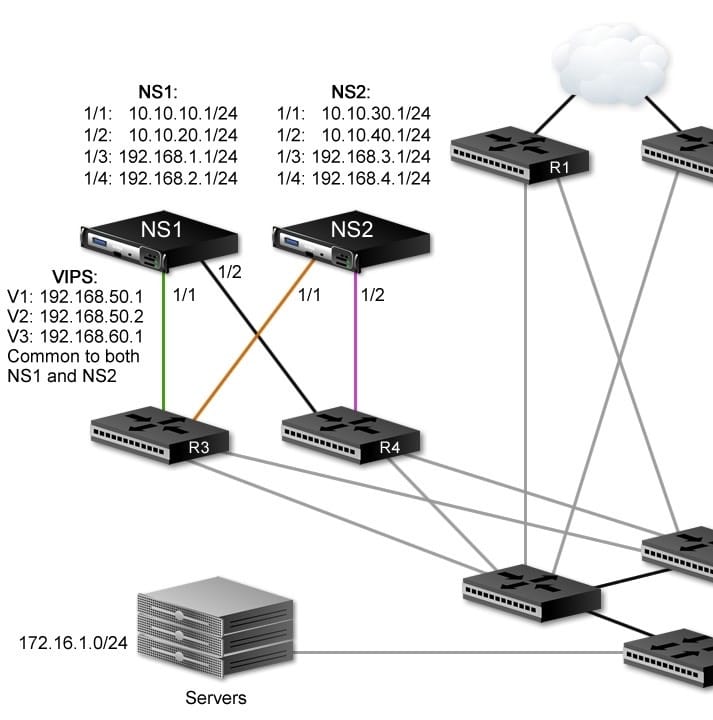
How can the administrator achieve this HA functionality?
A. Enable the dynamic routing feature.
B. Configure Route Health Injection (RHI).
C. Bind a route monitor to each NetScaler device.
D. Enable Independent Network Configuration (INC).
Scenario: An administrator is configuring a NetScaler system in one-armed mode. The administrator has connected the NetScaler appliances to the network through a switch and will soon configure the appliances as a pair with HA enabled.
Which two steps should the administrator take to successfully configure HA in this environment? (Choose two.)
A. Disable all unused network interfaces.
B. Ensure the NSIP is unique on each node.
C. Ensure the NSIP is identical on each node.
D. Change the default nsroot password on each node of the HA pair.
In order to prevent configuration errors from typographical errors and to streamline the creation of expressions, an administrator should leverage __________ when creating policies. (Choose the correct option to complete the sentence.)
A. pattern sets
B. entity templates
C. inline expressions
D. named expressions
What can an administrator configure to perform a health check for a SVC1, which is transferring HTTPS traffic so that a probe is only sent when there is no traffic to the server?
A. An HTTP monitor with the secure parameter selected
B. An HTTP monitor with the transparent parameter selected
C. An HTTP-Inline monitor with the secure parameter selected
D. An HTTP-ECV monitor with the transparent parameter selected
Scenario: An administrator has set up a NetScaler in HA mode and now wants to bind the SSL certificate to one of the SSL virtual servers. However, the administrator notices that the command failed on the secondary node while succeeding on the primary node. Both nodes in HA are healthy, with successful configuration synchronization and command propagation.
Which reason explains the command failure on the secondary node?
A. Command syntax is not correct.
B. Command not executed with root ID.
C. SSL command not available on secondary node.
D. SSL certificate is not present on secondary node.

Home | Contact Us | About Us | FAQ | Guarantee & Policy | Privacy & Policy | Terms & Conditions | How to buy
Copyright © 2026 pass4itsure.com. All Rights Reserved