 TESTED 17 Jul
1Y0-402 Online Practice Questions and Answers
Scenario: A Citrix Architect needs to design a new XenApp and XenDesktop environment. The following
design requirements have been identified:
External Partner users should be denied access to published resources unless connecting from a
corporate laptop running up-to-date antivirus software.
External users and partners authenticate using Two-Factor authentication.
External employees are logged off Citrix Receiver for Web after 10 minutes of inactivity.
Clipboard mapping is enabled for external engineering users.
Once authenticated to a company device, internal users do NOT authenticate a second time to access
published apps and desktops.
Later in the Assess phase, the architect creates the Access Matrix shown in the Exhibit.
Click the Exhibit button to view the Access Matrix.
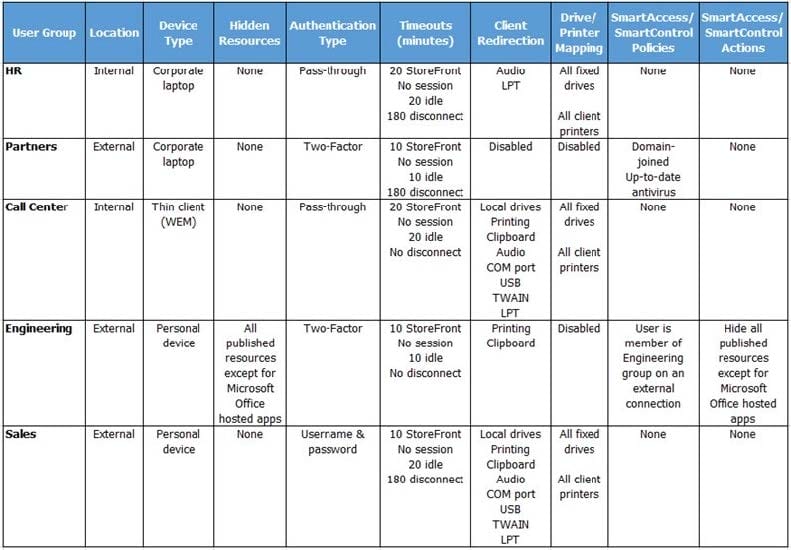
During the quality assurance review, the architect determines that one of the user groups does NOT align with the design requirements.
Which user group should the architect modify to match the design requirements identified?
A. HR
B. Engineering
C. Call Center
D. Partners
E. Sales
Scenario: A Citrix Architect needs to manage the disaster recovery process for a XenApp and XenDesktop environment. The environment currently consists of an active datacenter which is typically accessed by users and a disaster recovery (DR) datacenter which would be used in the event that a disaster impacts the primary datacenter. The organization has made it a priority to minimize the loss of data when failing over between datacenters and has begun planning for an event in which the environment must fail over from the primary datacenter to the DR datacenter.
What is the appropriate sequence of steps that the architect should follow after getting management approval to complete the process in case of such an event?
A. Block access to primary datacenter, complete replication, terminate/drain existing sessions, reverse direction of replication, enable access in DR datacenter
B. Block access to primary datacenter, terminate/drain existing sessions, complete replication, reverse direction of replication, enable access in DR datacenter
C. Terminate/drain existing sessions, complete replication, block access to primary datacenter, enable access in DR datacenter, reverse direction of replication
D. Complete replication, terminate/drain existing sessions, block access to primary datacenter, reverse direction of replication, enable access in DR datacenter
E. Complete replication; block access to primary datacenter, terminate/drain existing sessions, enable access in DR datacenter, reverse direction of replication
F. Terminate/drain existing sessions; block access to primary datacenter, complete replication, reverse direction of replication, enable access in DR datacenter
Scenario: A Citrix Architect needs to design a new XenApp and XenDesktop environment.
The architect has identified the User Layer requirements, as shown in the Exhibit. Click the Exhibit button to view the requirements.
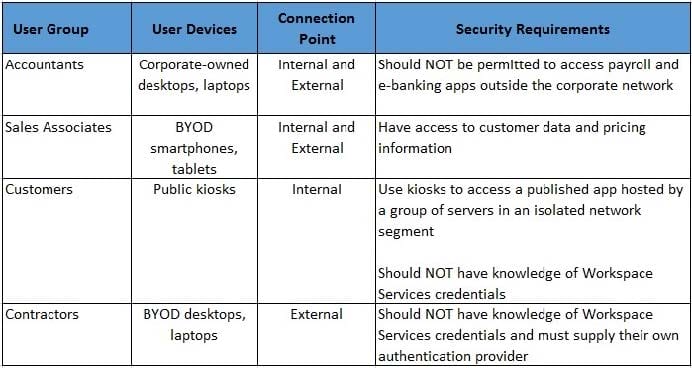
Additionally, management at the organization has identified the following general Access Layer
requirements:
A multi-factor authentication method is required for any connections to the XenApp and XenDesktop
environment originating from outside the corporate network.
External connections must be authenticated by a NetScaler Gateway virtual server located in a DMZ
network.
Internal connection traffic should NOT leave the internal corporate network.
Which Access Layer feature should the architect configure to meet the security requirements of the
Accountants group?
A. SmartControl
B. Endpoint analysis scan
C. SmartAccess
D. Federated Authentication Service
Scenario: A Citrix Architect is using LDAP as single-factor authentication. The architect is migrating the environment to Citrix Cloud and wants to retain the same authentication procedure for XenApp and XenDesktop service in Citrix Cloud.
Which deployment strategy should the architect use for NetScaler and StoreFront to ensure that the solution reduces management overhead without incurring additional costs?
A. Use Citrix Cloud NetScaler Gateway service and on-premises StoreFront.
B. Set up a new NetScaler VPX instance and StoreFront on-premises.
C. Use Citrix Cloud NetScaler Gateway service and Citrix Cloud Workspace.
D. Set up NetScaler with bring-your-own license (BYOL) and StoreFront in a public cloud.
Scenario: A Citrix Architect is performing a XenApp and XenDesktop design. During a discussion with the server hardware team, two potential network configurations are proposed for the XenServer hosts.
Click the Exhibit button to view the network configurations.
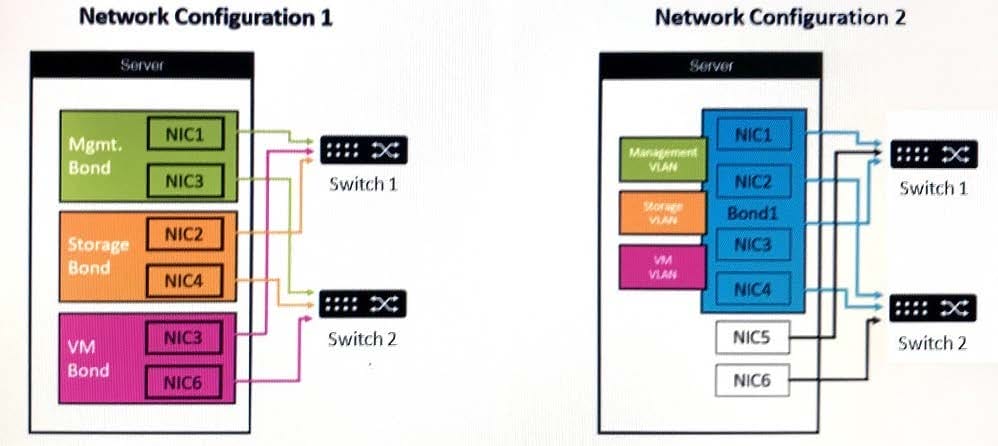
Which statement will support a decision to use Network Configuration 2?
A. It will ensure that virtual machine workloads do NOT interfere with each other.
B. It will provide greater security for all traffic types.
C. It will achieve a higher level of redundancy for the different traffic types.
D. It will reserve more bandwidth for virtual machine traffic.
Scenario: A Citrix Architect needs to create a conceptual architecture for a XenApp and XenDesktop environment, on behalf of a retail chain. Based on some initial discussions around the firm's business goals and objectives, the architect has collected the information as shown in the Exhibit.
Click the Exhibit button to view the information.
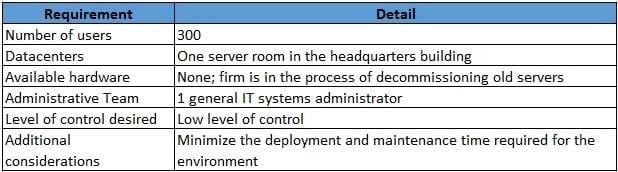
Which delivery model should the architect recommend?
A. Single-Site in Citrix Cloud, single public cloud resource location
B. Multi-Site, single-zone, multiple public cloud resource locations
C. Multi-Site, single on-premises datacenter
D. Single-Site in Citrix Cloud, single on-premises resource location
E. Single-Site, single-zone, single on-premises datacenter
Scenario: A Citrix Architect is designing a new XenApp and XenDesktop Service environment. During
discussions about the Access Layer design, the architect gathers the following requirements:
Minimize management overhead where possible.
Multi-factor authentication should be used for all user access to the XenApp and XenDesktop environment.
Users should receive different Citrix policy settings depending on whether their connection is external to
the internal network.
Which deployment option should the architect recommend for the design?
A. NetScaler Gateway on-premises with StoreFront on-premises
B. NetScaler Gateway on-premises with Workspace in Cloud
C. NetScaler Gateway Service with Workspace in Cloud
D. NetScaler Gateway Service with StoreFront on-premises
Scenario: A Citrix Architect needs to design a new XenApp and XenDesktop environment. Machine Creation Services has been selected for image management.
Which storage feature should the architect consider to lower storage cost with minimal impact to performance?
A. Read caching
B. Storage tiering
C. Thin provisioning
D. Data de-duplication
Scenario: A Citrix Architect needs to design a new XenApp and XenDesktop environment. Due to licensing and compliance reasons, the customer has requested that users connecting from external locations must NOT be presented with applications from the Microsoft Office suite.
How should the architect ensure that users are only presented with Microsoft Office applications when connecting to the environment from internal locations?
A. Configure a separate Store for external connections, configure keywords on all Microsoft Office applications, and use Set-DSResourceFilterKeyword to enable filtering.
B. Configure a separate Store for external connections, configure keywords on all Microsoft Office applications, and use Citrix ADC Content Switching to enable filtering.
C. Use the existing Store for external connections, configure keywords on all Microsoft Office applications, and use Set-DSResourceFilterKeyword to enable filtering.
D. Use the existing Store for external connections, configure keywords on all Microsoft Office applications, and use Citrix ADC Content Switching to enable filtering.
Scenario: While assessing the User Layer, a Citrix Architect finds that most of the internal users connect using corporate-owned laptops, desktop devices, and thin clients. Many of these laptops and desktop devices are running Windows 10, while the remainder of the machines are running Windows 7 and are in the process of being migrated to Windows 10. Some users also connect using personal devices which have Receiver Desktop Lock installed.
Currently, Citrix Receiver is manually installed on any endpoint device added to the company. All these devices use Citrix Receiver version 4.8 and above. The IT team is planning to automate a process to update all the devices with the latest version of Citrix Receiver and to automate another process for automatic installation of Citrix Receiver without incurring extra costs and maintenance.
During the initial testing of the Citrix Receiver Auto-Update feature, the architect observed that the Citrix Receiver Auto-Update feature does NOT work on some of the machines.
Which two reasons could be causing this issue? (Choose two.)
A. Citrix Receiver Auto-Update is disabled on machines where Receiver Desktop Lock is installed.
B. The Citrix receiver Auto-Update feature needs to be configured before Receiver Desktop Lock is configured.
C. The user does NOT have local administrative permission on the endpoint device.
D. The local Advanced Preferences within Citrix Receiver were incorrectly configured.

Home | Contact Us | About Us | FAQ | Guarantee & Policy | Privacy & Policy | Terms & Conditions | How to buy
Copyright © 2026 pass4itsure.com. All Rights Reserved