 TESTED 12 Jul
1D0-541 Online Practice Questions and Answers
Which security technique limits access by unauthorized users to parts of an enterprise database?
A. Views
B. Concurrency
C. Locking
D. Integrity controls
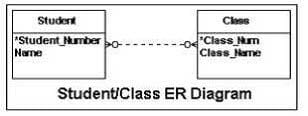
Consider the entity-relation (ER) diagram shown in the exhibit. When the logical database design phase is completed, which of the following is a valid DBDL description of the base relations for the ER diagram?
A. STUDENT( Student_Number: integer NOT NULL Name: variable length character string length 20 NOT NULL) Primary Key Student_Number CLASS( Class_Num: integer NOT NULL Class_Name: integer NOT NULL) Primary Key Class_Num
B. STUDENT( Student_Number: integer NOT NULL Name: variable length character string length 20 NOT NULL) Primary Key Student_Number CLASS( Class_Num: integer NOT NULL Class_Name: integer NOT NULL) Primary Key Class_Num Foreign Key Class_Num References STUDENT
C. STUDENT( Student_Number: integer NOT NULL Name: variable length character string length 20 NOT NULL) Primary Key Student_Number STU_CLASS( Student_Number: integer NOT NULL Class_Num: integer NOT NULL) Primary Key Student_Number CLASS( Class_Num: integer NOT NULL Class_Name: integer NOT NULL) Primary Key Class_Num
D. STUDENT( Student_Number: integer NOT NULL Name: variable length character string length 20 NOT NULL) Primary Key Student_Number STU_CLASS( Student_Number: integer NOT NULL Class_Num: integer NOT NULL) Primary Key Student_Number CLASS( Class_Num: integer NOT NULL Class_Name: integer NOT NULL) Primary Key Class_Num
Which subset of Structured Query Language (SQL) is used to perform operations such as data retrieval or deletion on the data contained in a database?
A. Data Control Language
B. Data Definition Language
C. Data Formatting Language
D. Data Manipulation Language
What is a relational database domain?
A. A group of attributes
B. A set of permissible tuple values
C. A collection of related data items
D. A set of permissible attribute values
Which term describes the rejoining of relations that have been decomposed?
A. Normalization
B. Denormalization
C. Referential integrity
D. Domain constraints
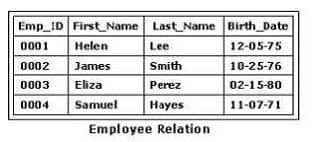
Consider the relation shown in the exhibit. Which of the following SQL statements would properly add information for a new employee?
A. INSERT INTO Employee VALUES(0005, Tim, Bogart, 03-15-77);
B. INSERT INTO Employee(Emp_ID, First_Name, Last_Name, Birth_Date) VALUES(0004, Tim, Bogart, 03-15-77);
C. INSERT INTO Employee(Emp_ID, First_Name, Last_Name, Birth_Date) VALUES(0005, Tim, Bogart, 03-05-77);
D. INSERT INTO Employee(Emp_ID, First_Name, Last_Name, Birth_Date) VALUES(0005, Tim, Bogart, 03-05-77);
Which of the following is a characteristic of the three-tier database architecture?
A. A Web browser is used as the application server.
B. The application logic is centralized on a dedicated server.
C. A thick client is used to perform business application logic functions locally.
D. Database application logic and database functionality are integrated and reside on a common server.
What is a relational database domain?
A. A group of attributes
B. A set of permissible tuple values
C. A collection of related data items
D. A set of permissible attribute values
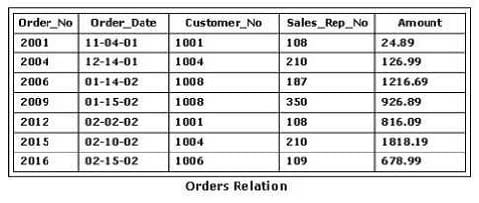
Consider the Orders relation shown in the exhibit. Which of the following SQL statements would replace the value in the Sales_Rep_No column with 110 everywhere that Sales_Rep_No 108 is listed?
A. UPDATE Sales_Rep_No IN Orders SET(Sales_Rep_No = 110 WHERE Sales_Rep_No = 108);
B. UPDATE Orders SET Sales_Rep_No = 110 WHERE Sales_Rep_No = 108;
C. UPDATE Orders SET Sales_Rep_No = 110;
D. UPDATE Orders WHERE Sales_Rep_No = 108 SET Sales_Rep_No = 110;
Which of the following best describes the information contained in the data dictionary (or system catalog)?
A. Metadata
B. Data model
C. Table data
D. Metafile

Home | Contact Us | About Us | FAQ | Guarantee & Policy | Privacy & Policy | Terms & Conditions | How to buy
Copyright © 2026 pass4itsure.com. All Rights Reserved