 TESTED 13 Jul
101-01 Online Practice Questions and Answers
What is the default action of a Steelhead appliance when it enters admission control?
A. Fail-to-wire
B. Fail-to-block
C. Passthrough all connections
D. Passthrough new connections
E. Drop new connections
A user uploads a Microsoft Word document to a server across the network using the file transfer protocol (FTP). The file has been seen before by the Steelhead appliances that are optimizing the link and so the user experiences warm performance. A second user at the same location downloads the file from the same server using the CIFS protocol. This file transfer can be considered:
A. Cold, the data now travels in another direction so the Steelhead appliances need to relearn the data
B. Cold, the application protocol is now different so the Steelhead appliances need to relearn the data
C. Warm, the data has been seen by the Steelhead appliances before making the application protocol irrelevant
D. Warm, only because the transfer uses CIFS
E. Partially warm, the Steelhead appliances only need to learn the new data
When upgrading a Steelhead appliance from the Management Console, the new image is always installed on the:
A. Booted partition
B. Backup partition
C. Both the boot and backup partitions
D. The image is only installed into a partition after a reboot (from a temporary location)
E. Upgrades can only be done from the CLI
Which trunking protocols are supported by the Steelhead appliance?
A. 802.1Q
B. 802.1P
C. 802.1AD
D. Dynamic Etherchannel
When MAPI prepopulation is enabled, what is default TCP keep-alive time used to prepopulate the Steelhead appliance with emails and attachments?
A. 24 hours
B. 48 hours
C. 72 hours
D. 96 hours
You have noticed that your connections through the Steelhead appliance are slower than without it. All TCP connections show as optimized in the web interface. You are also experiencing intermittent connectivity and periodic file errors. Of the following, what could be the most likely cause of this slowdown?
A. Duplex mismatch on either the LAN or WAN interfaces or both
B. Asymmetric Routing
C. Link speed mismatch on either the Primary or AUX interface
D. Packet ricochet is causing packets to consume bandwidth through the In-path interface
E. Memory corruption has caused buffer overflow on write I/O to SDR on disk
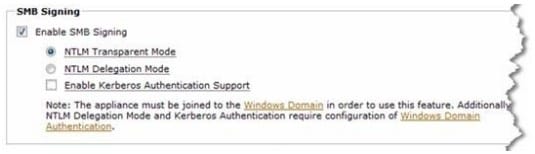
Which SteelHead domain authentication features can be used to optimize signed SMB traffic or encrypted MAPI traffic? (Choose two.)?
A. Transient mode
B. Domestic mode
C. Transparent mode
D. Delegation mode
You have a SteelHead with paths over a public and a private network. You want to encrypt the traffic which goes via the public network. Which are the relevant SteelHead configuration requirements? (Choose two.)
A. The peer SteelHead must be marked as a Cloud SteelHead in the local SteelHead peering table.
B. The network must be set to 'public' by ticking the 'Public Network' box in the configuration.
C. A SteelCentral Controller for SteelHead must be used to push the secure transport configuration.
D. The In-Path IP address of the SteelHead must be in public address space.
What feature is not available for optimized connections when using Port or Full transparency over the WAN?
A. Top Talkers report
B. Quality of Service marking
C. VLAN segregation
D. Path Selection
E. Connection Pooling
Which statement is true regarding licensing of SteelHead SaaS?
A. Licensing is based on the number of SaaS applications to optimize.
B. Licensing is based on the number of SteelHead appliances to be enabled.
C. Licensing is based on the number of users requiring SaaS optimization.
D. Licensing of SaaS optimization is included in the support contract.

Home | Contact Us | About Us | FAQ | Guarantee & Policy | Privacy & Policy | Terms & Conditions | How to buy
Copyright © 2026 pass4itsure.com. All Rights Reserved